Crabronid ID clues
Recognising Crabronids
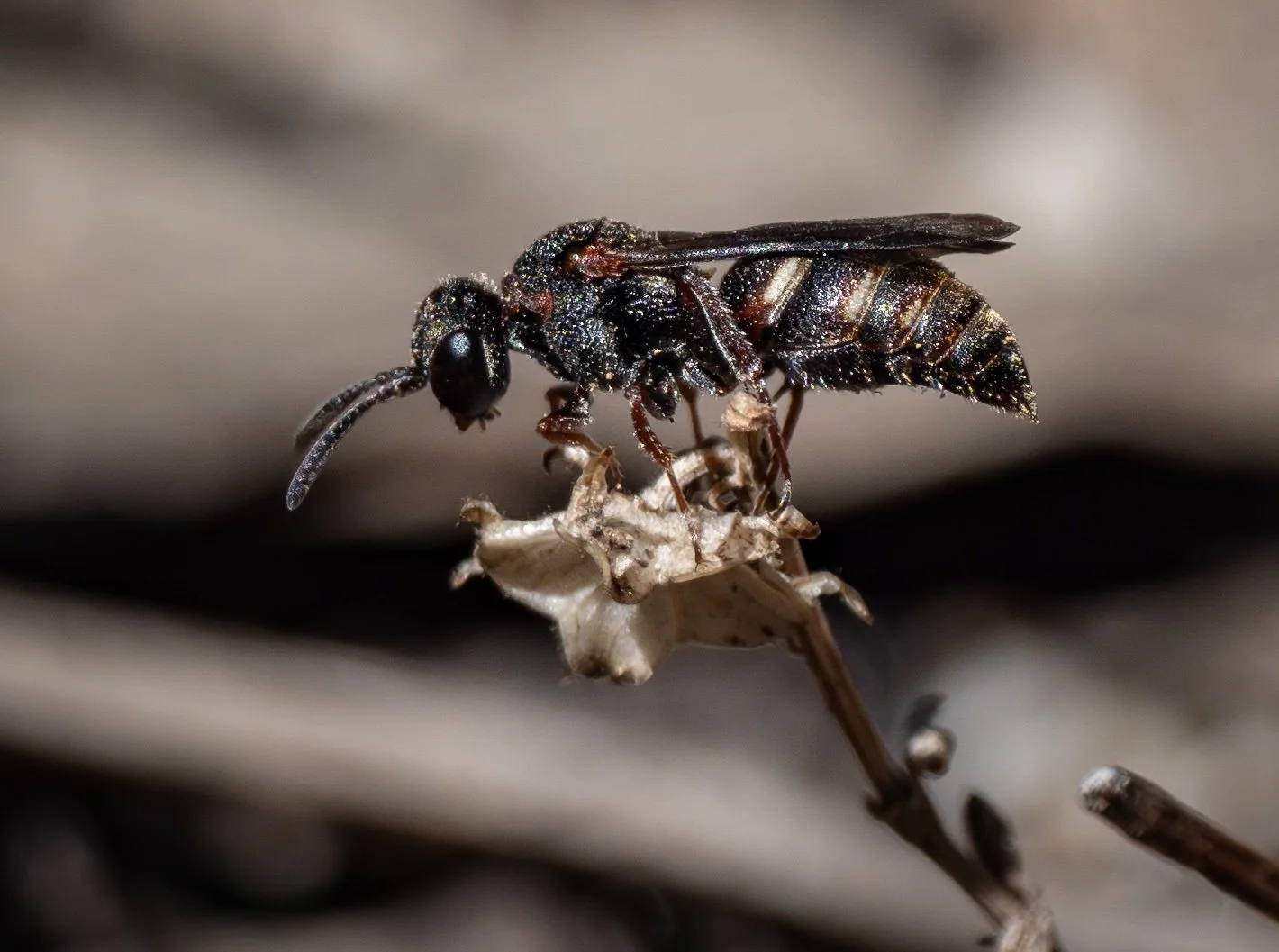
Many wasps can be readily placed to family or subfamily, based on a combination of morphology and behaviour. Spider wasps (Pompilidae), with their long, spiny legs and characteristic hunting behaviour. Paper wasps and potter wasps (Vespidae), with their folded wings, distinctive pronotum and recognisable nests. Cuckoo wasps (Chrysididae), with their thick, often metallic cuticle. And so on.
Crabronid recognition is not so straight forward.
Crabronidae is a large and diverse family, and acknowledged to be polyphyletic. That is, not a discrete and natural group in evolutionary terms. For example, some crabronids are more closely related to bees than they are to other crabronids (Peters et. al. 2017). Unsurprisingly, there is no short list of characters that can be used to define them. Crabronids do not even share a useful common name - that tends to be left to subfamilies or even tribes.
“or is it a bee?”
It is not uncommon for crabronids to be confused with bees. And again, there are few simple, single strategies that will work in all cases. Some crabronids are densely hairy and ‘beelike’, while some bees are entirely smooth-bodies and very ‘wasplike’.
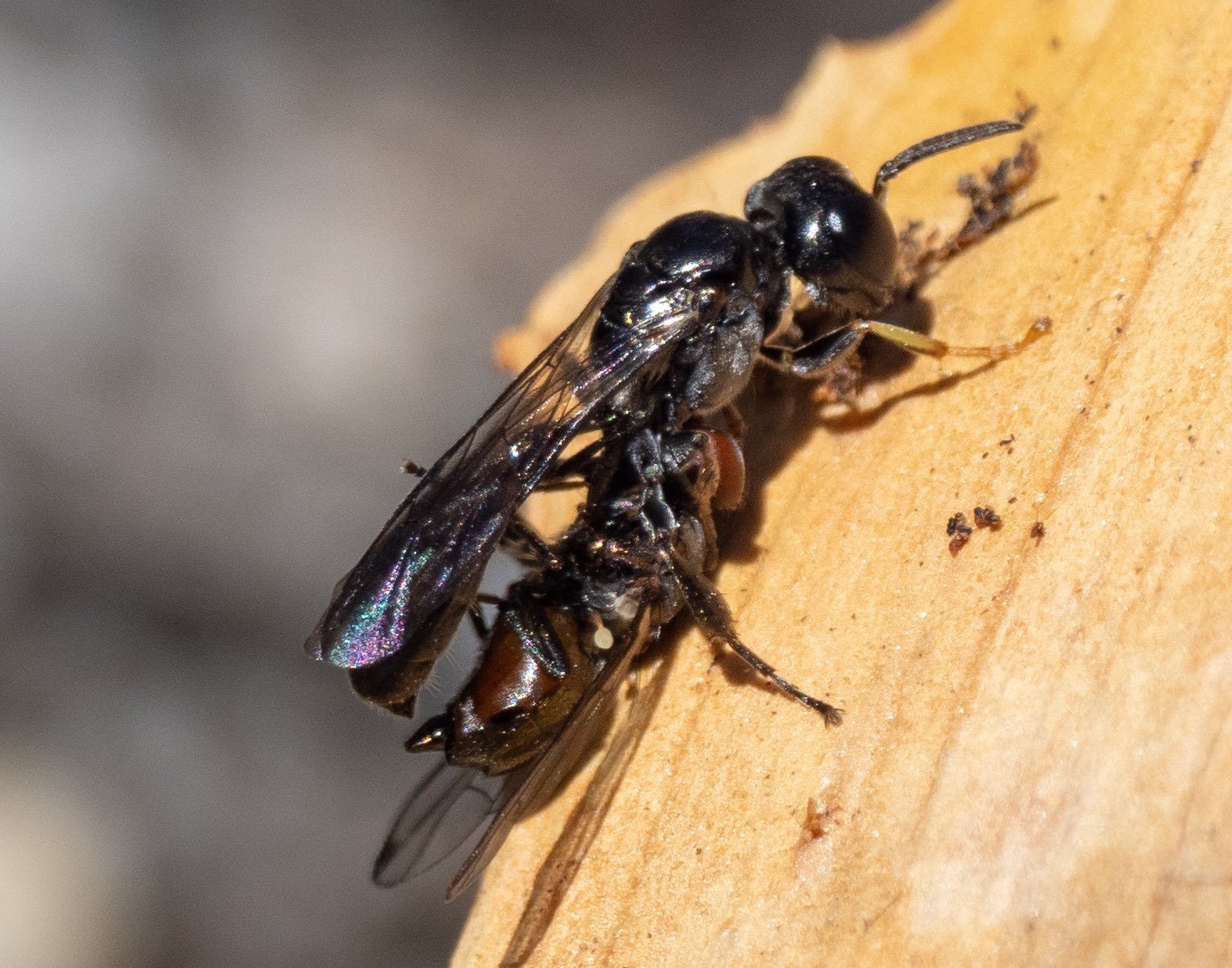
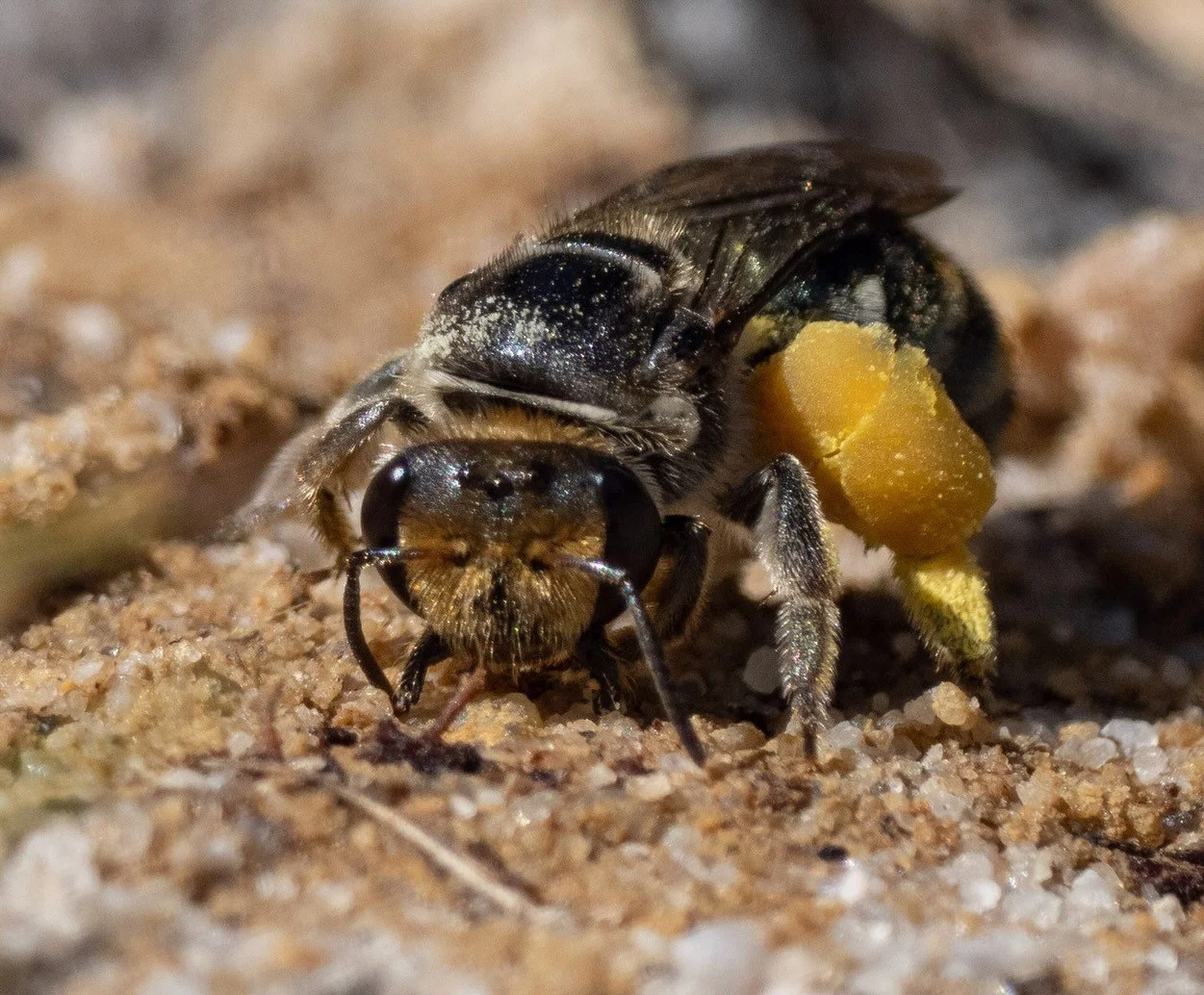
But if you see them hauling food, there’s no question. Crabronids eat meat, bees are vegetarian! That only works for the identification of females, but it’s a start. Note that crabronids will sometimes be heavily covered in pollen, but that’s just an accident. Most adults regularly feed on nectar … but they only collect meat for their offspring. Bees carry pollen, often visibly packaged on their bodied.



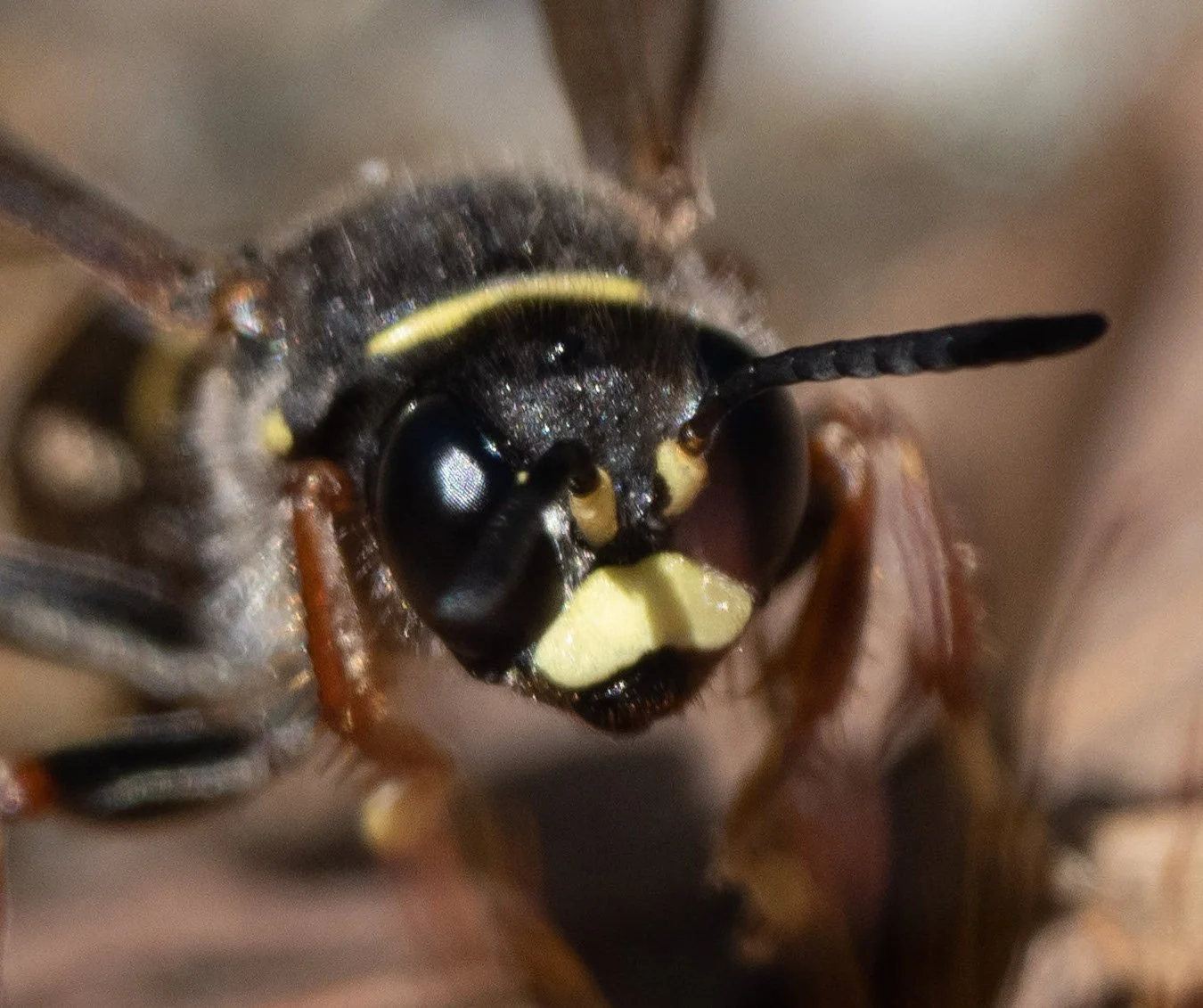
Antennae can help
The antennae sometimes help in distinguishing crabronid wasps from bees. In general, the antennae arise high on the face in bees. In many crabronids - but not all – the antennal sockets are low, close to the clypeus. Still no guarantee, but useful nonetheless.

Distinguishing subfamilies and tribes
So given the lack of defining features at the family level, how do you know a crabronid when you see one? My approach is ‘if it doesn’t seem a good fit elsewhere, check it against each of the crabronid subfamilies’. Admittedly, my growing familiarity with crabronids helps.
Being methodical (and more than a little obsessive) by nature, I have put together a cheat sheet to help me winnow the candidates without overlooking any possibilities. Australia is home to more than 800 crabronid species, across 46+ genera. It makes sense to start at the more managable level of the four subfamilies, their 16 tribes and subgroups.
Some of the features to look for
To make sense of the summary table one needs some knowledge of the important body parts. There are diagrams at the bottom of the Crabronid Hub page, but they dive into some rather technical details. As an entrée, here are some of the key features … as they appear in field photos.
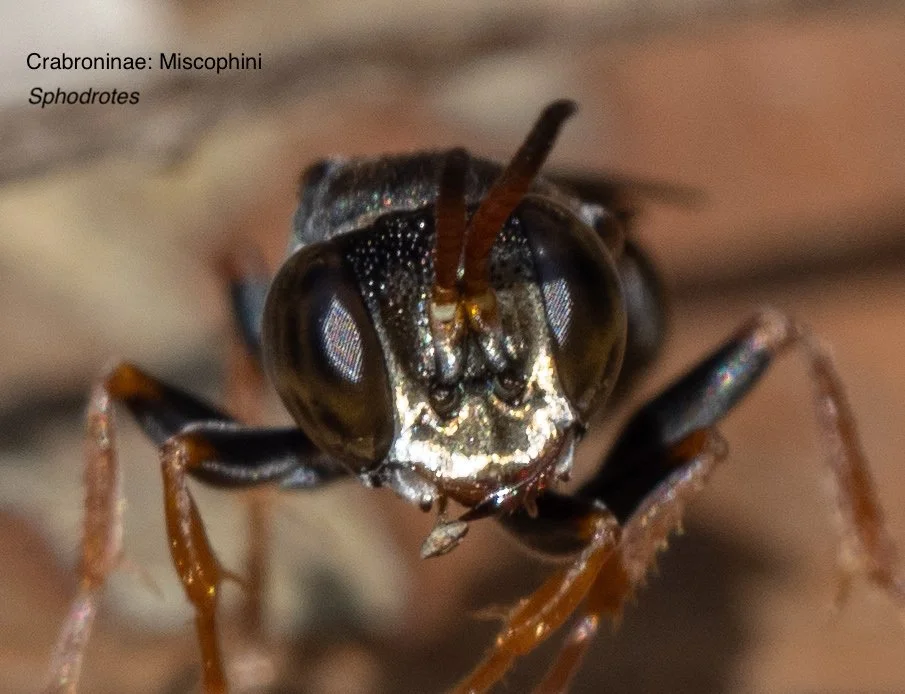
The eyes
The eyes provided valuable information for distinguishing between crabronid subfamilies, and in some cases genera. In particular, the shape and alignment of the inner margins of the eyes (from ocelli to clypeus). Fortunately, most of us instinctively try to capture a face shot – and some wasps will deliberately look straight at the bothersome photographer. Win win!



Forewing venation
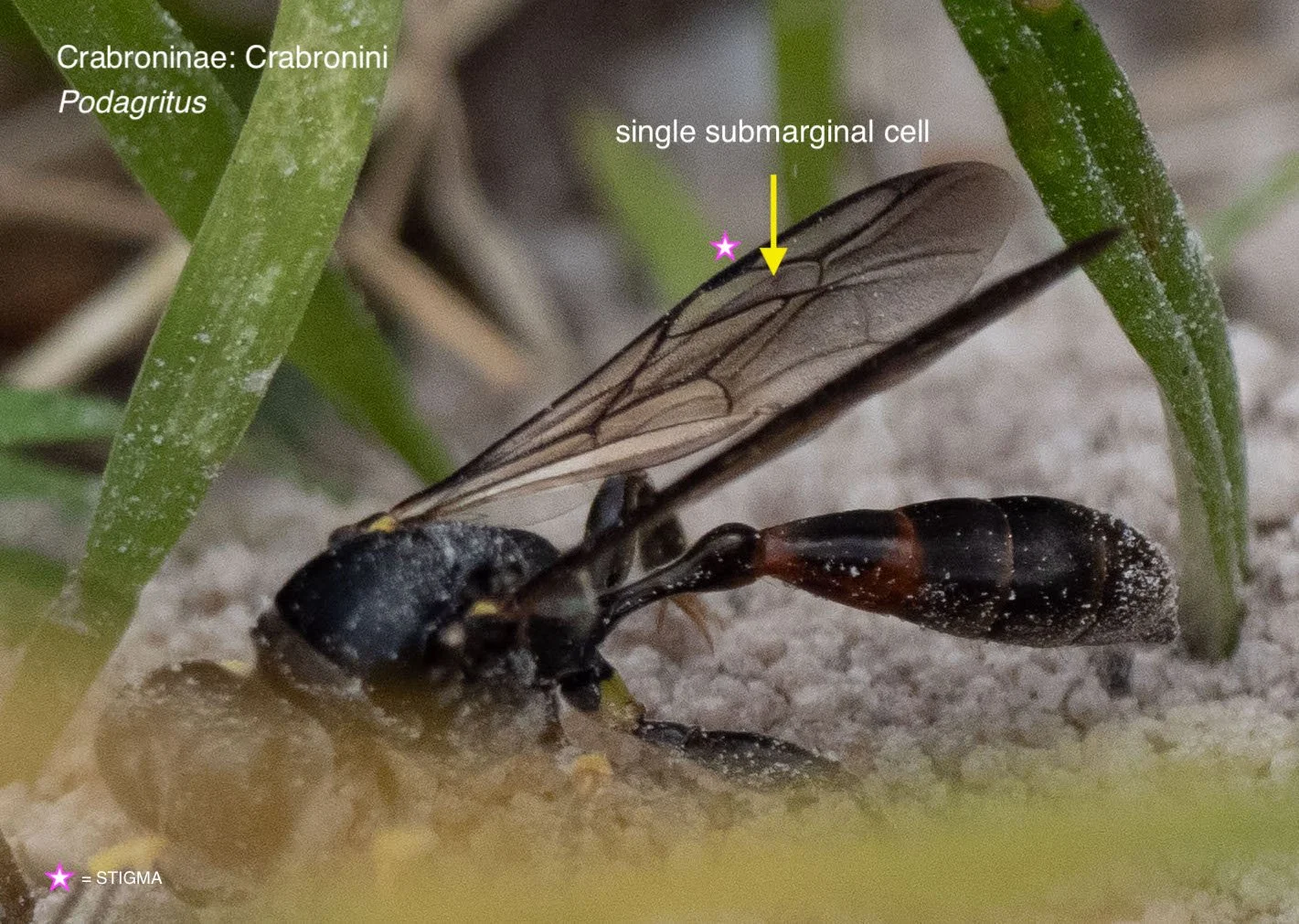
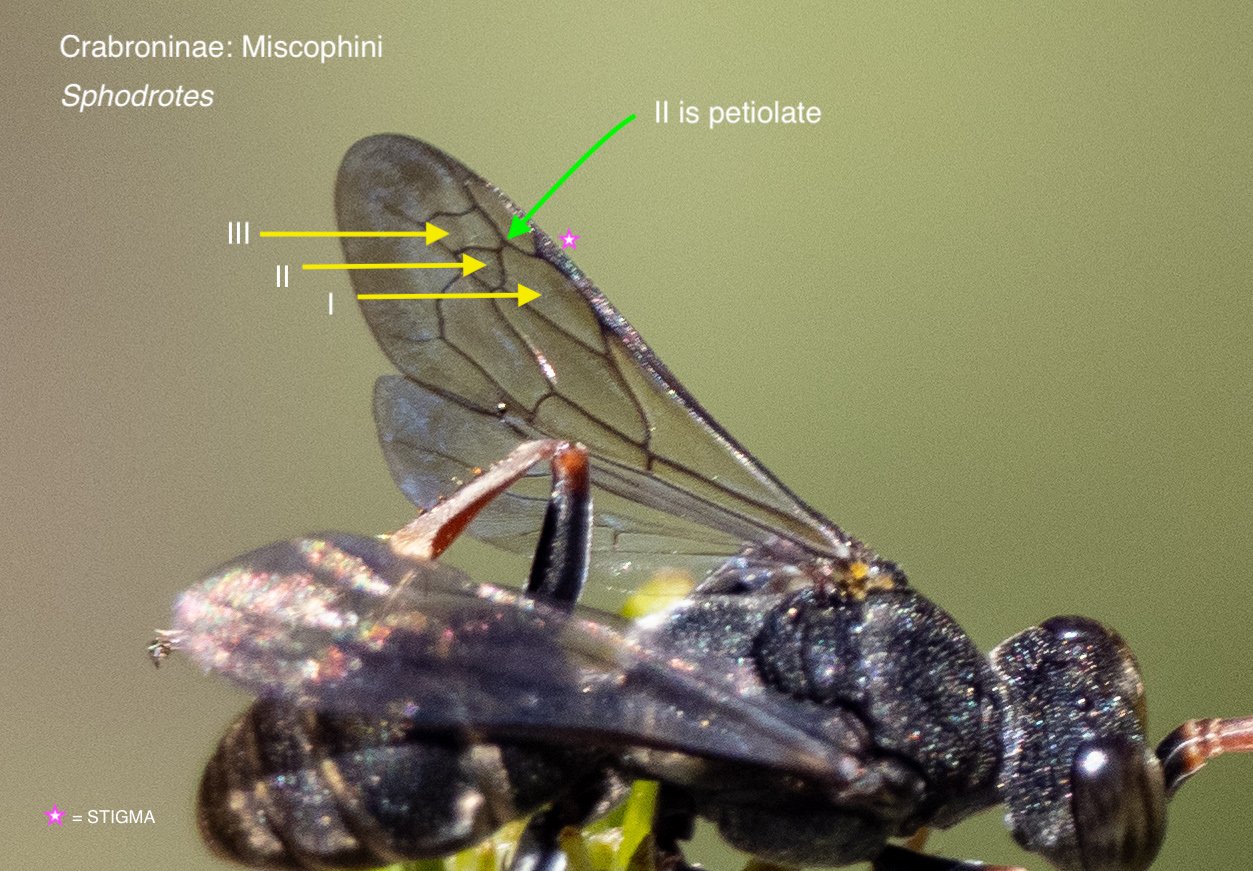
The pattern of veins in the forewing provides crucial information. Luckily, it is relatively easy to capture in a field photograph – particularly when a wasp is at rest and grooming.
The number, size and shape of the submarginal cells helps to distinguish various tribes and subtribes, while the relationship of these cells with the ‘recurrent veins’ can be diagnostic between genera or species.


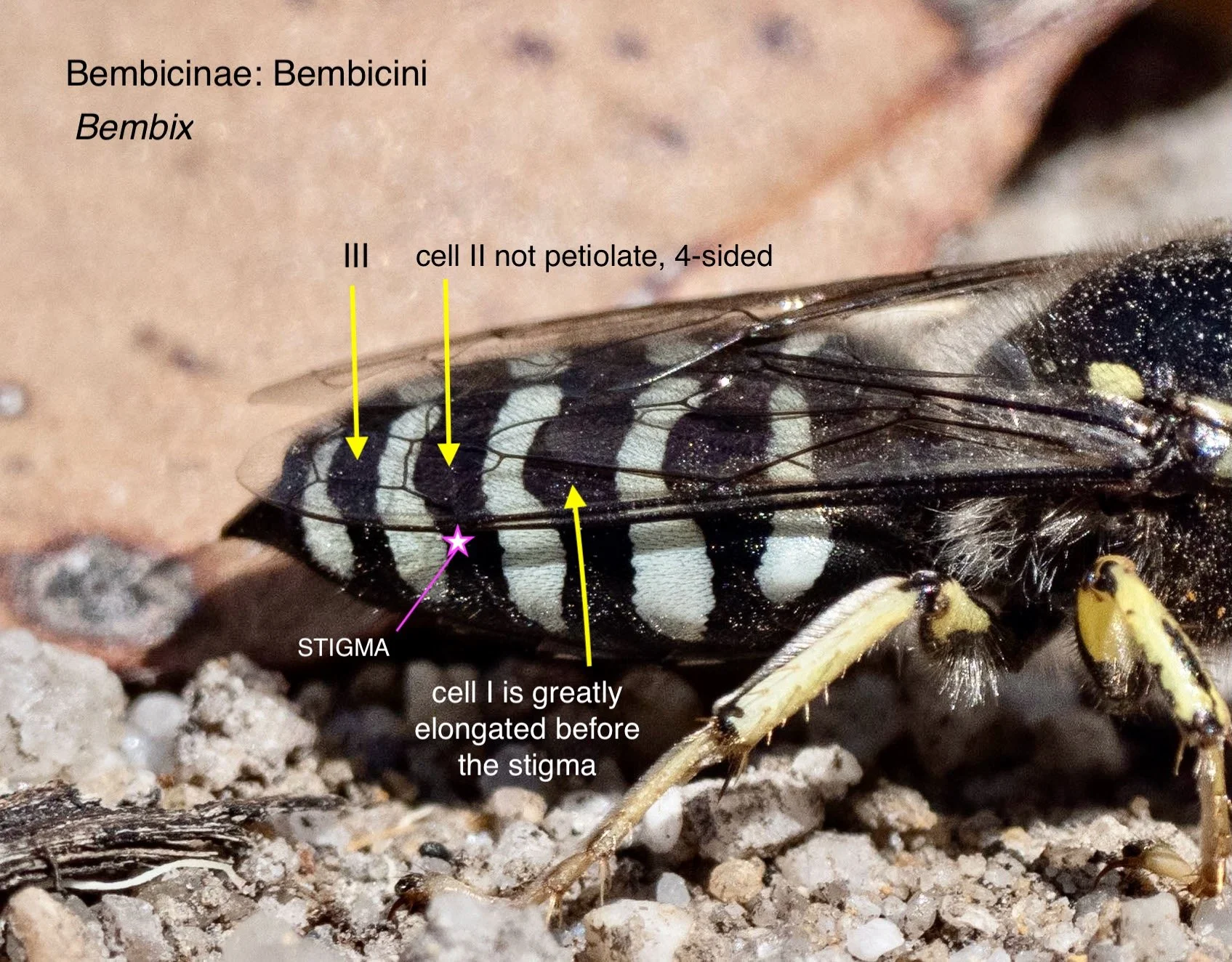
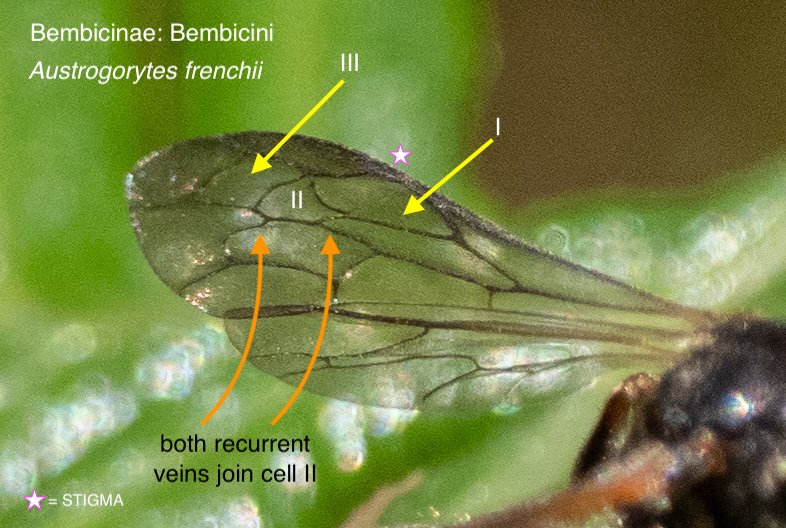
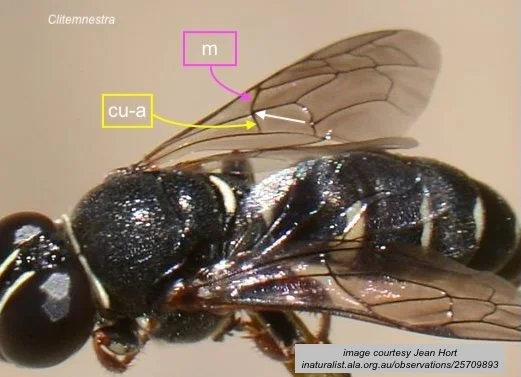
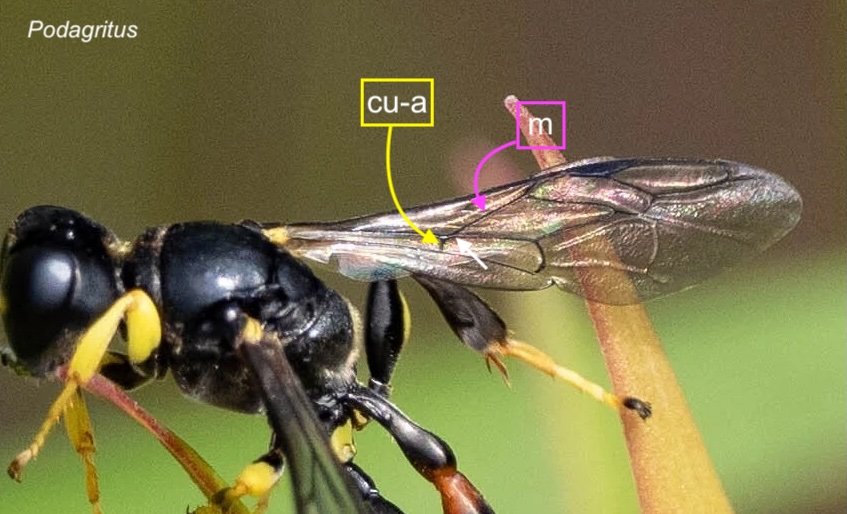
There is a second forewing feature worth noting: the point at which the media vein diverges with respect to the cu-a crossvein. Fortunately, this divergence point (marked in white arrows in the following gallery) is not too difficult to locate even when the wing is viewed obliquely or the image resolution low.

Antennae
For most crabronids, the number of segments in the antennae differs between the sexes. Males typically have 11 flagellar segments while females have 10. The relative length of the scape and its point of attachment to the head is also relevant.


Assorted extras
The following images show other features mentioned in the Summary Table. In particular, note the shape of the ‘abdomen’ (variously called gaster or metasoma). The width and shape of the first segment is diagnostic for some taxa.
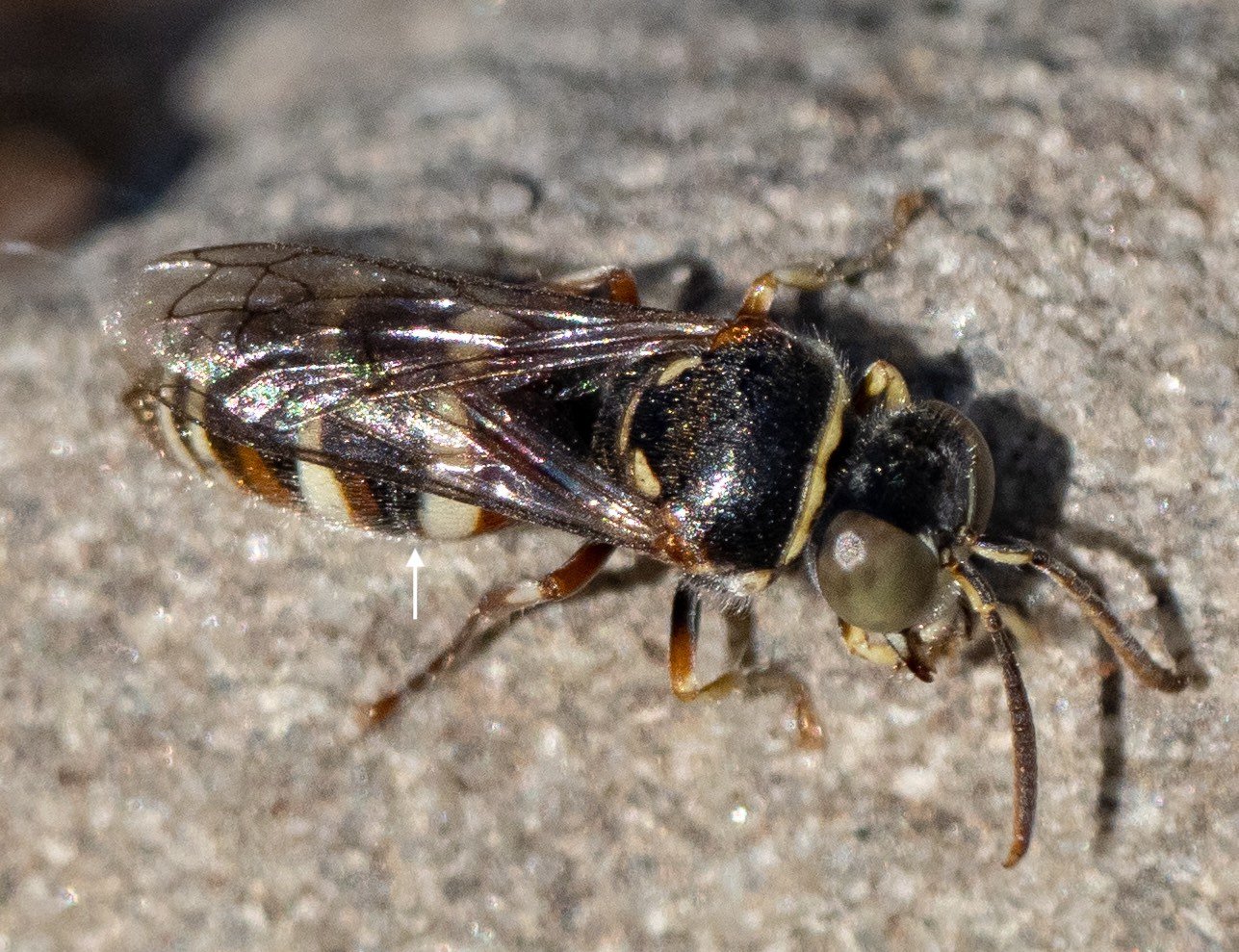
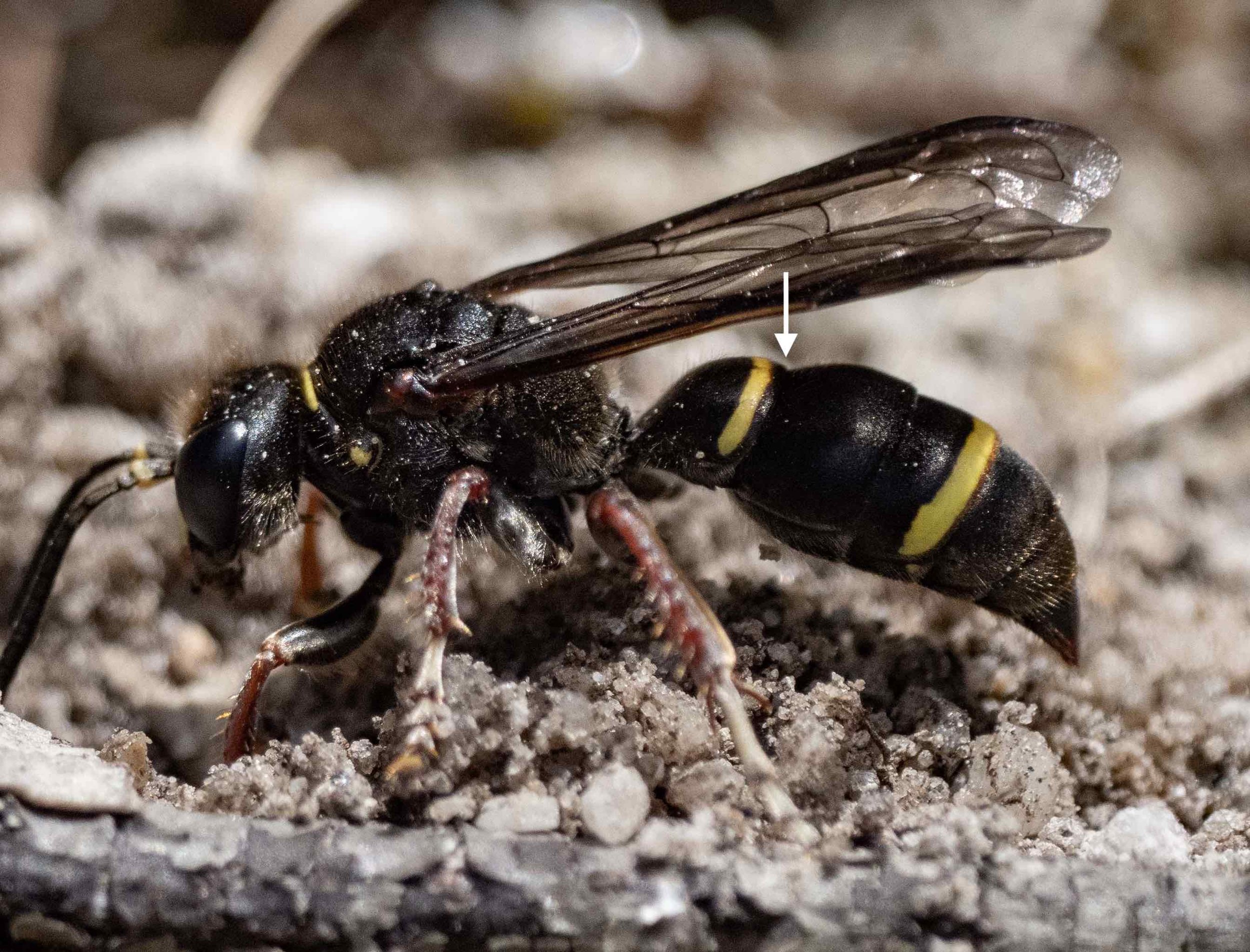
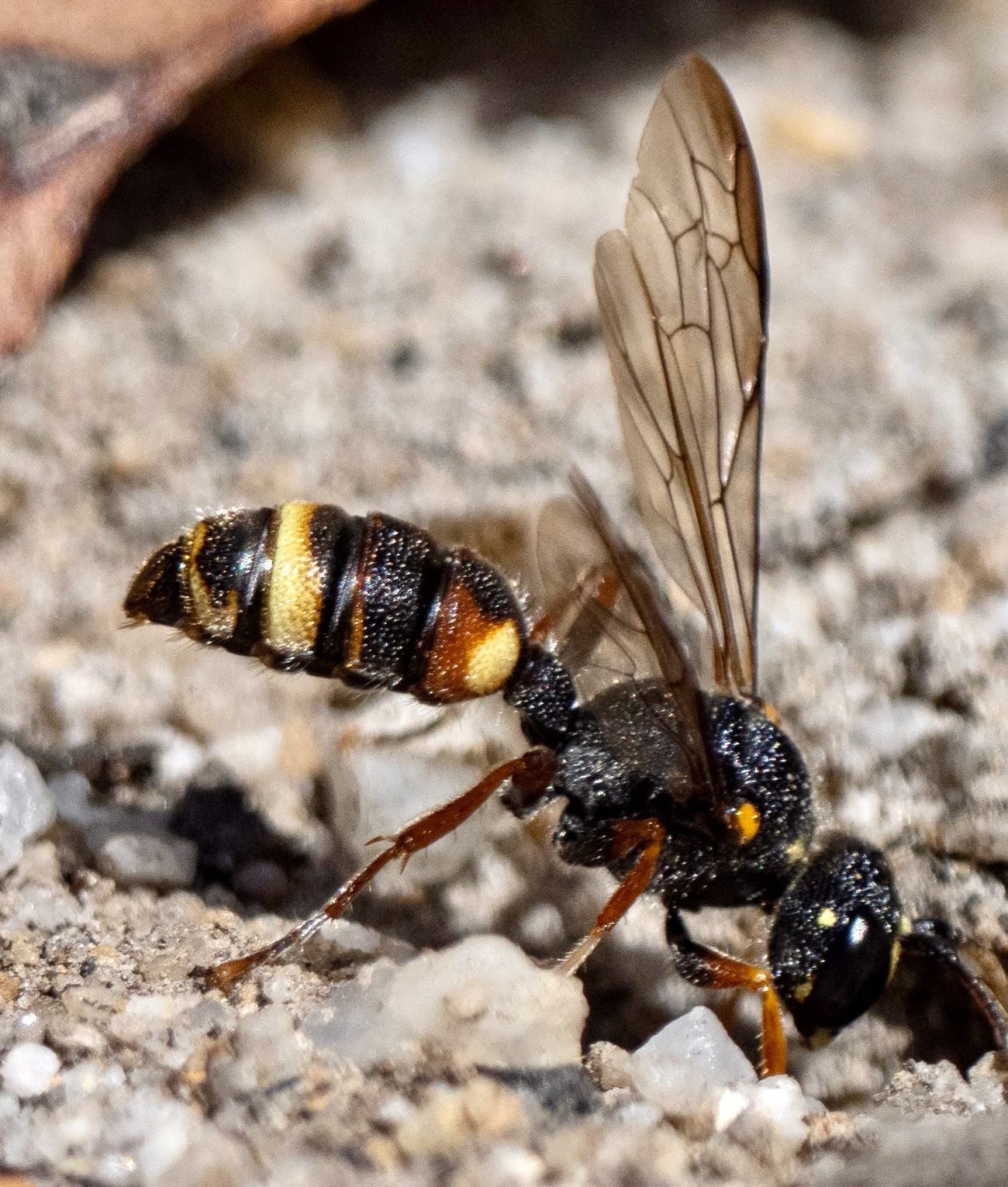
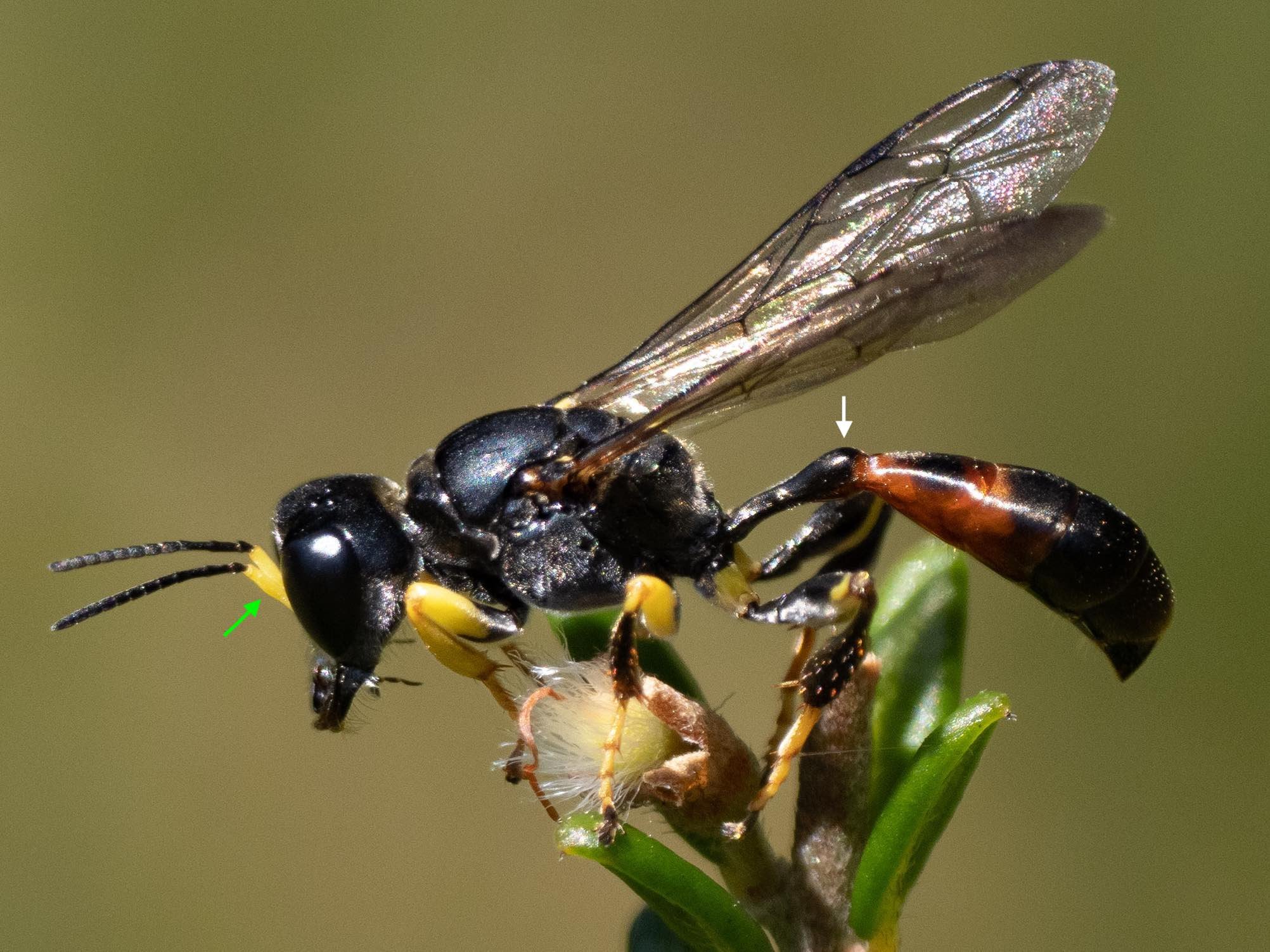
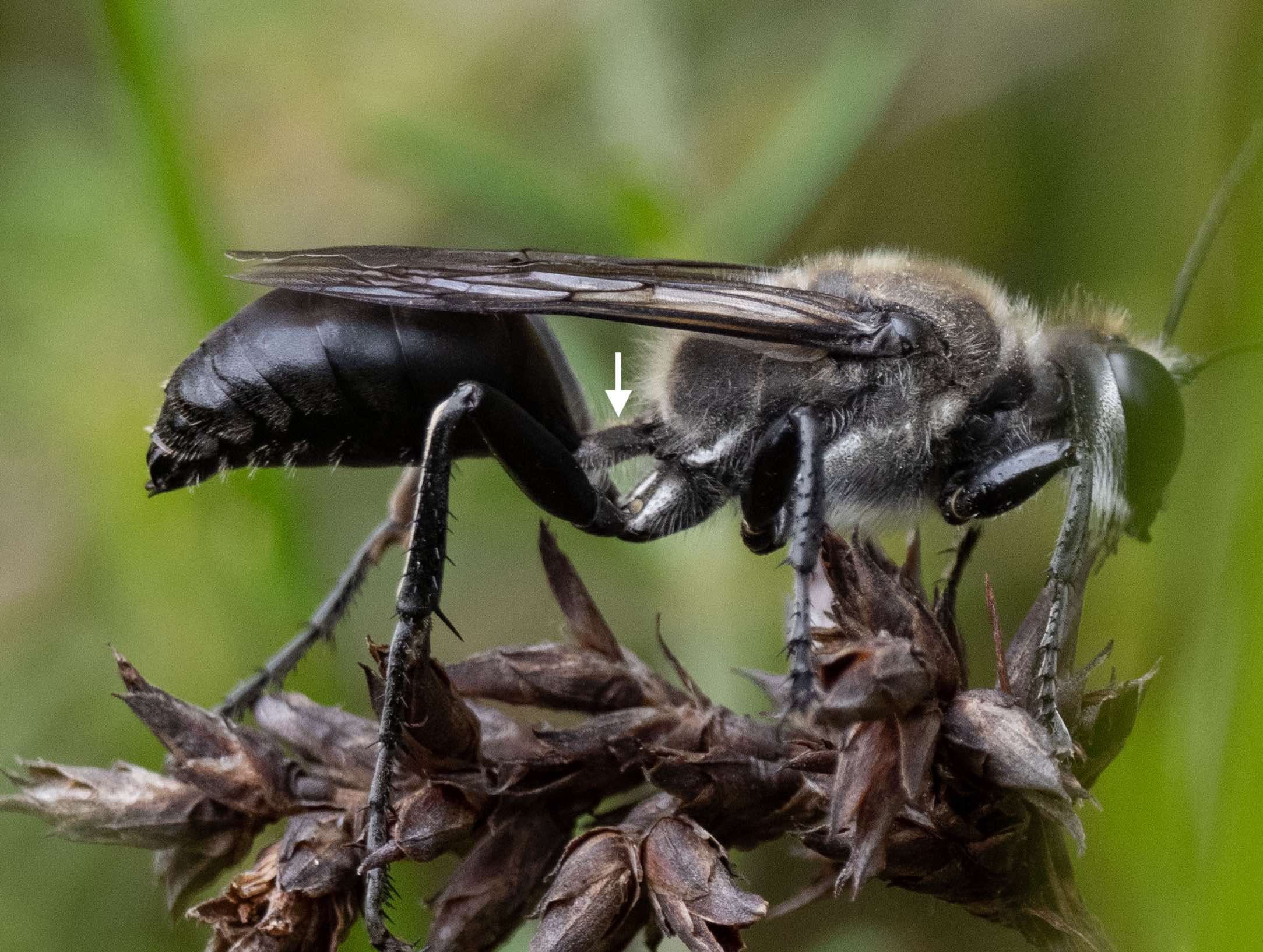
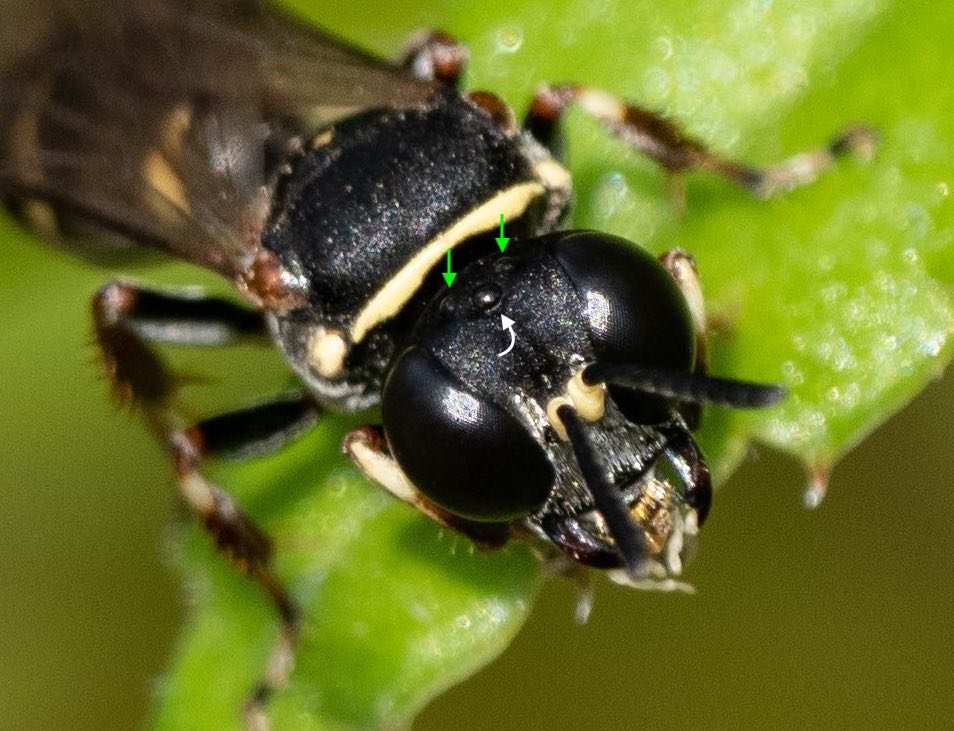
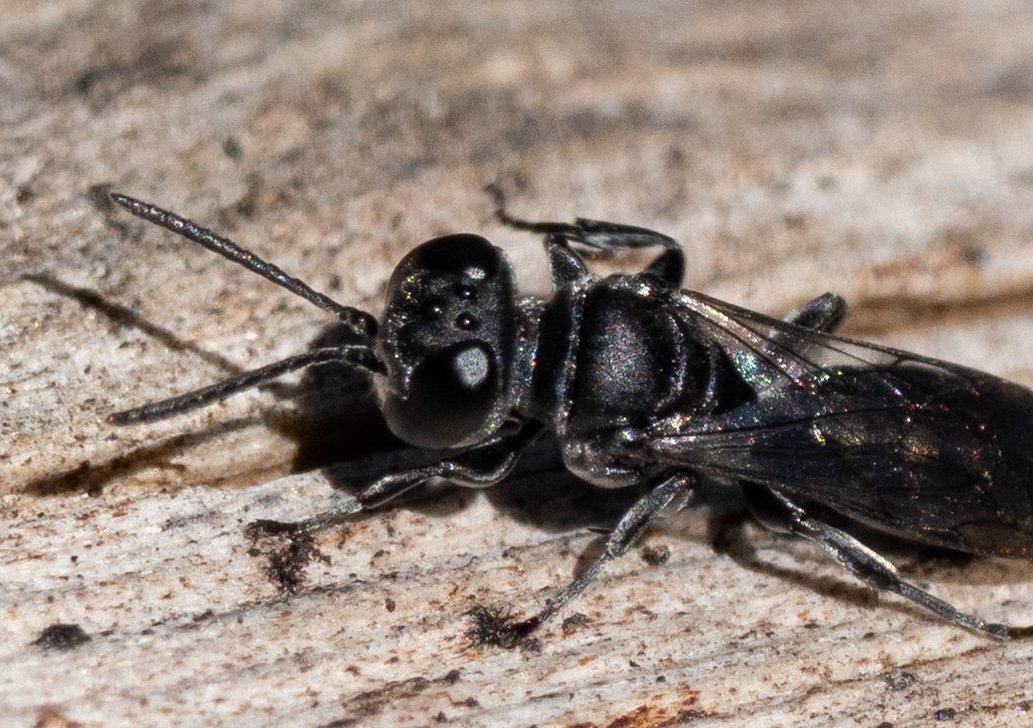

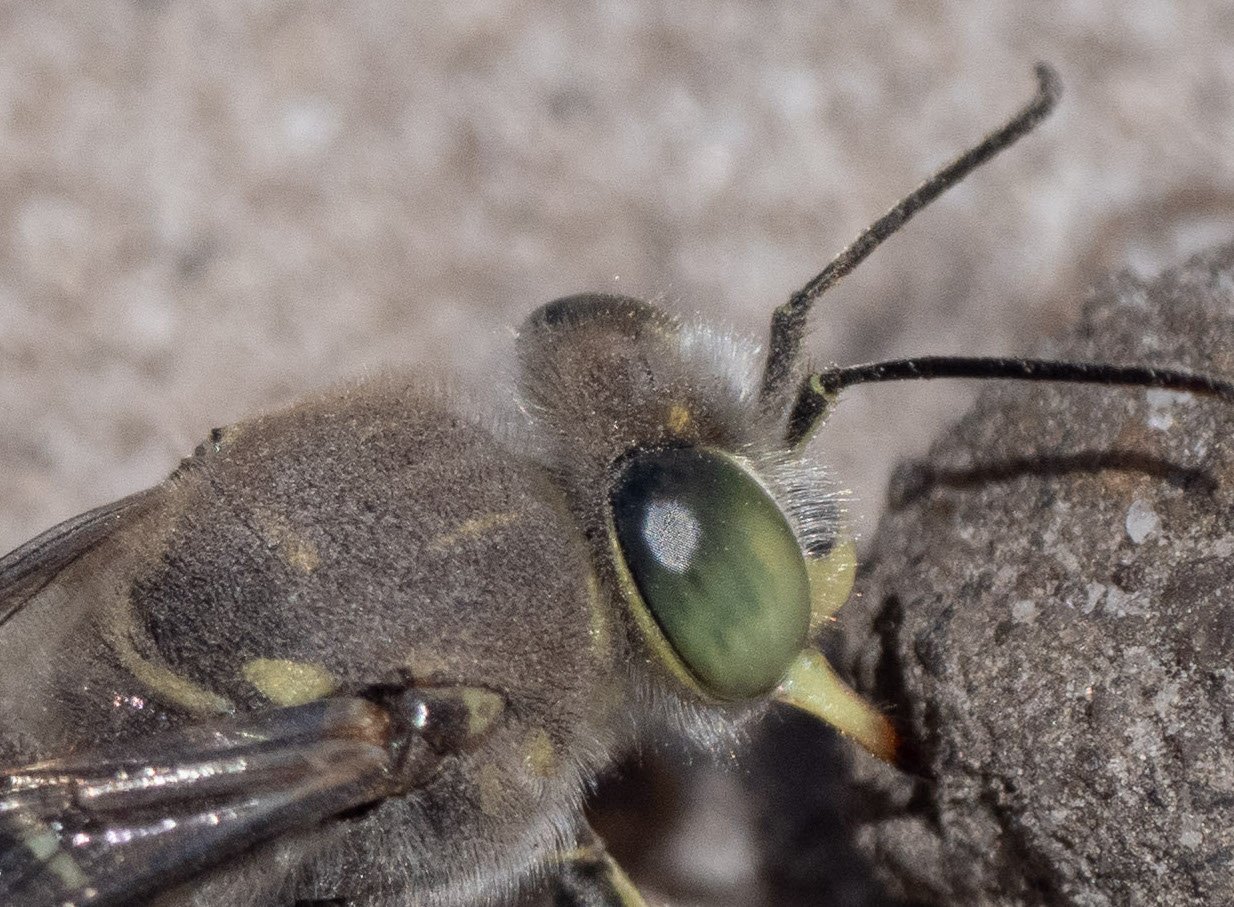
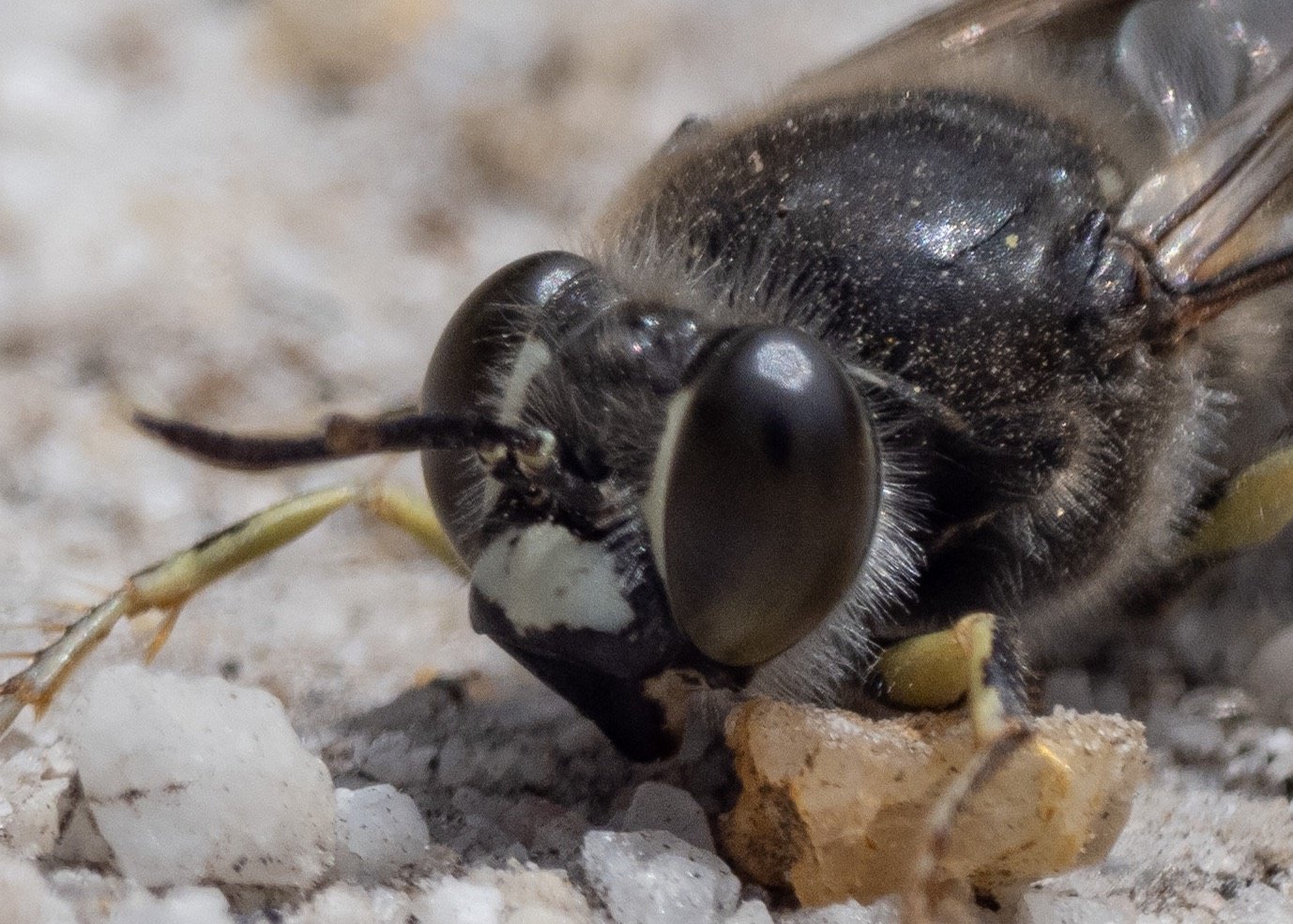
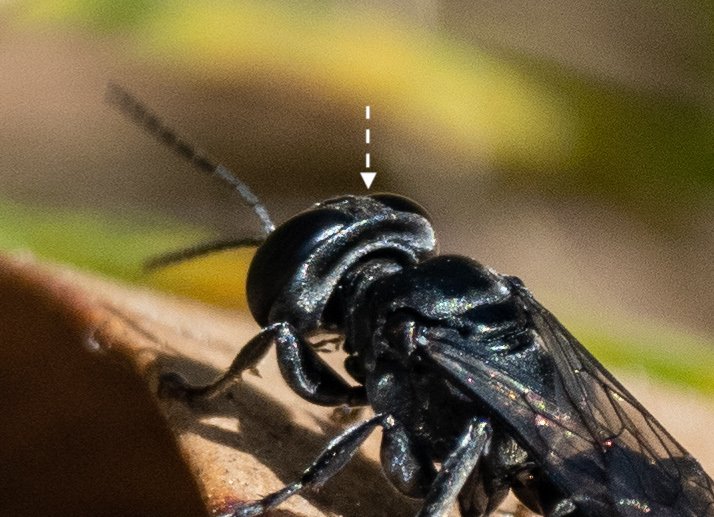
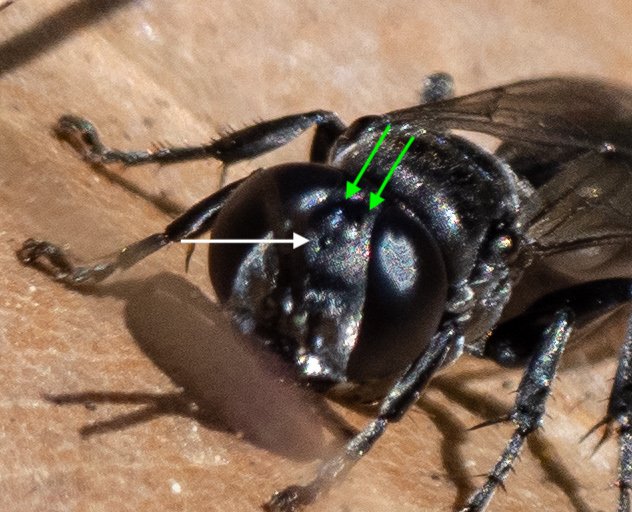
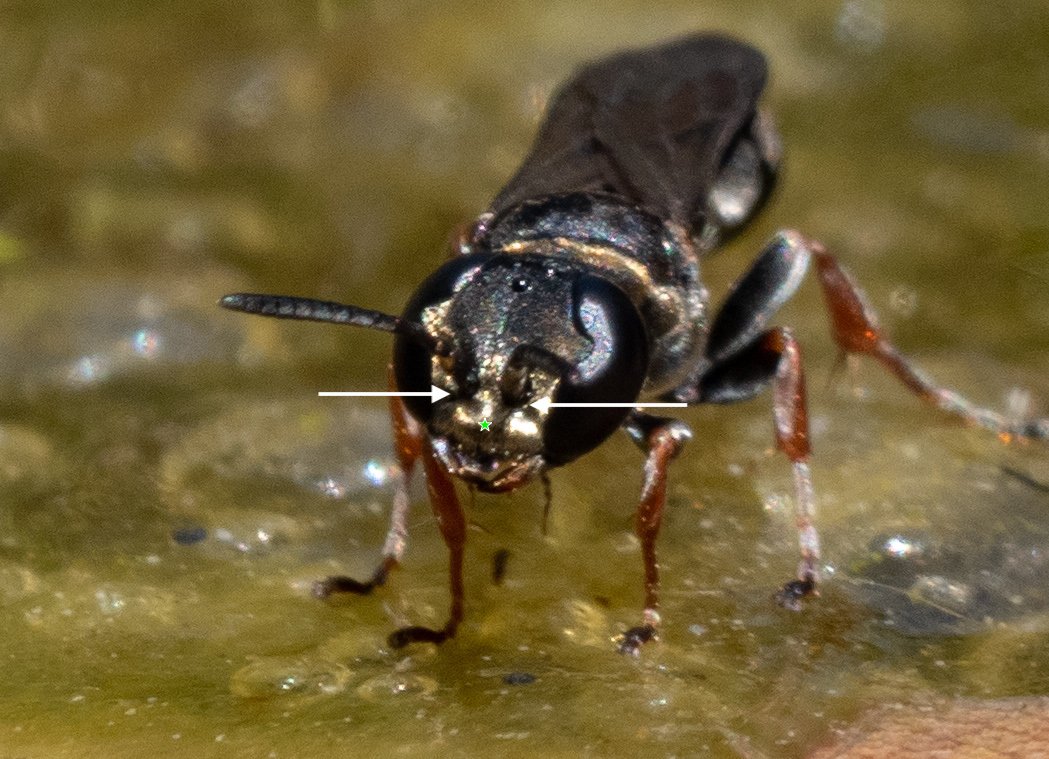
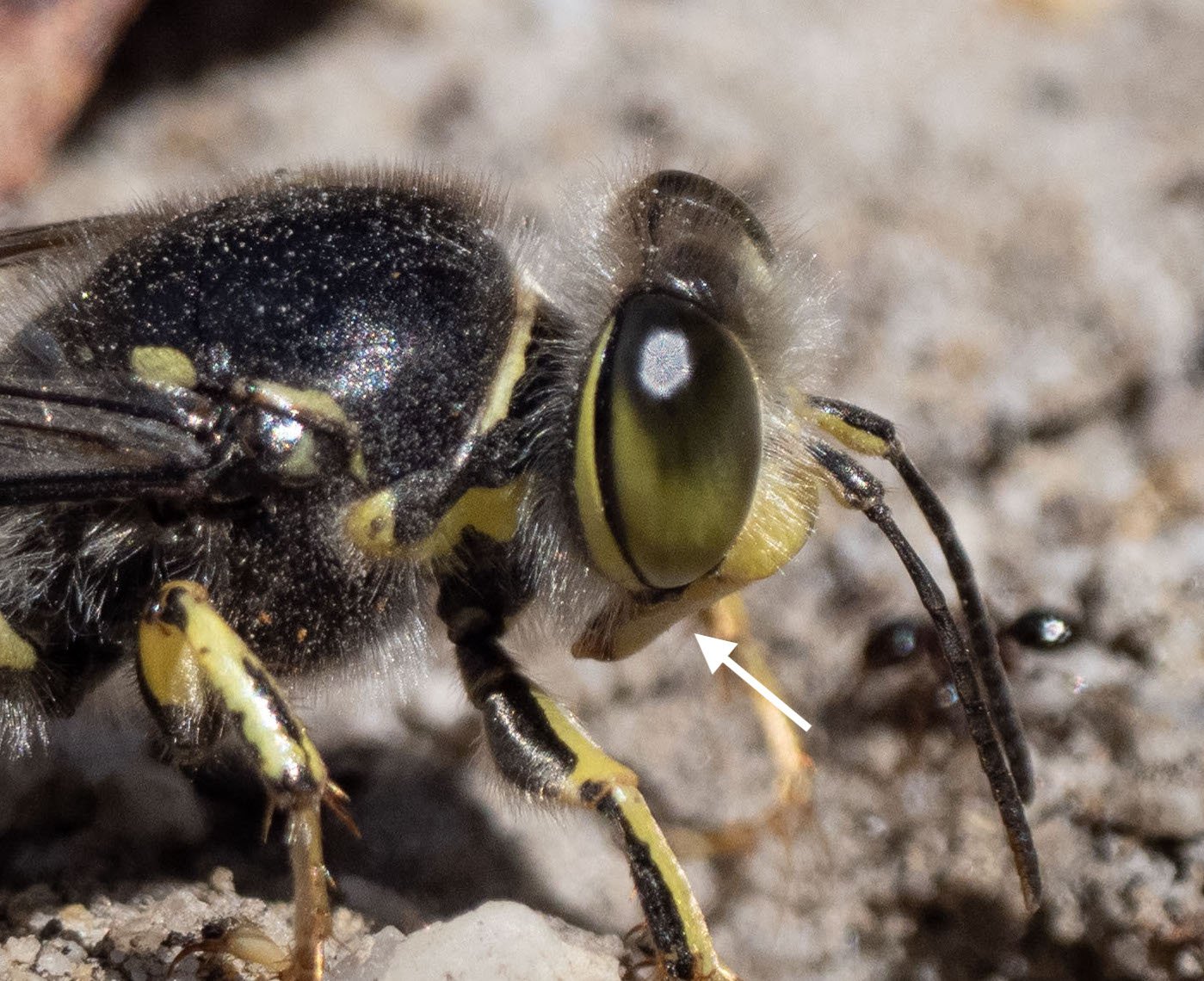
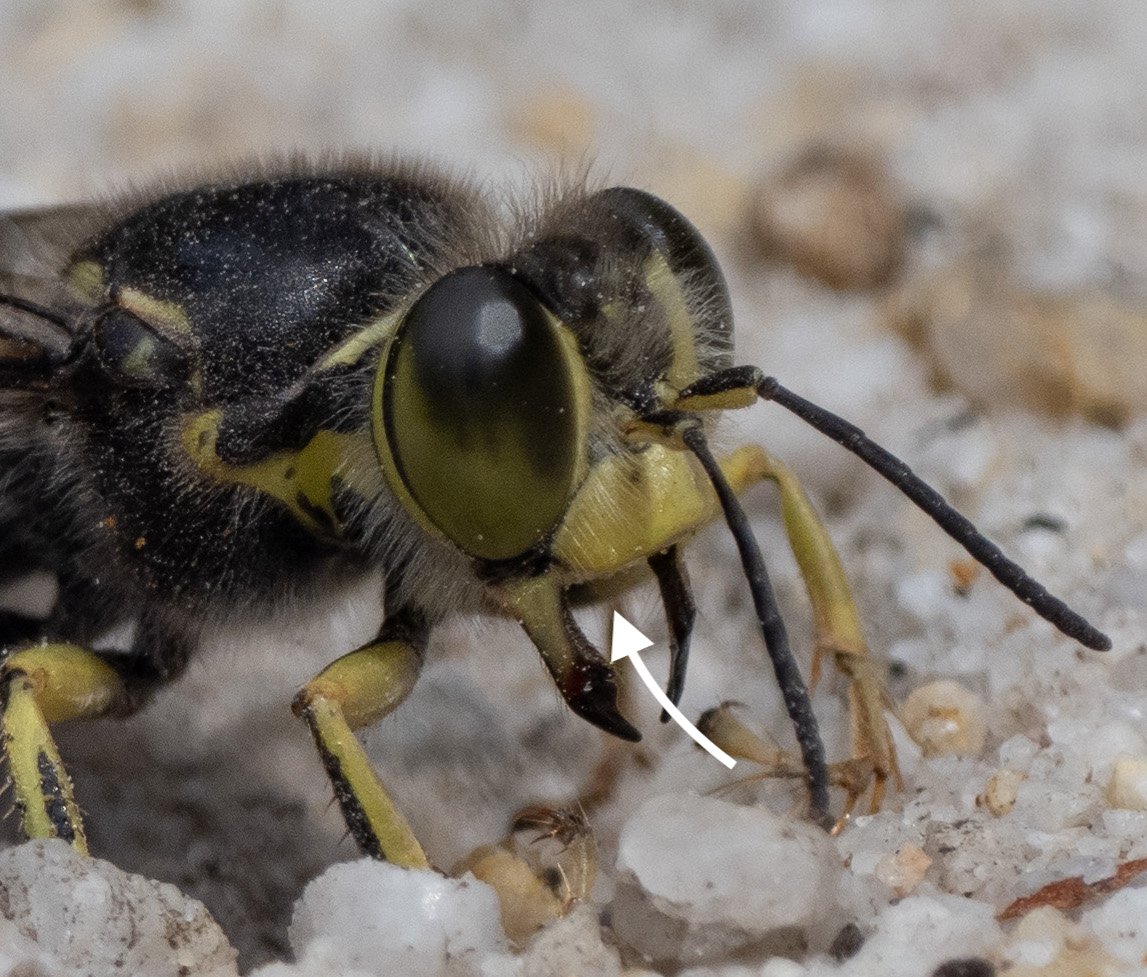
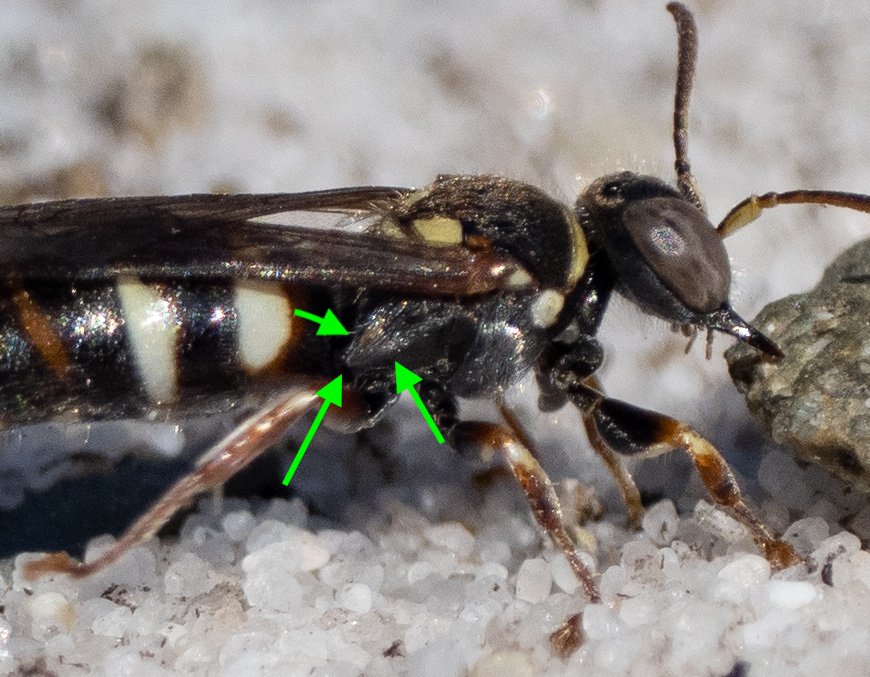
The reality is that when photographing wasps in the field, you haven’t a chance to get every shot you’d like to have. So the best strategy is to take as many photos as possible, from a variety of angles – then hope that it is enough.
Note: this page is an adapted extract from a blog post of February 2023 (Sand wasp puzzles: Part 1). That early post marked the beginning of my crabronid journey. A journey with (happily) no end in sight!
Bohart, R.M. & Menke, A.S. 1976. Sphecid Wasps of the World: A generic revision. University of California Press.
Peters, R.S., Krogmann, L., Mayer, C. …. Niehuis, O. 2017. Evolutionary history of the Hymenoptera. Current Biology. 27(7): 1013-1018 (open access … doi.org/10.1016/j.cub.2017.01.027)