
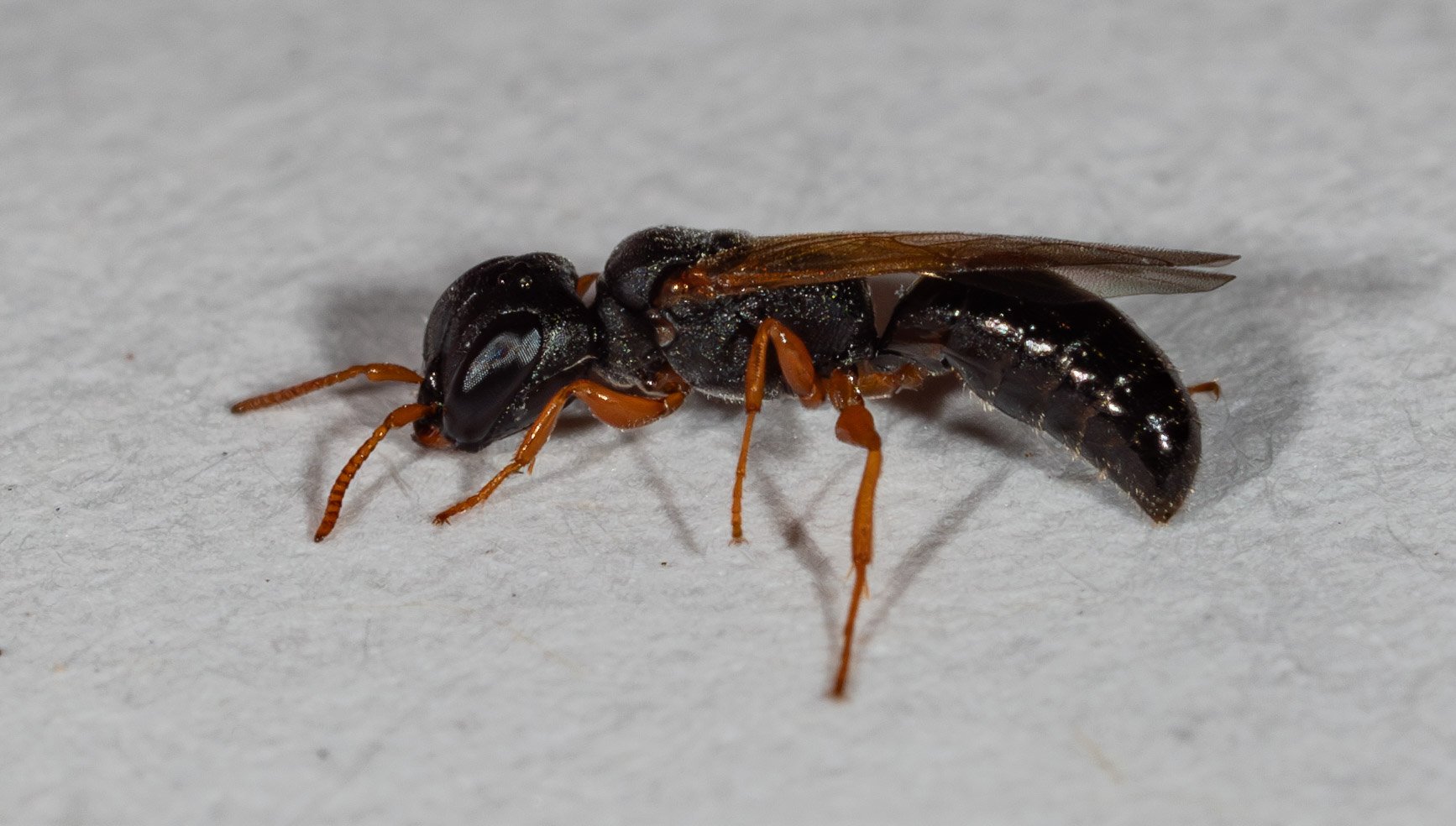
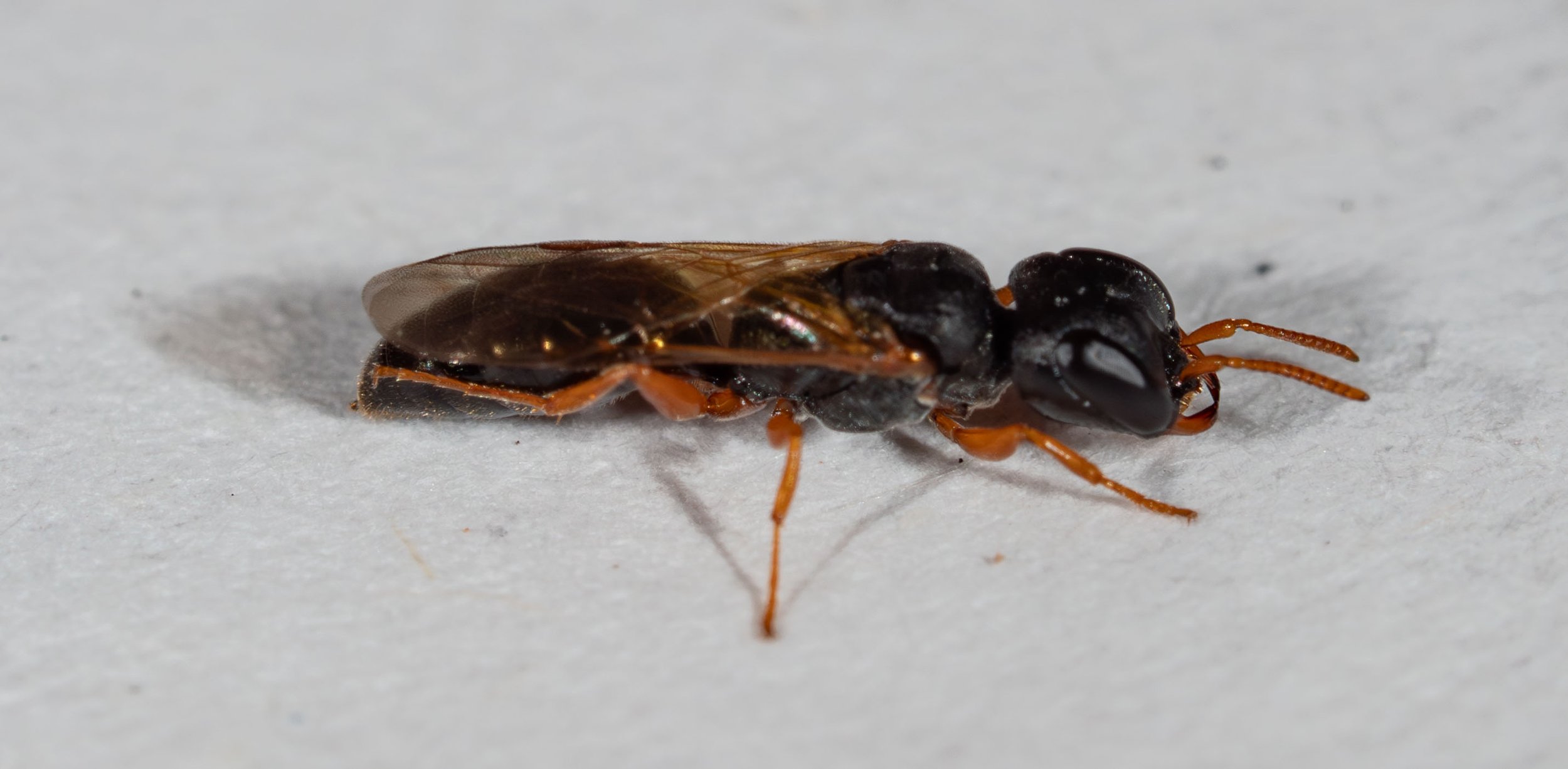
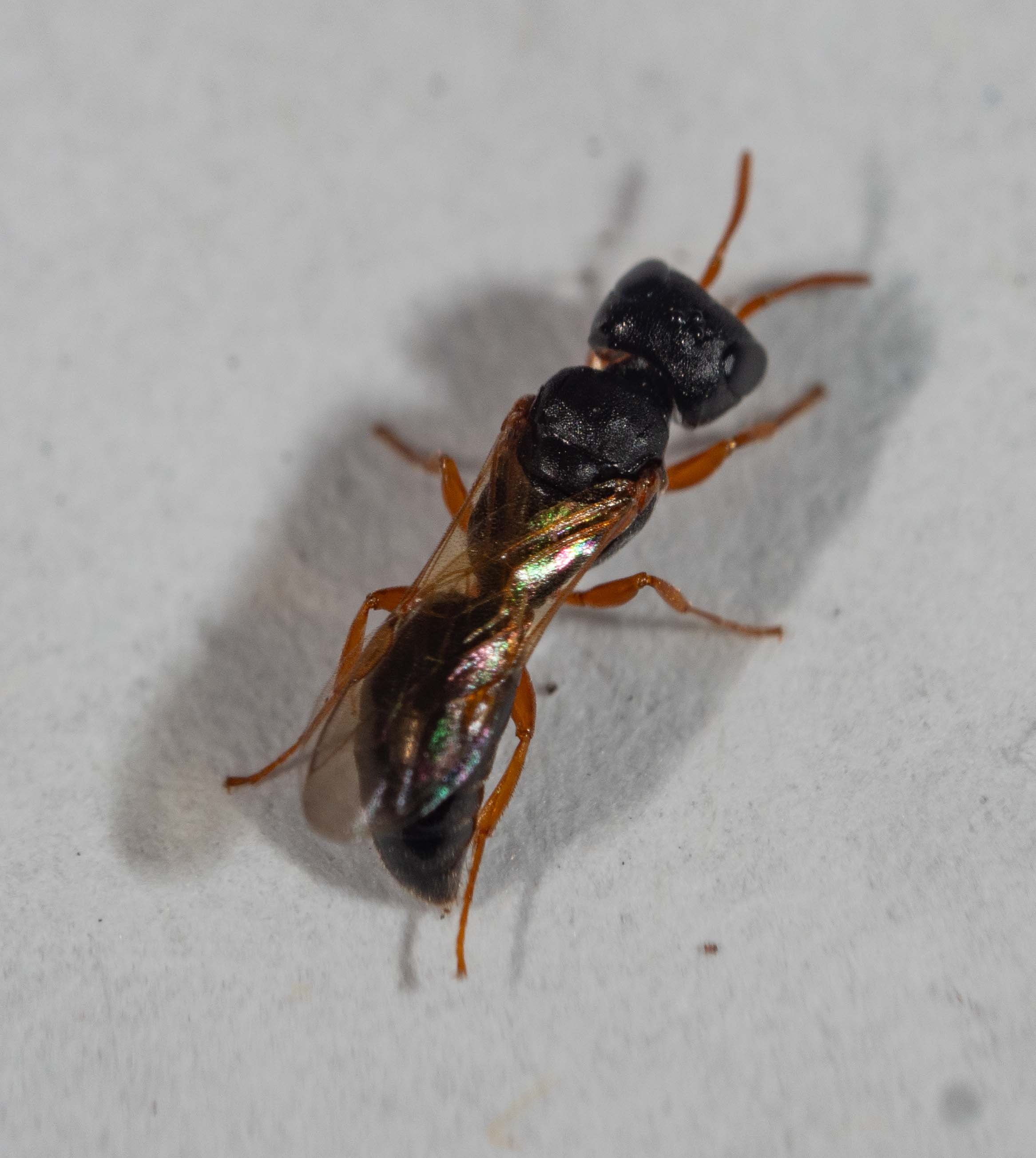
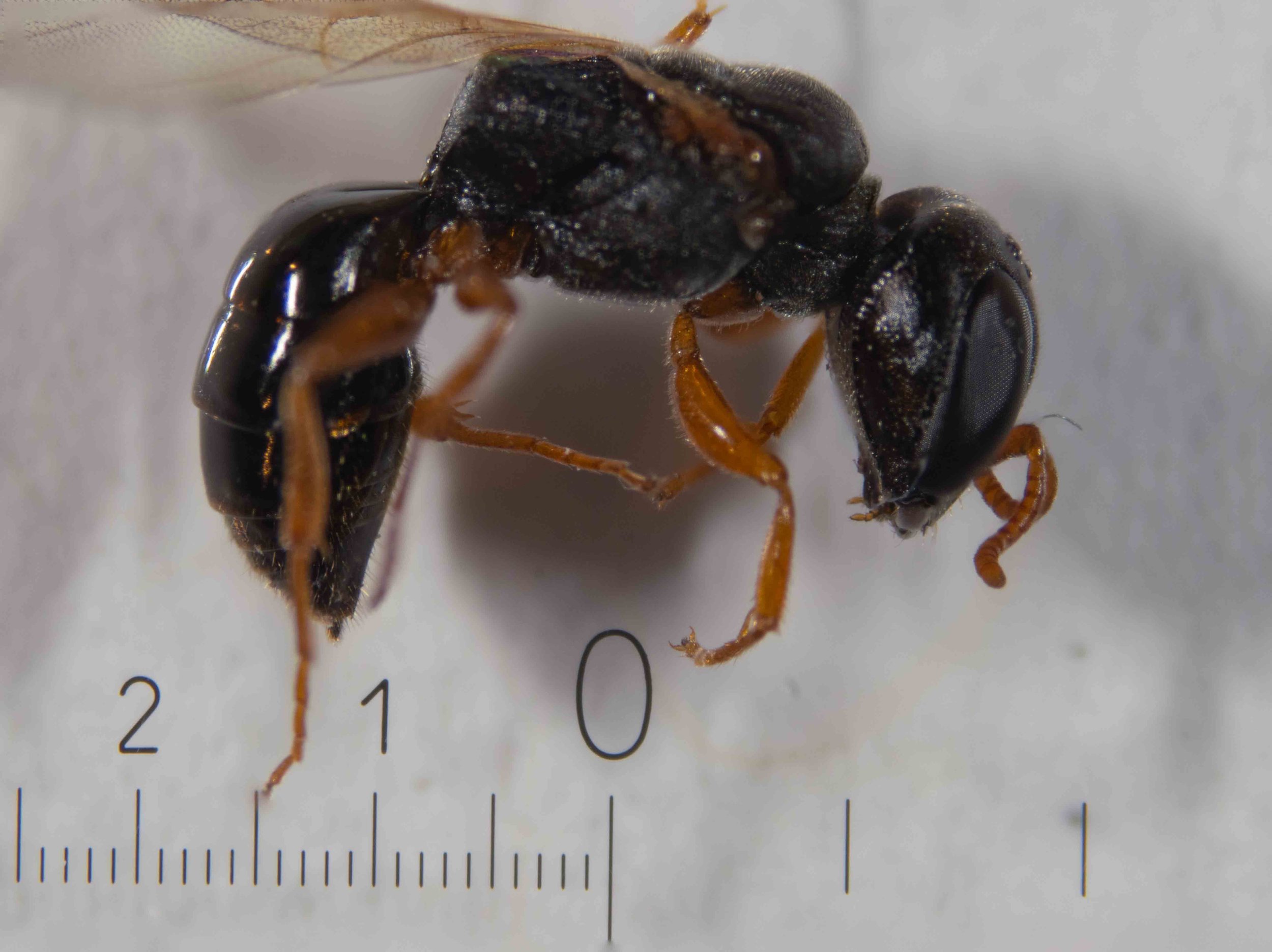
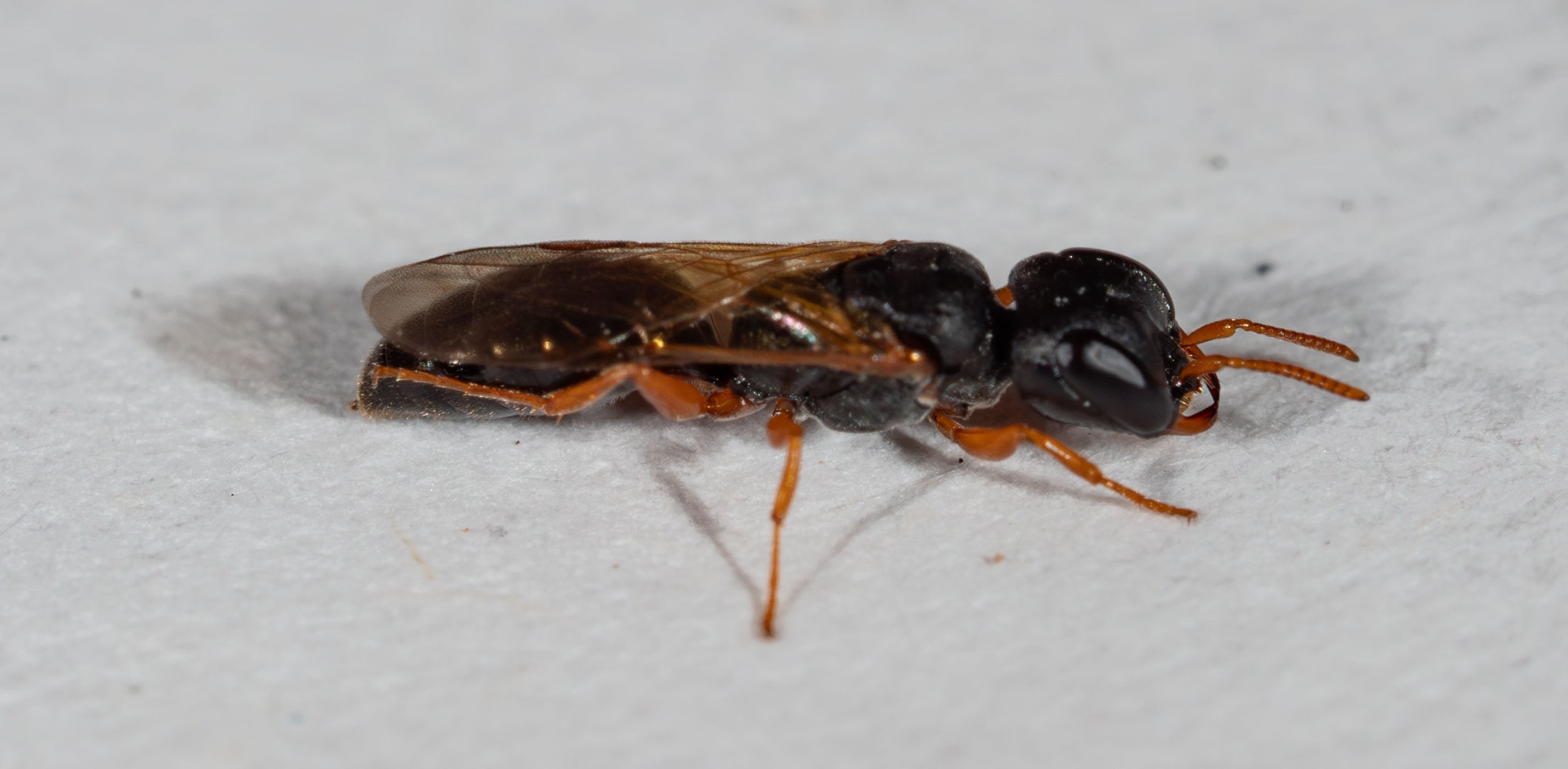
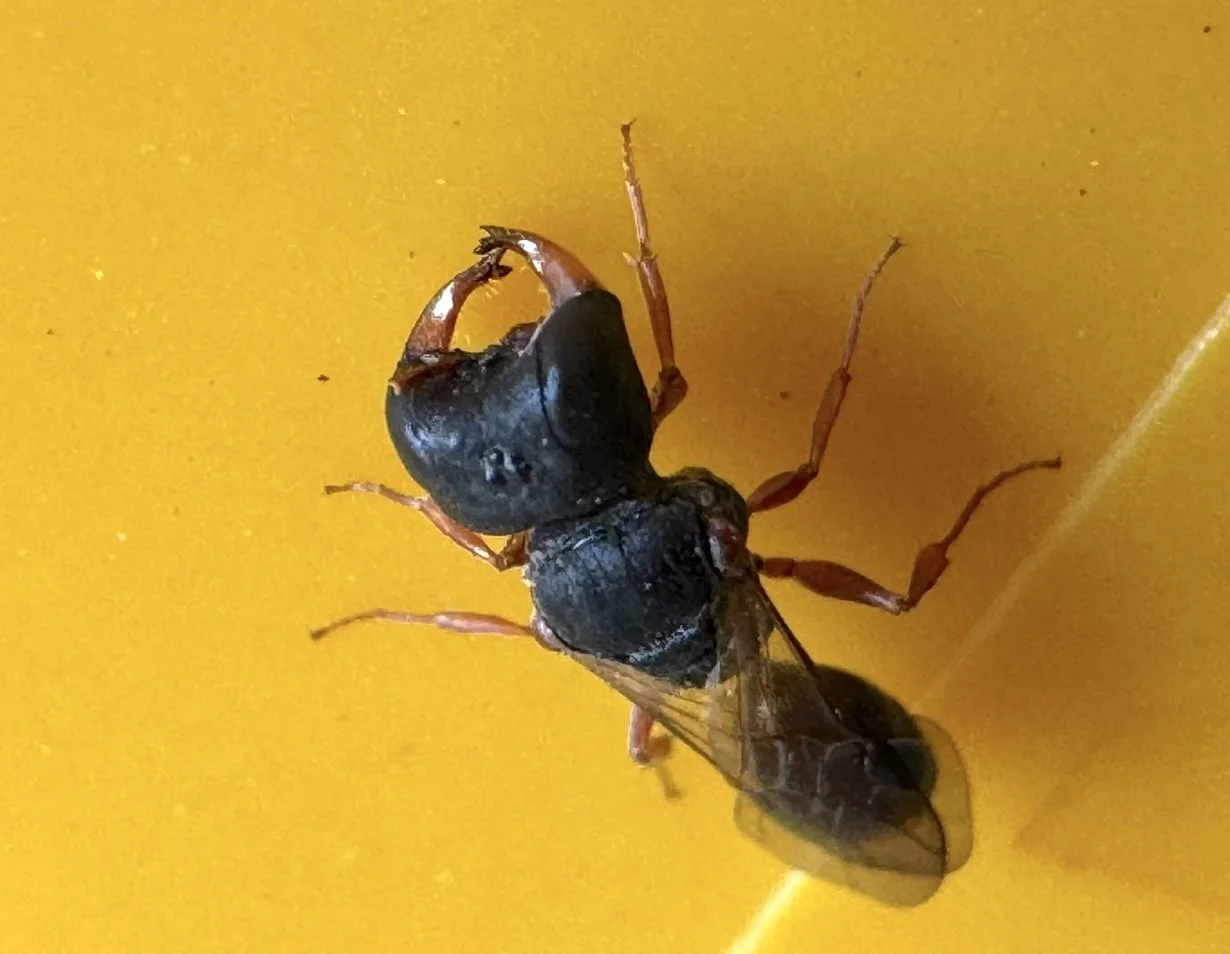
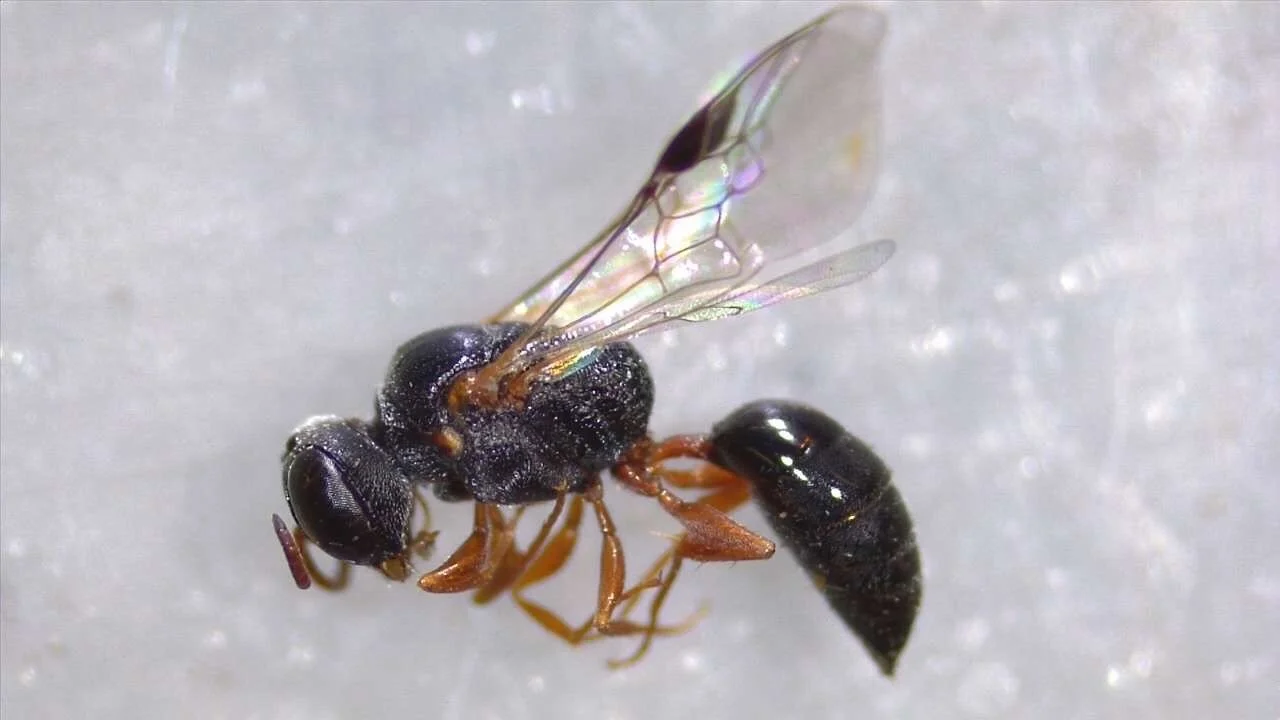
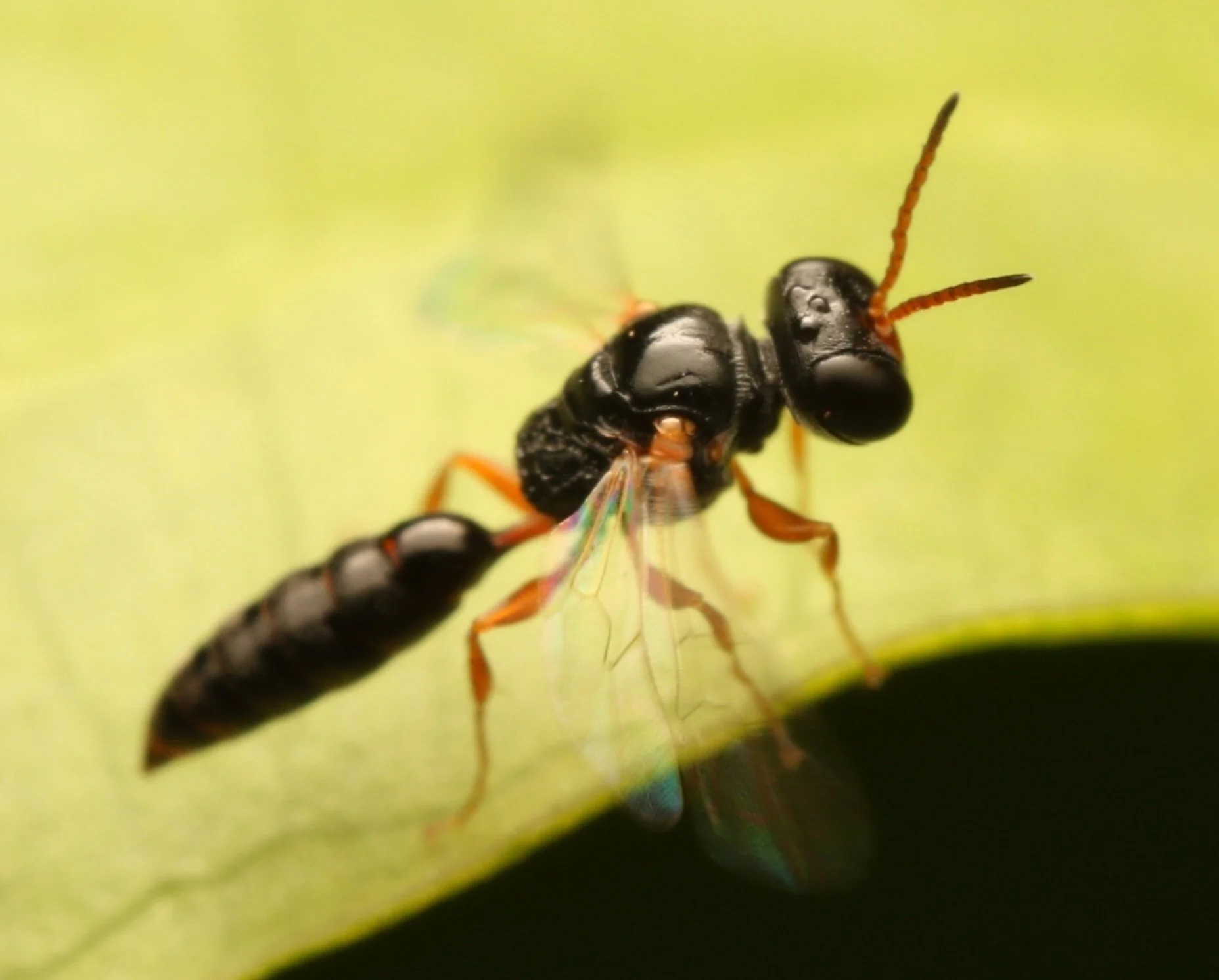
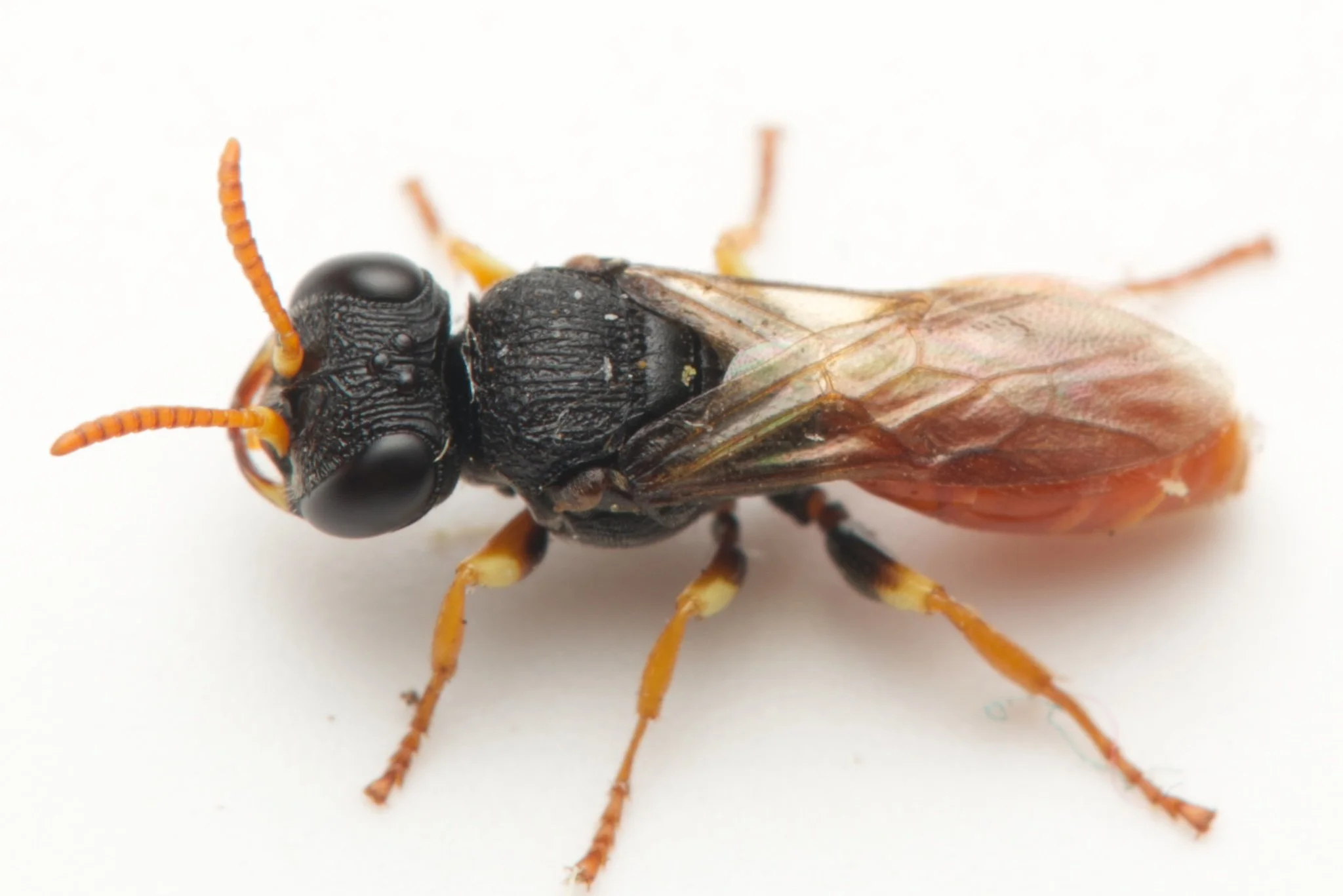
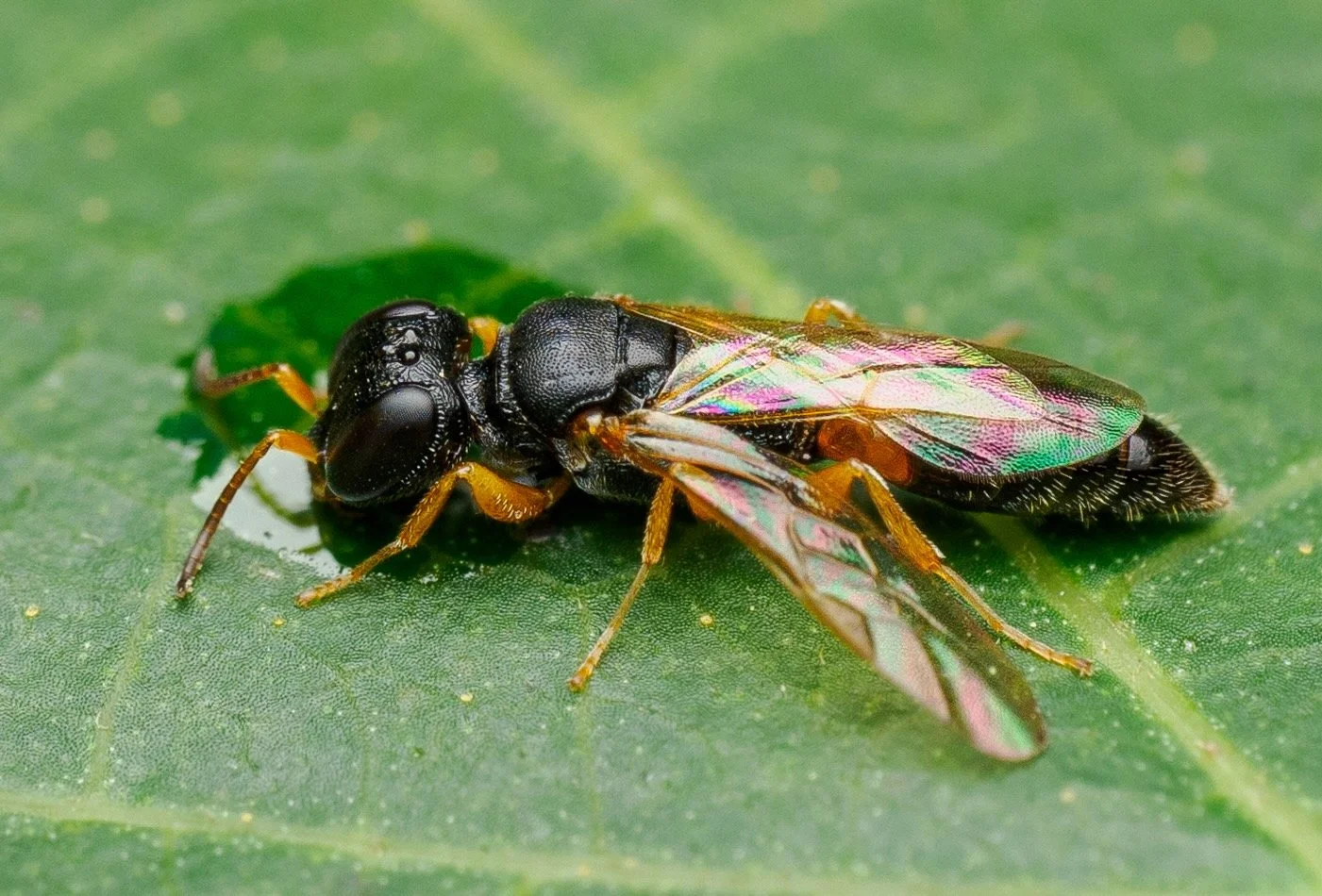
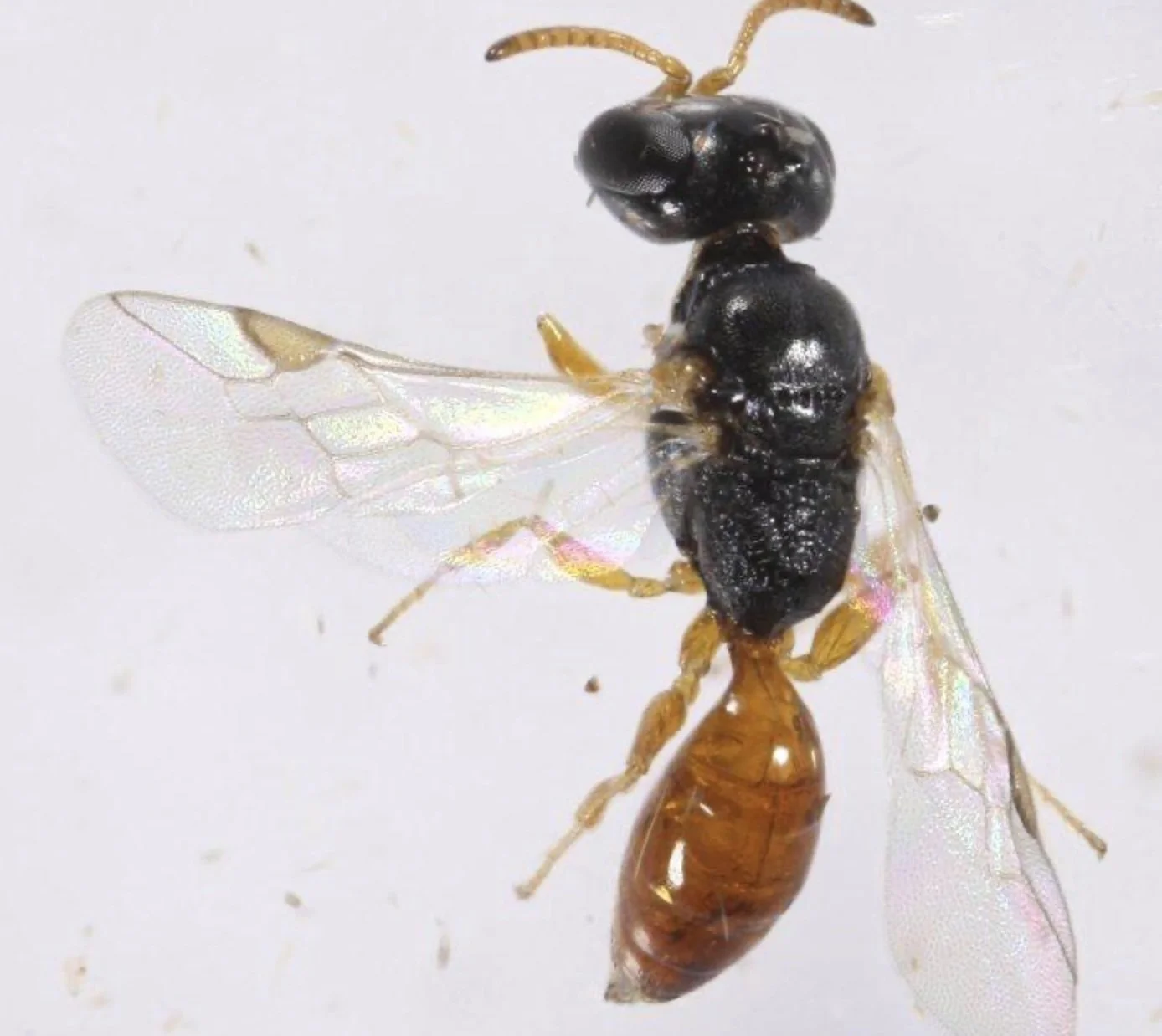
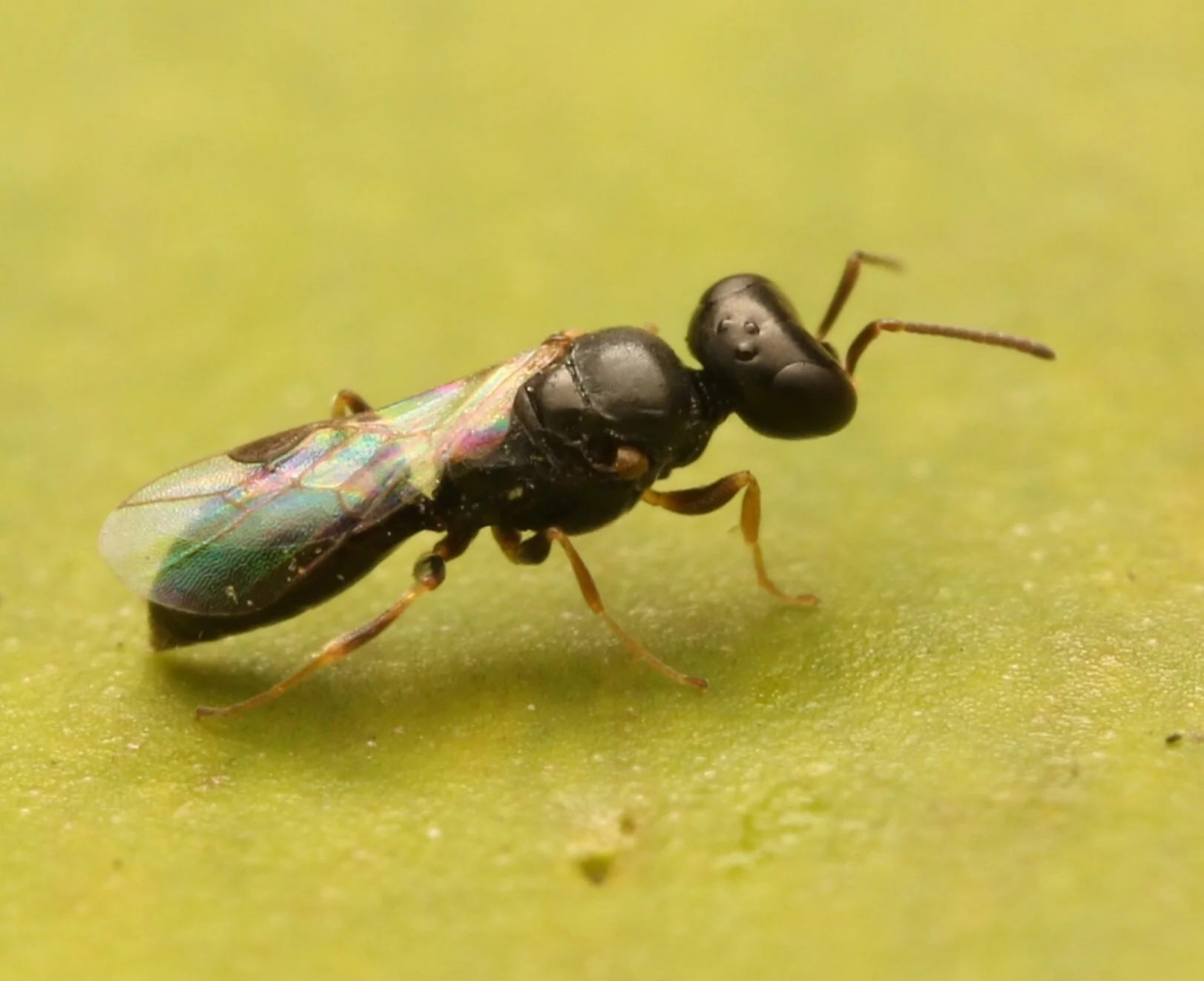
Found inside house, at window, 8/6/24. Collected ... specimen ID 2406A.
Perhaps it came in with sticks we collected for firewood. After taking these few shots, I euthanized & preserved her (dry) for detailed examination.
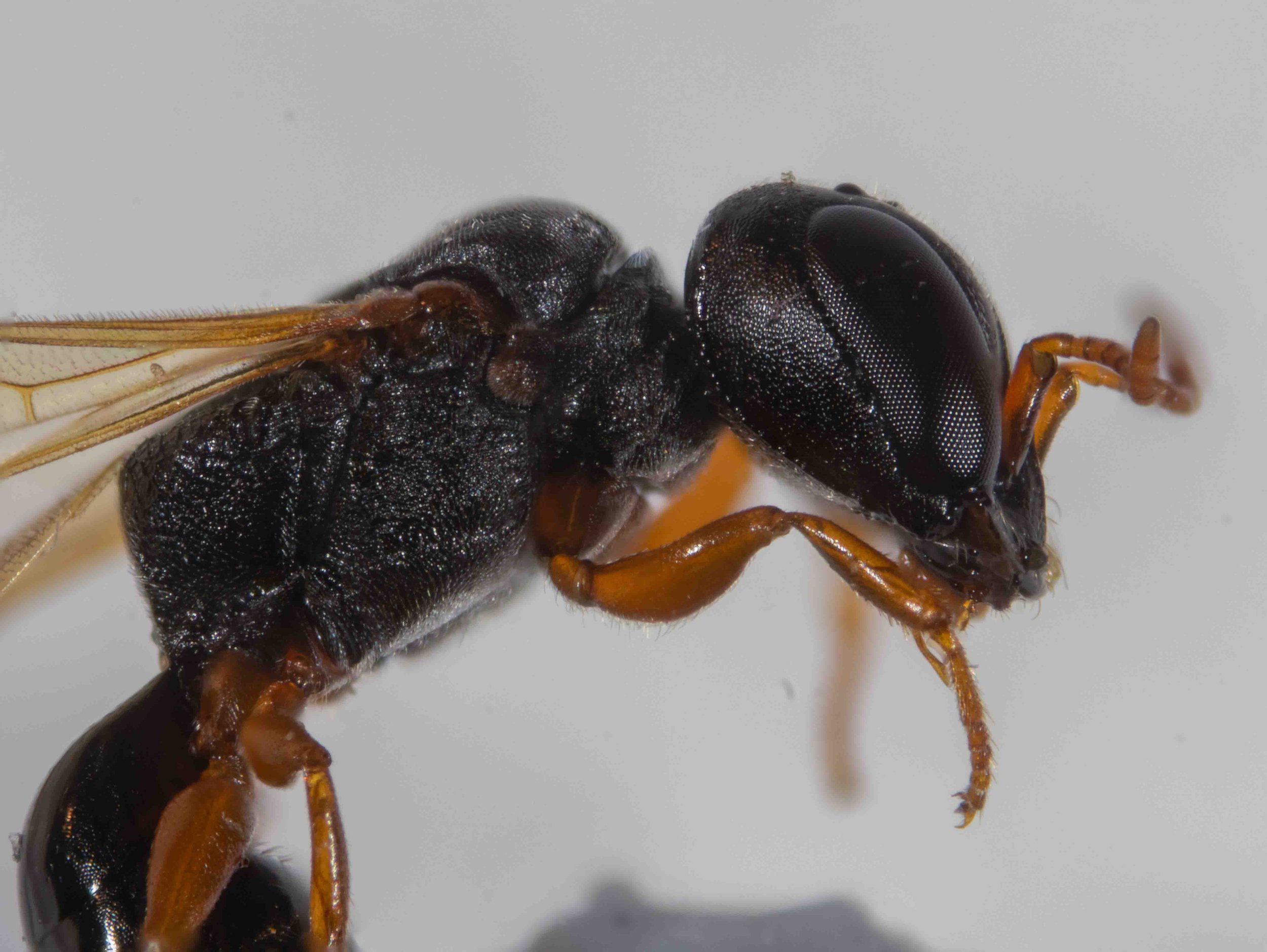
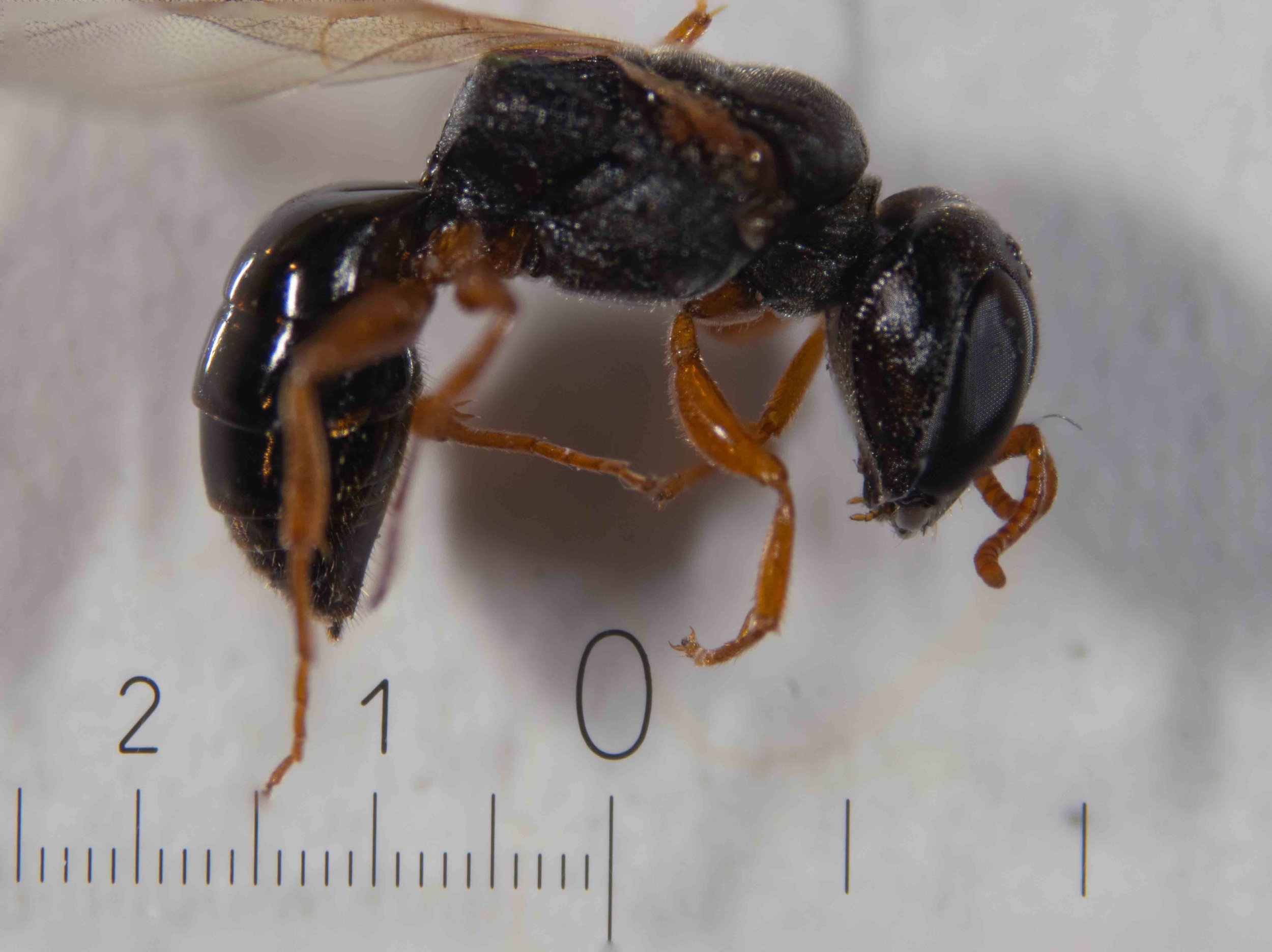
Less than 5mm long, and with a cuboidal head.
overall head+body length ~ 4.5mm
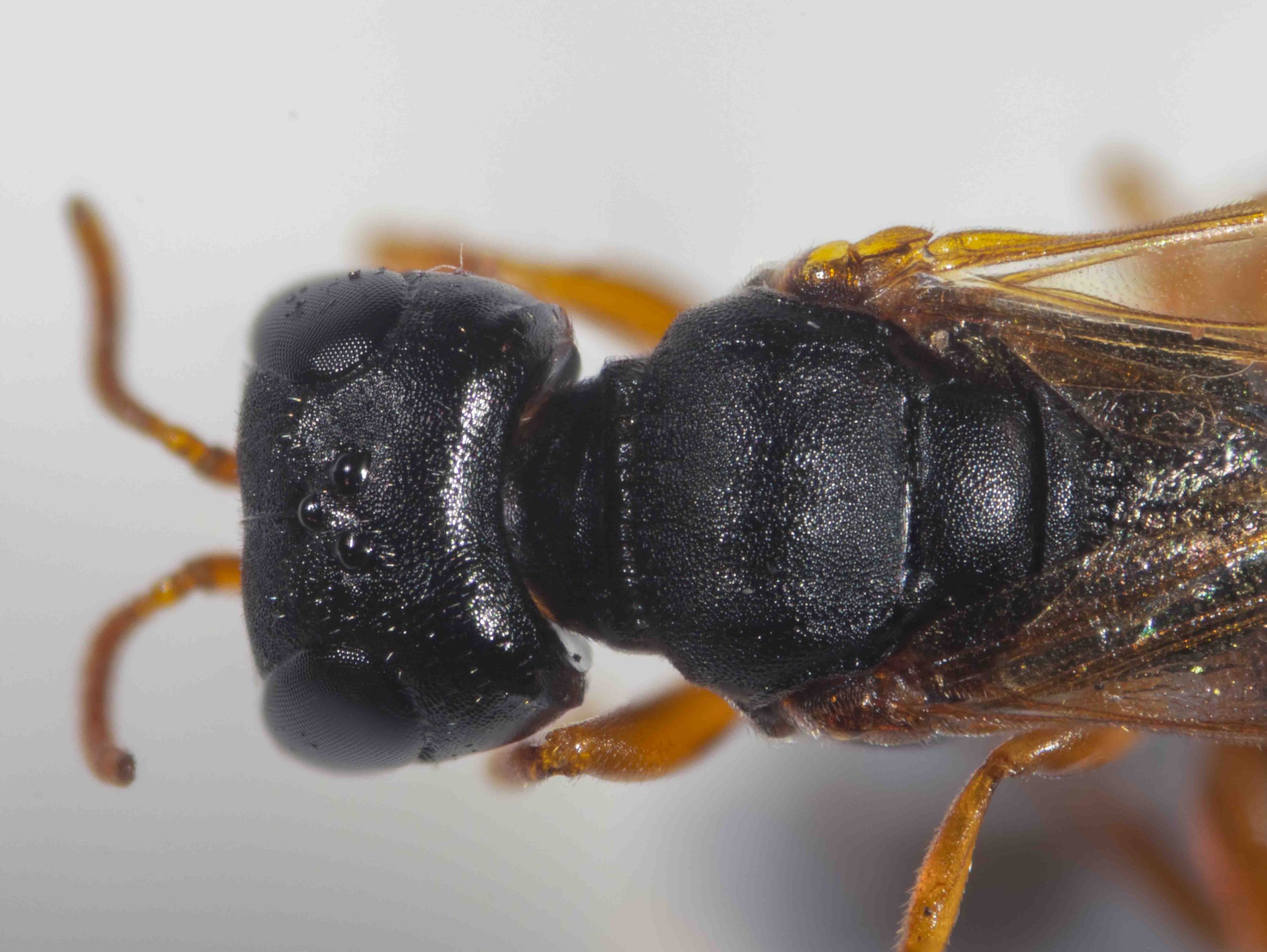
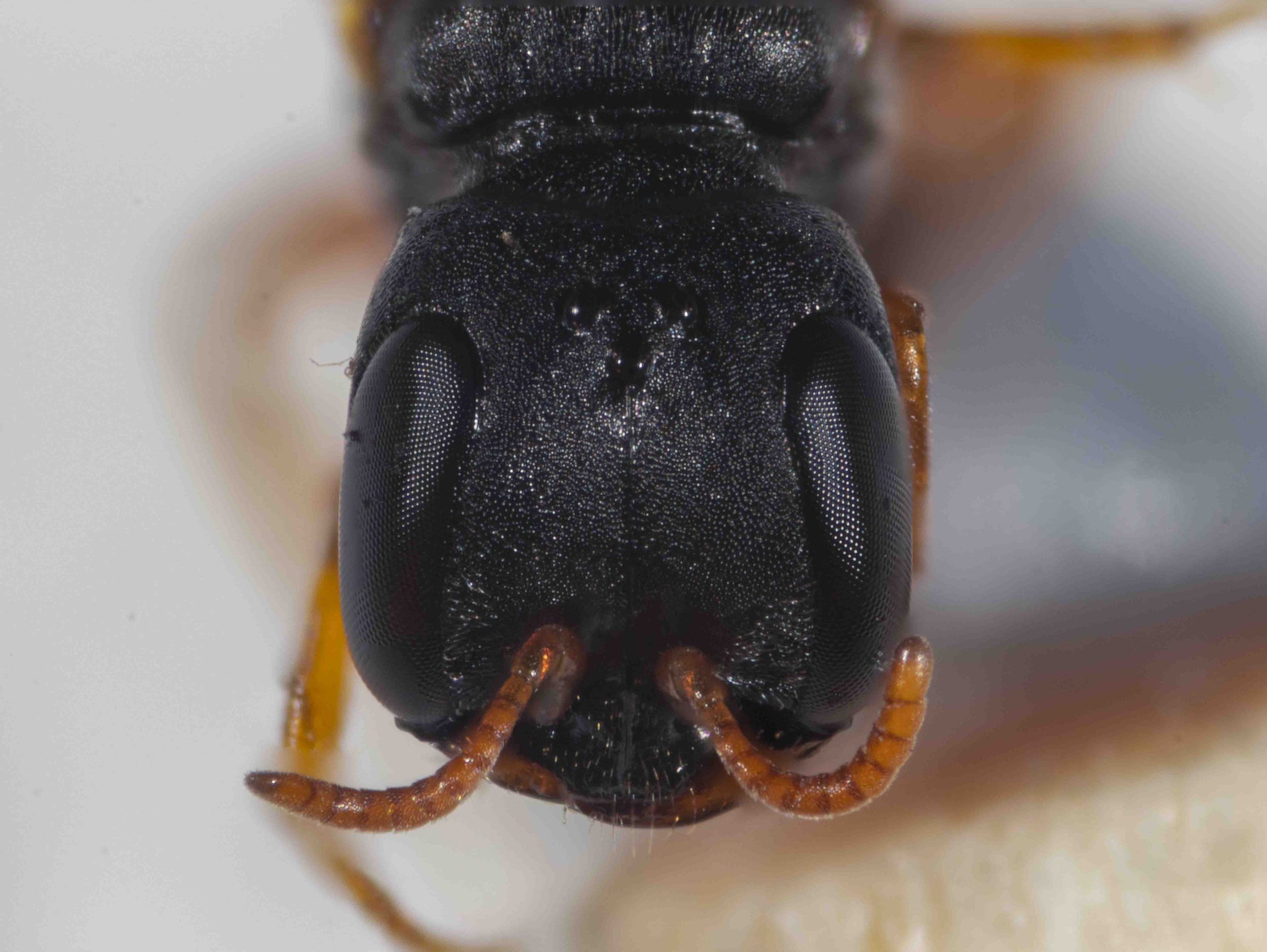
head rectangular in dorsal view
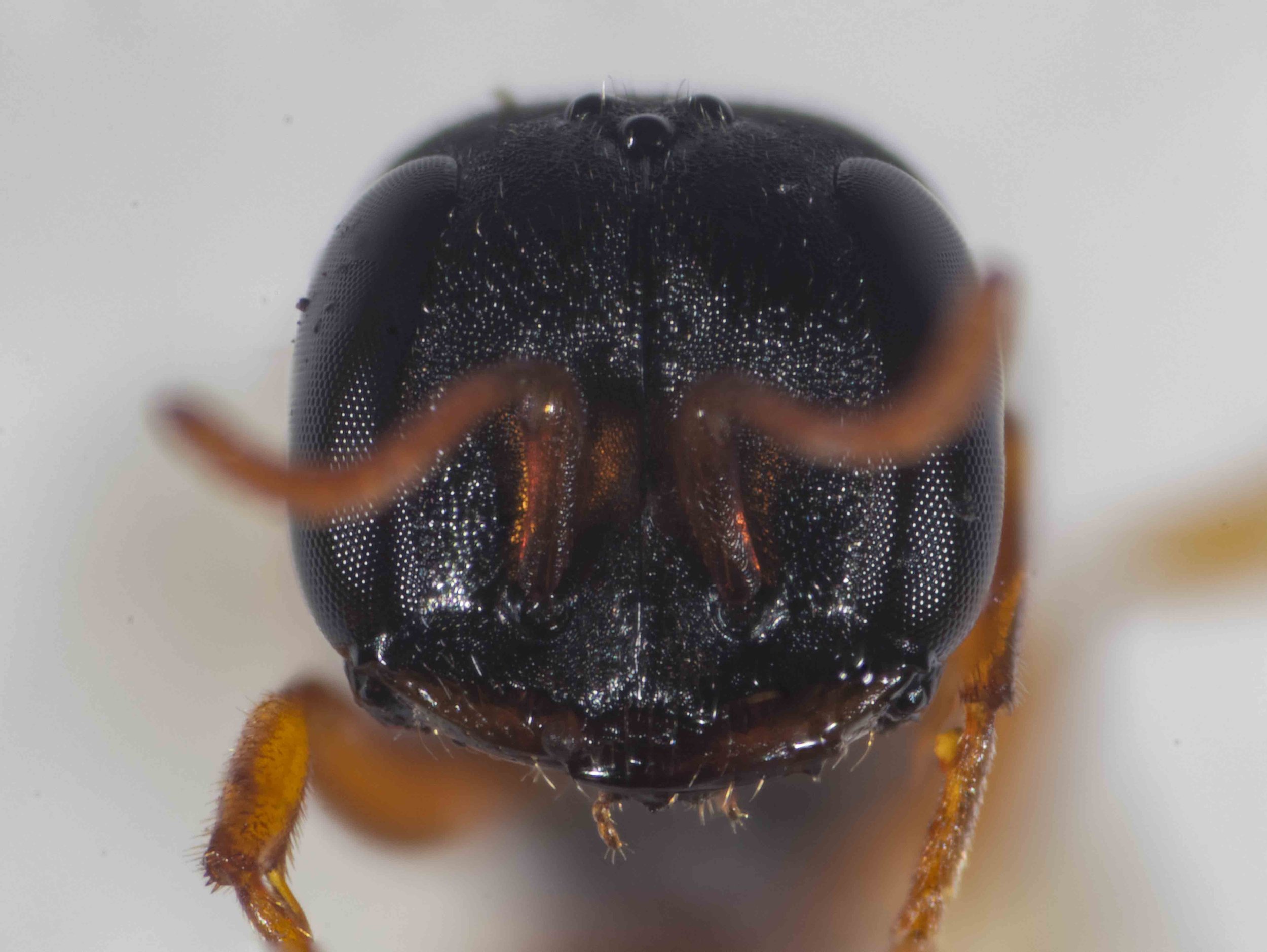
clypeus very short
eyes widely separated and near parallel
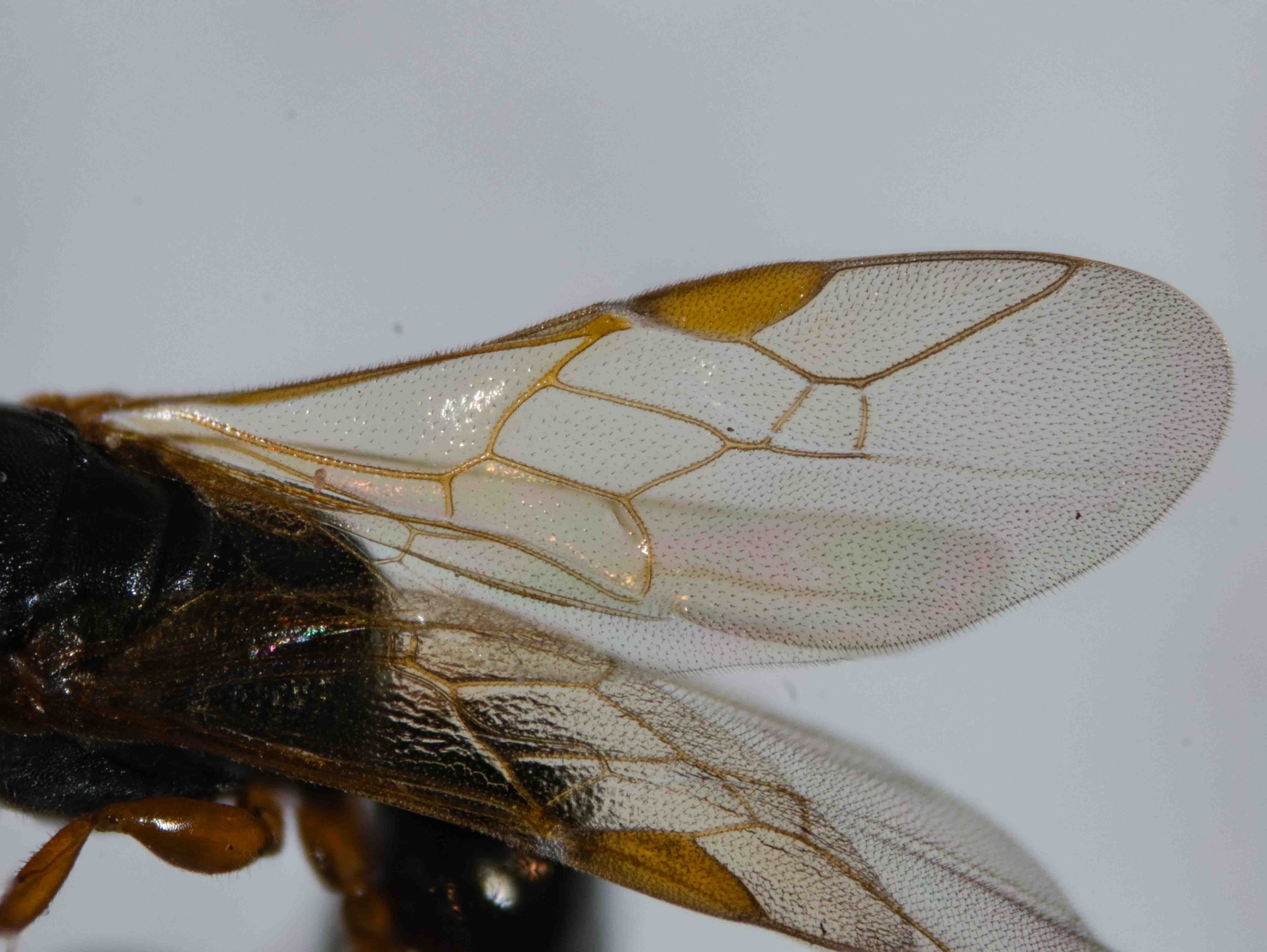
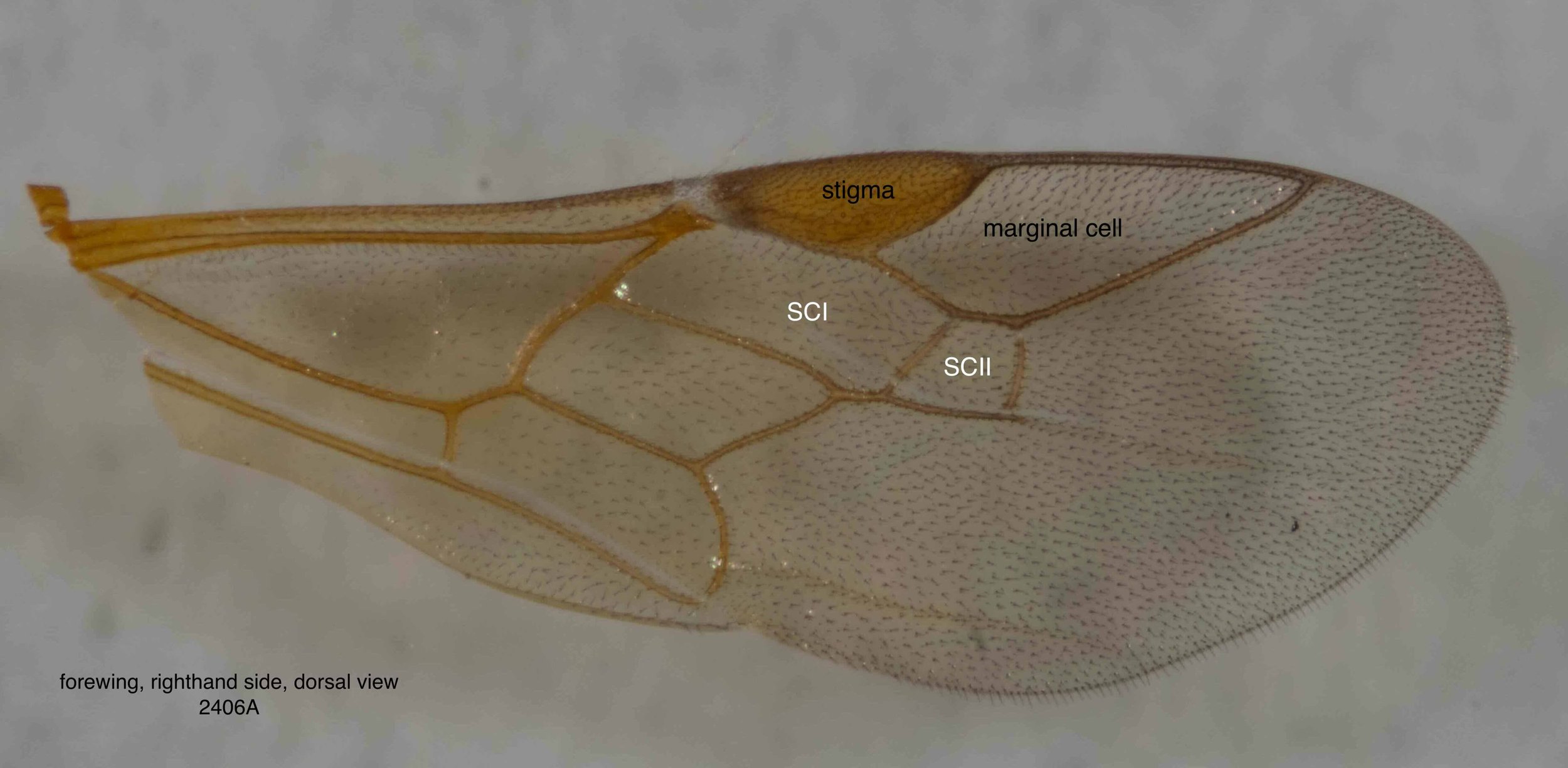
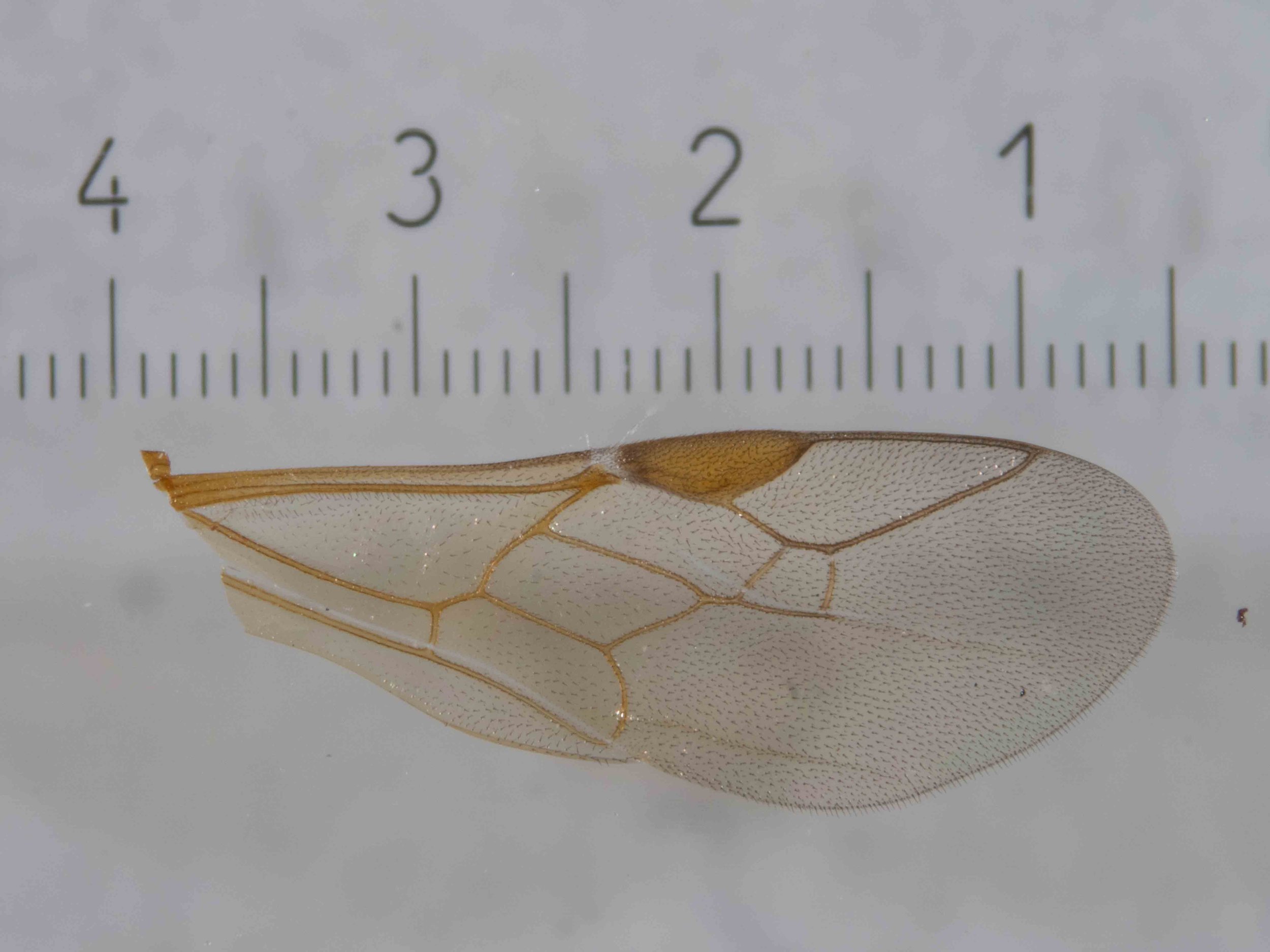
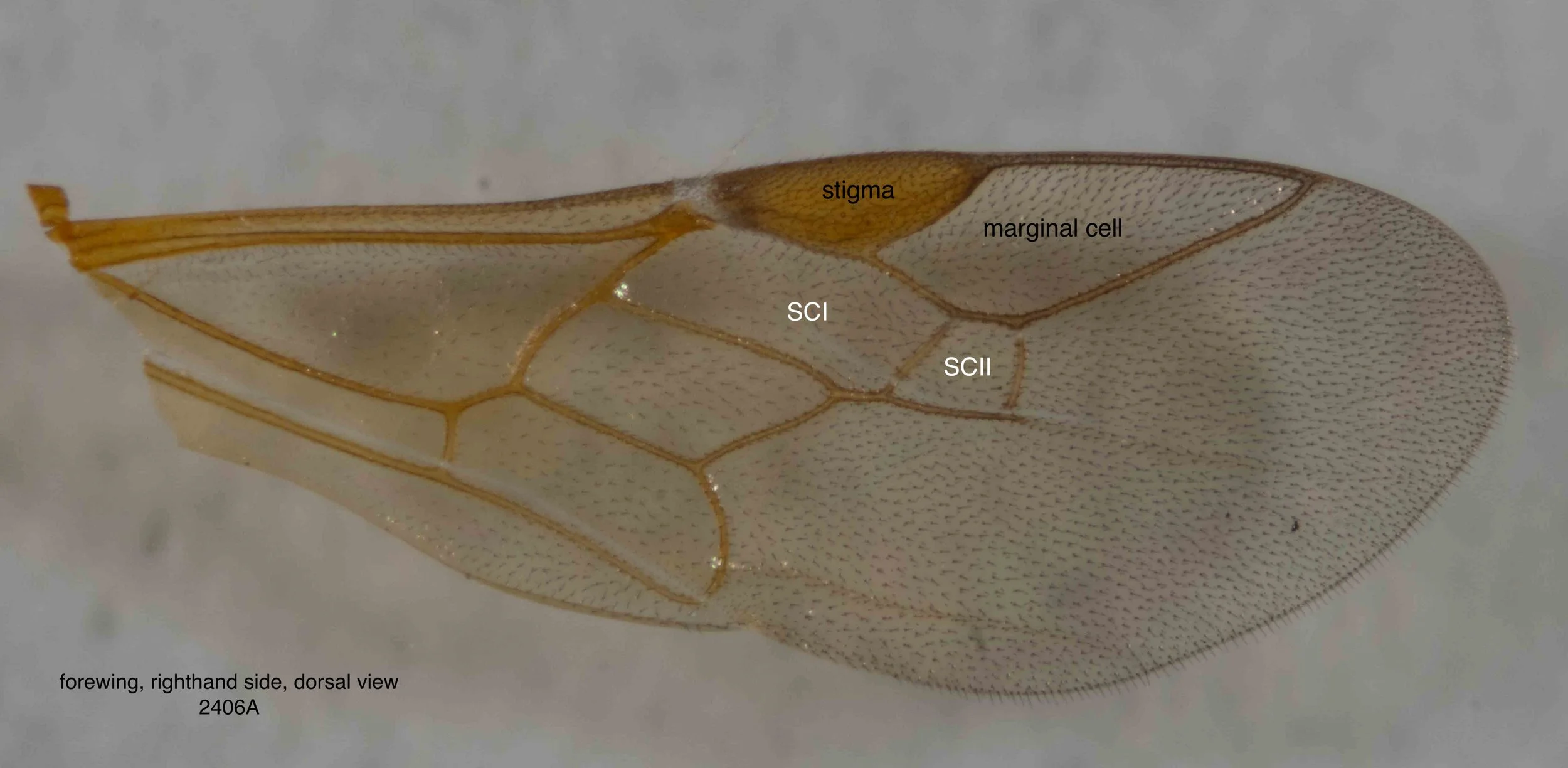
forewing with 2 submarginal cells
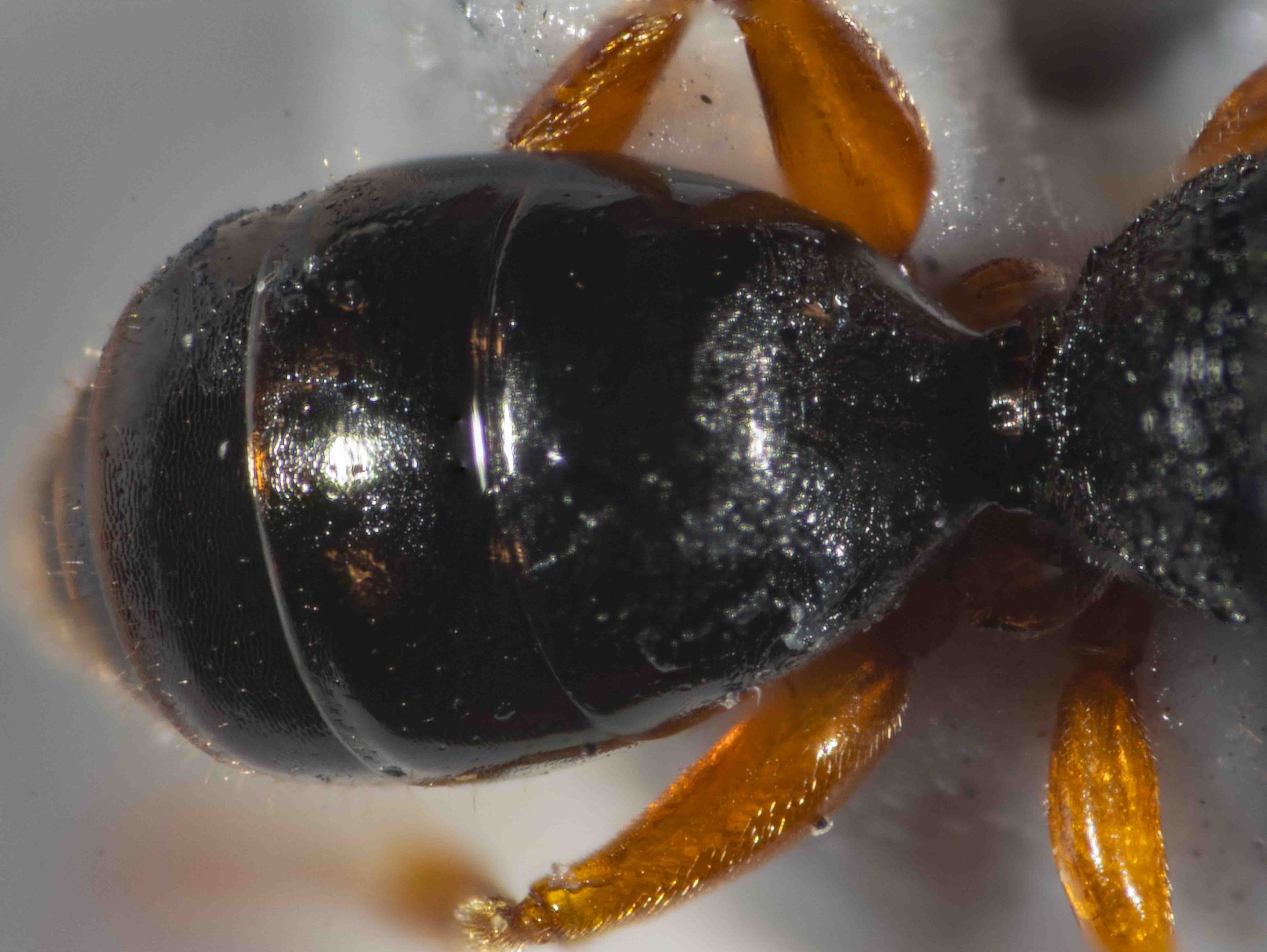
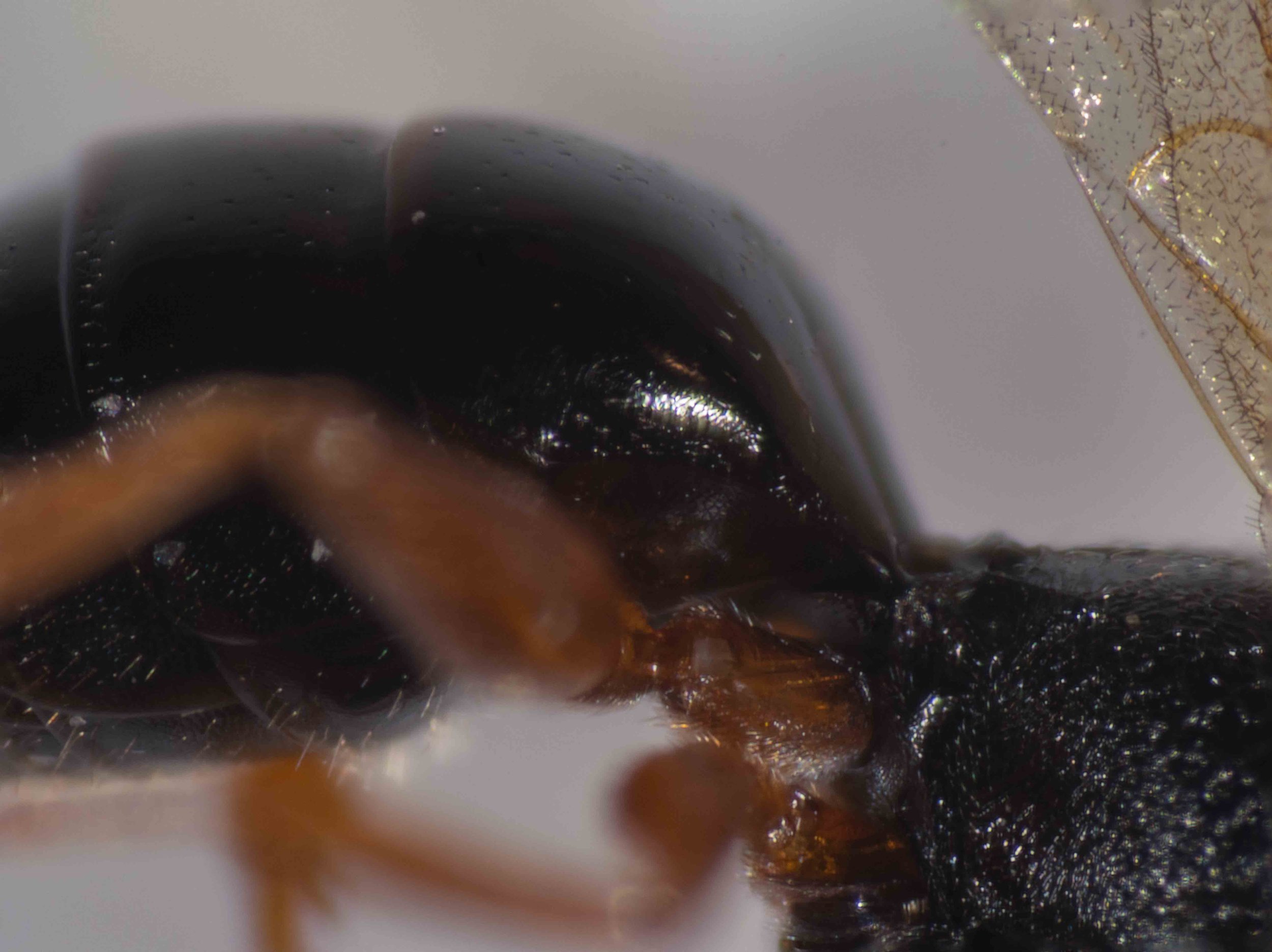
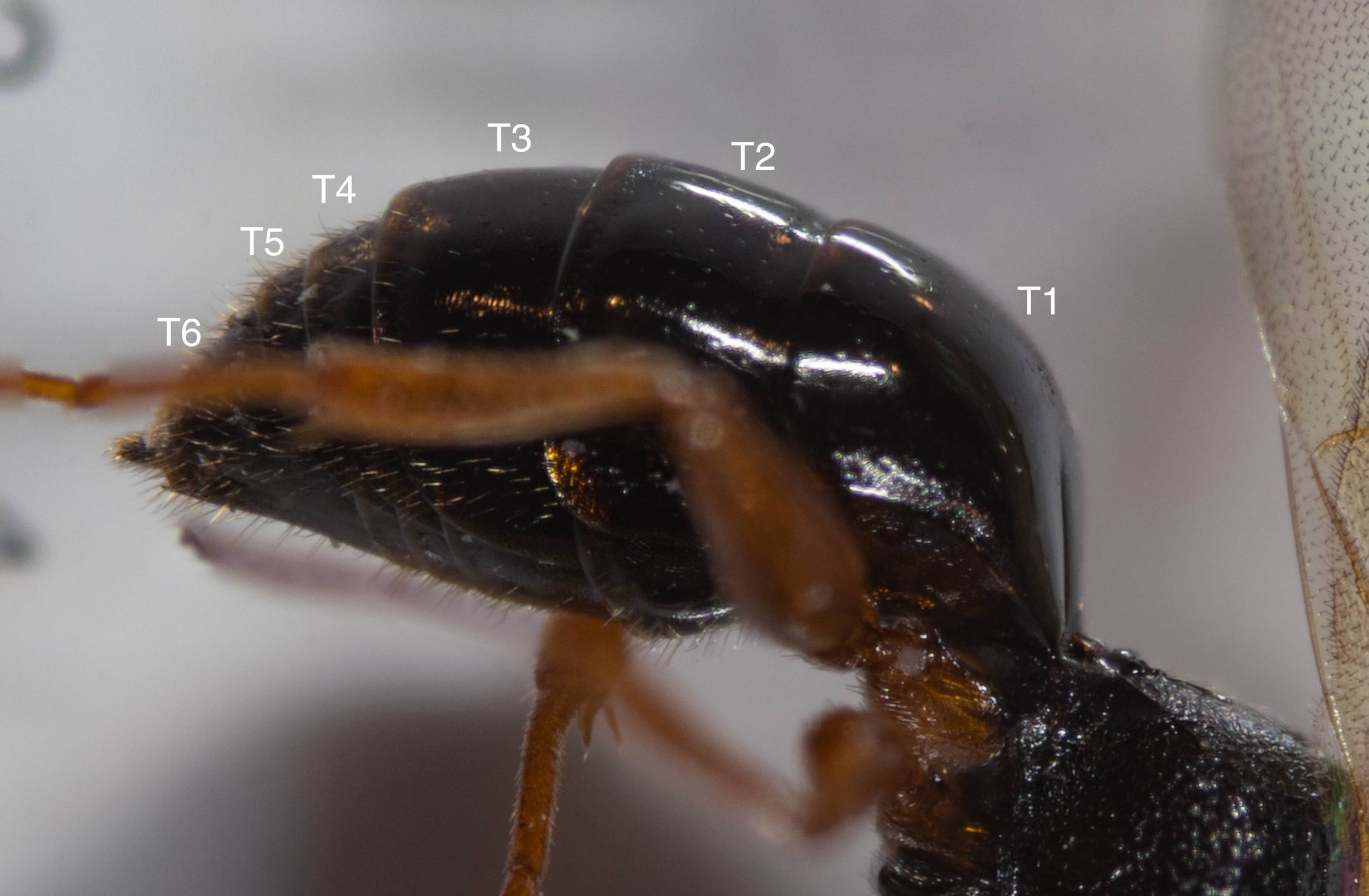
gaster sessile
(dorsal view)
gaster sessile
(lateral view)
eyes slightly convergent above; paraocular sulcus not evident along inner margins of eyes
eyes broadly separated, slightly convergent above; paraocular sulcus not evident along inner margins of eyes
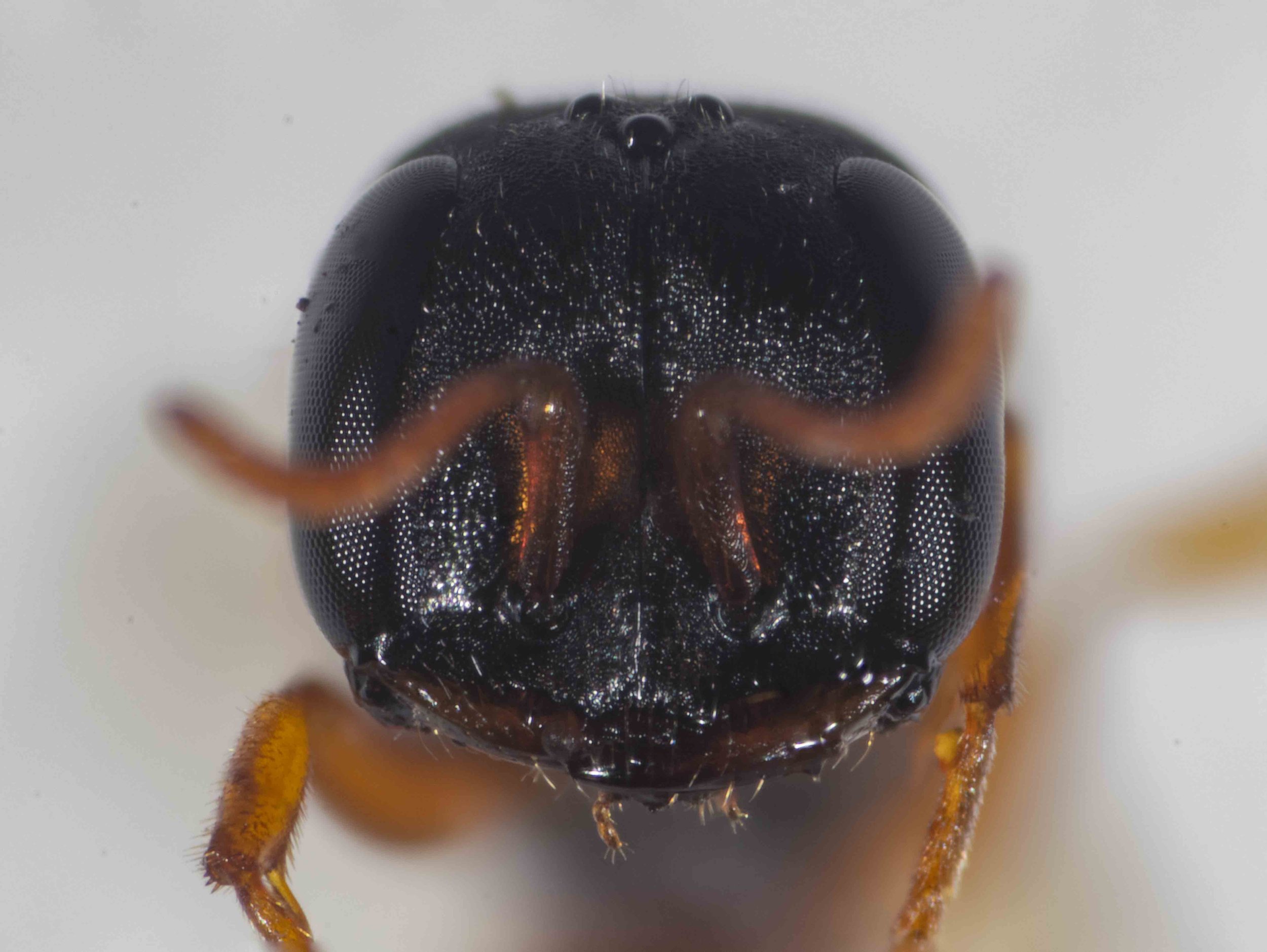
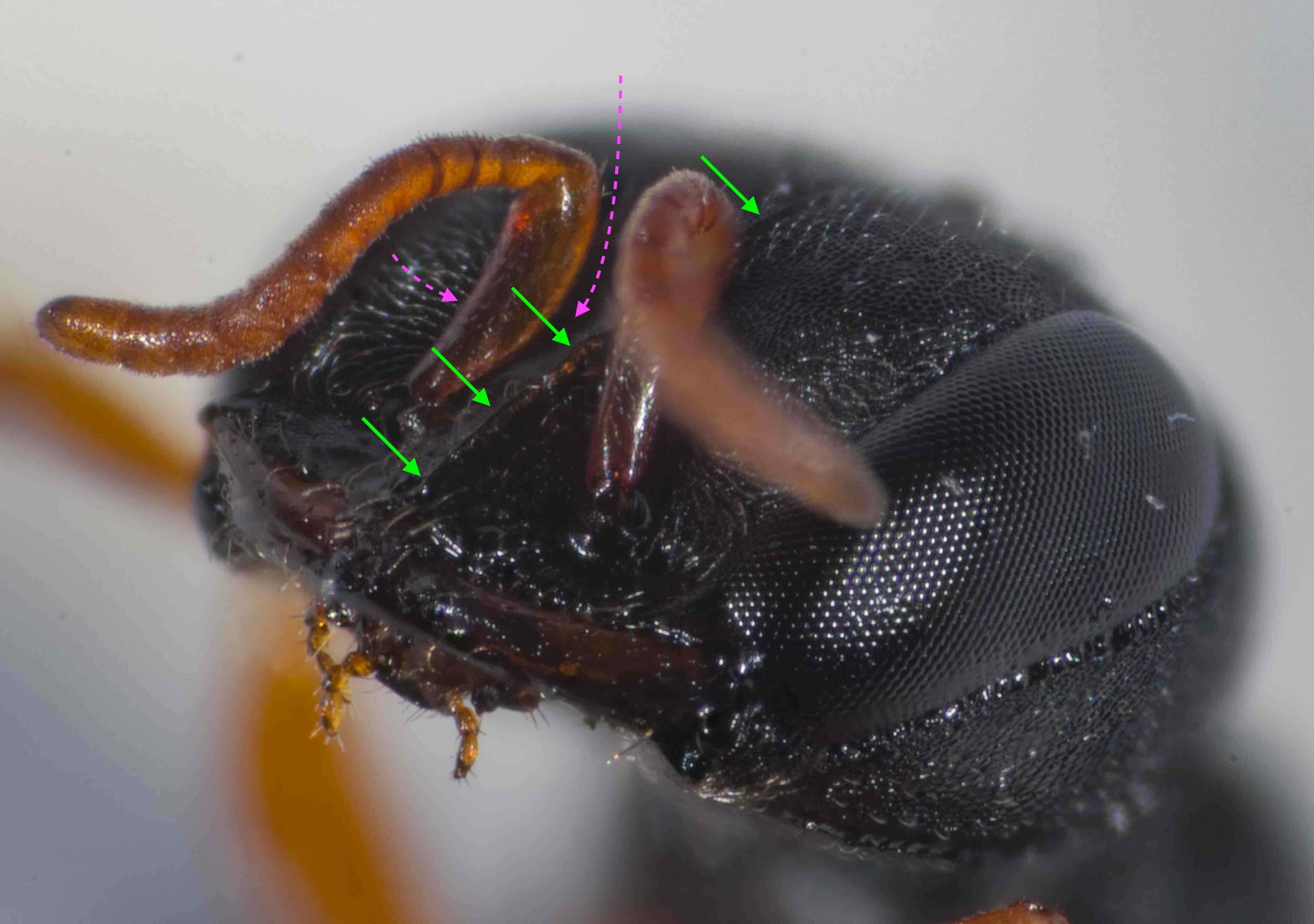
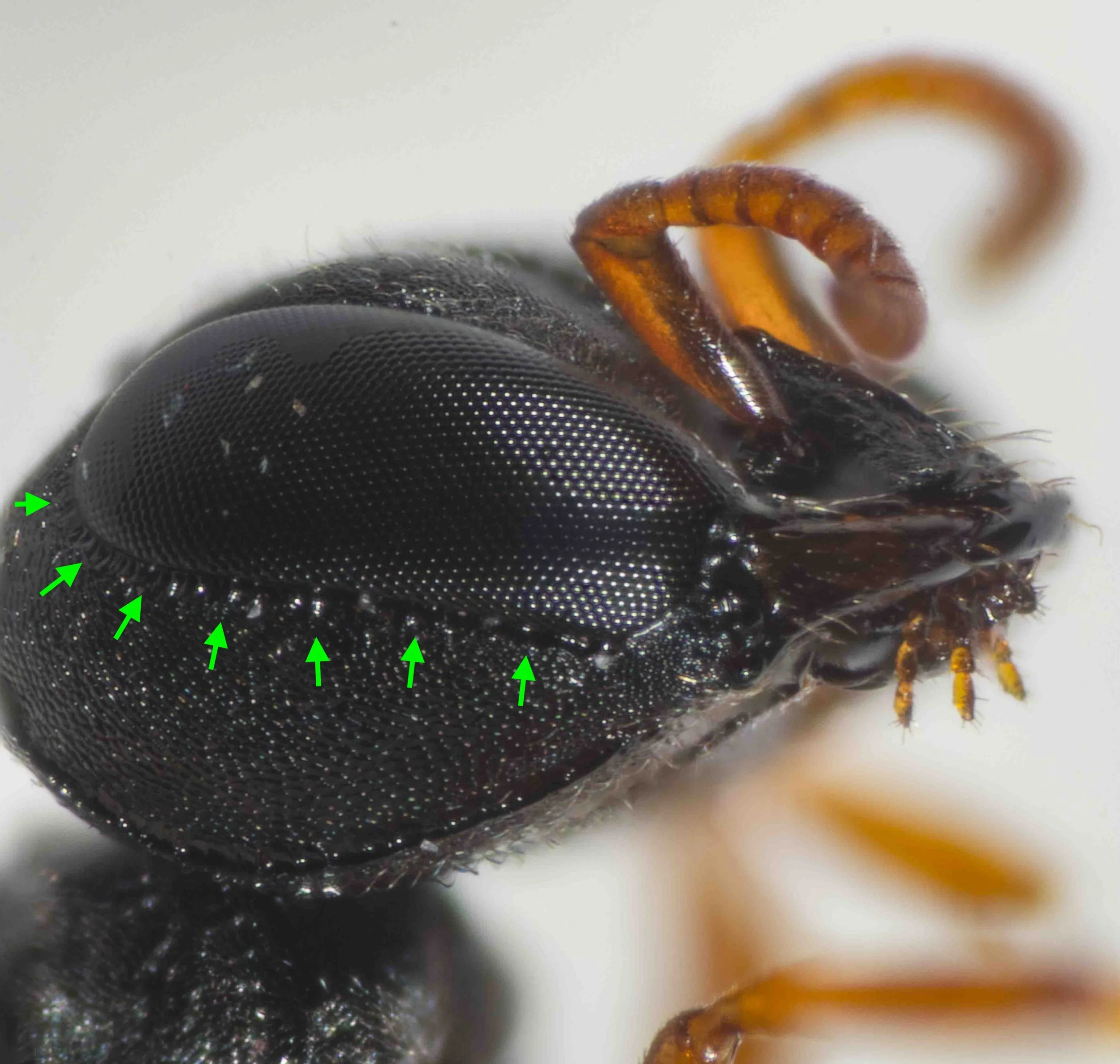
- pitted paraocular sulcus (arrows) along outer edge of eye
- palpi short
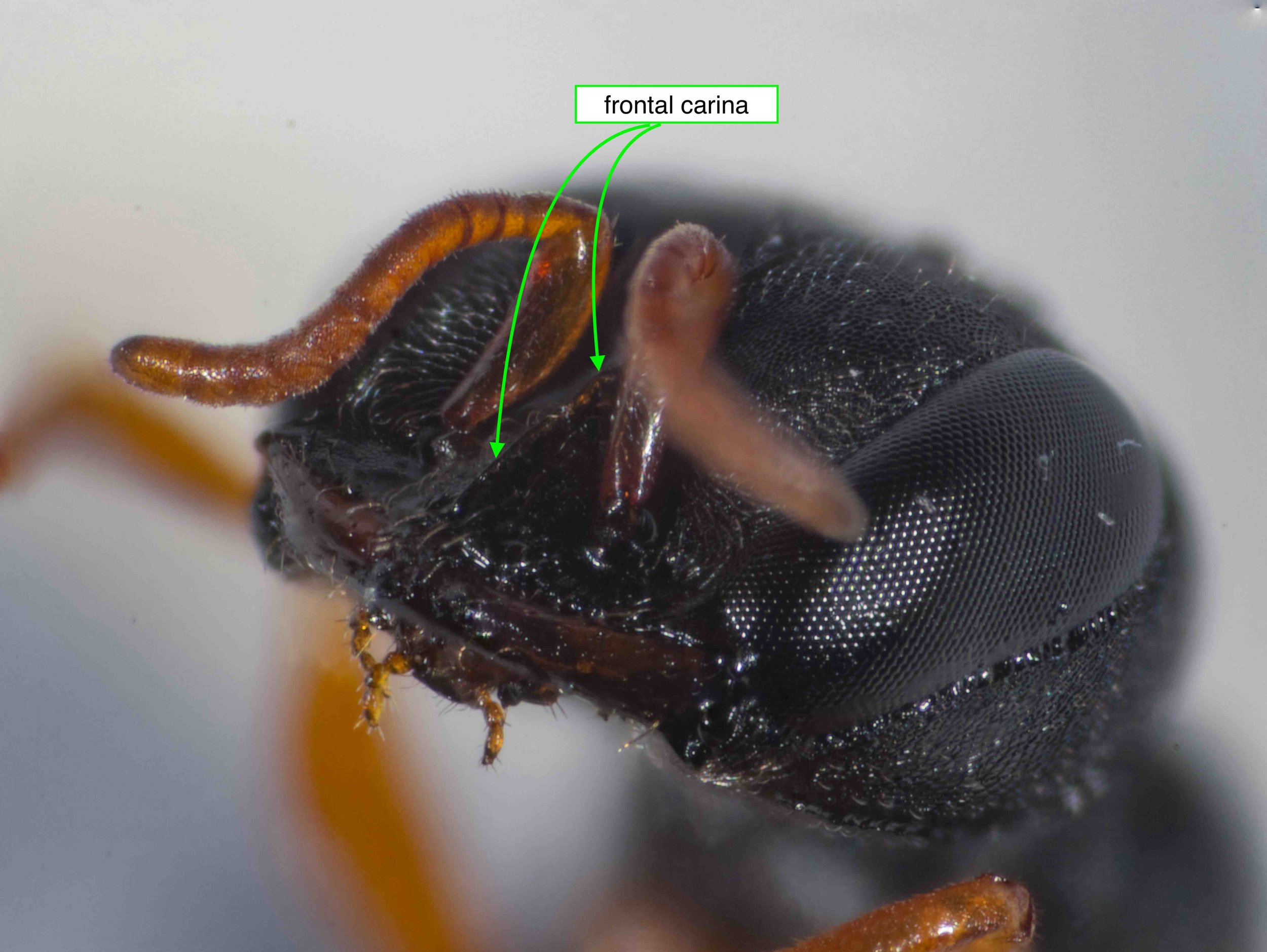
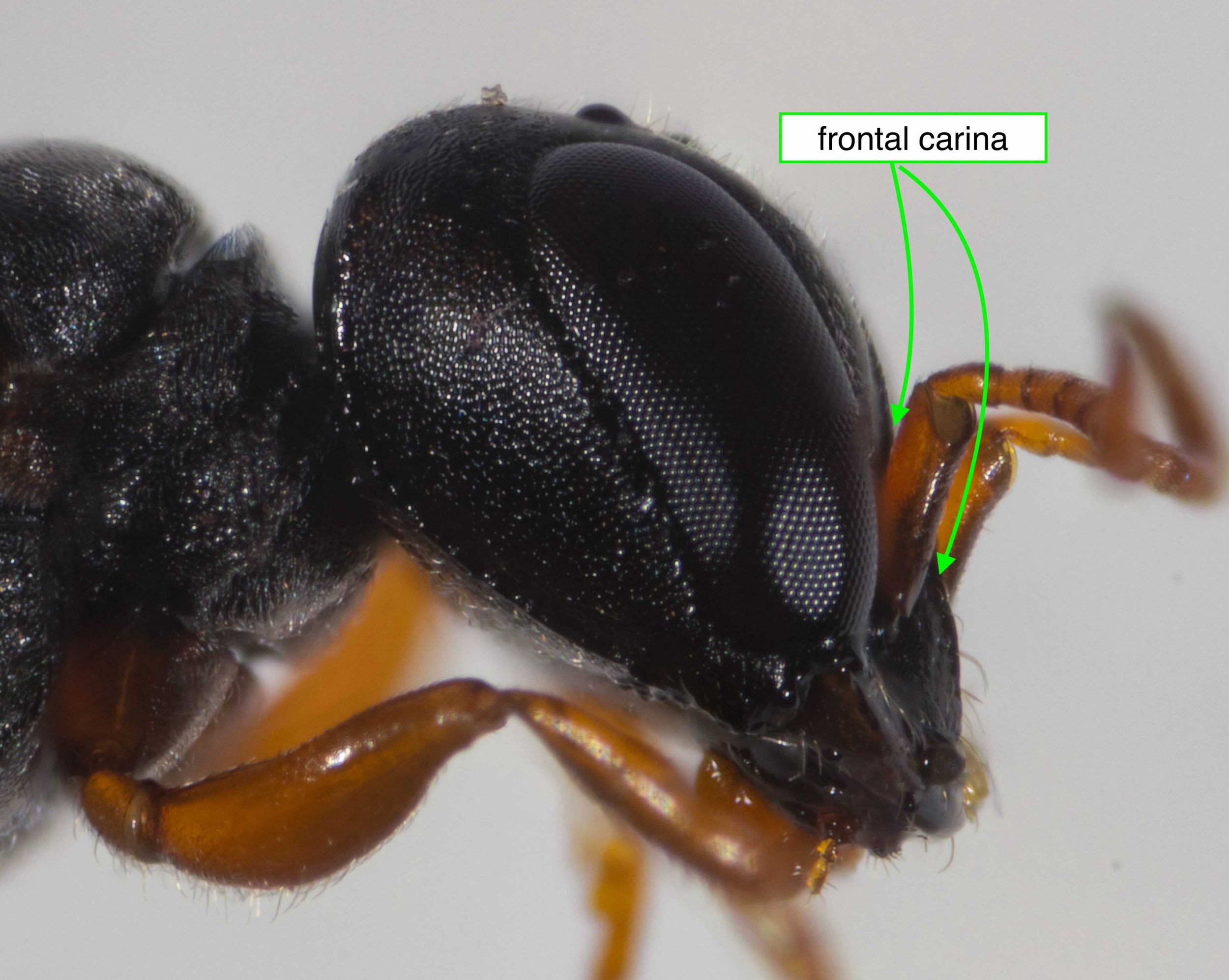
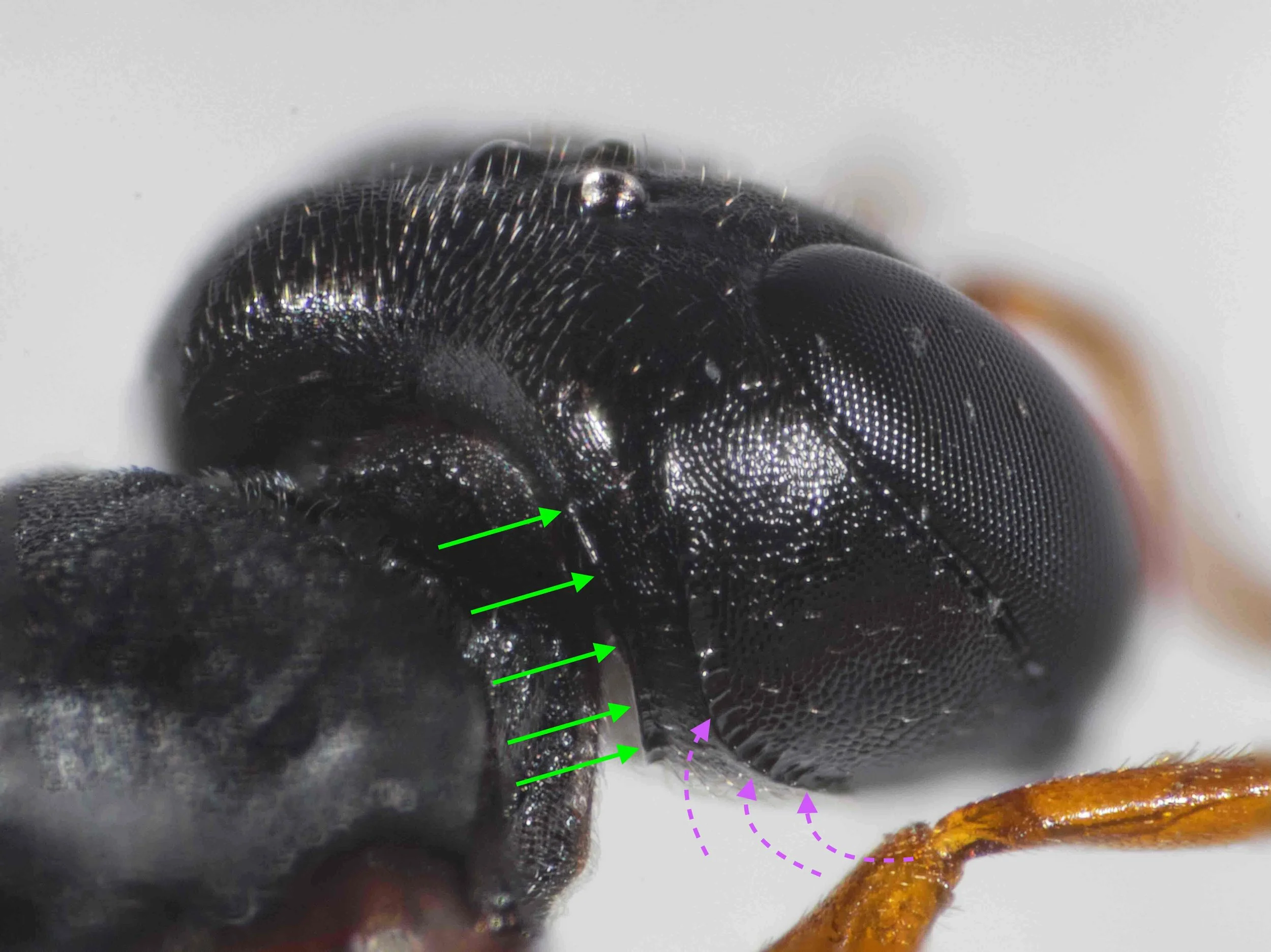
- obvious frontal carina (solid, green arrows) extending onto clypeus and raised in the interantennal space
- well-developed scapal basin (dashed, pink arrows)
- palpi short
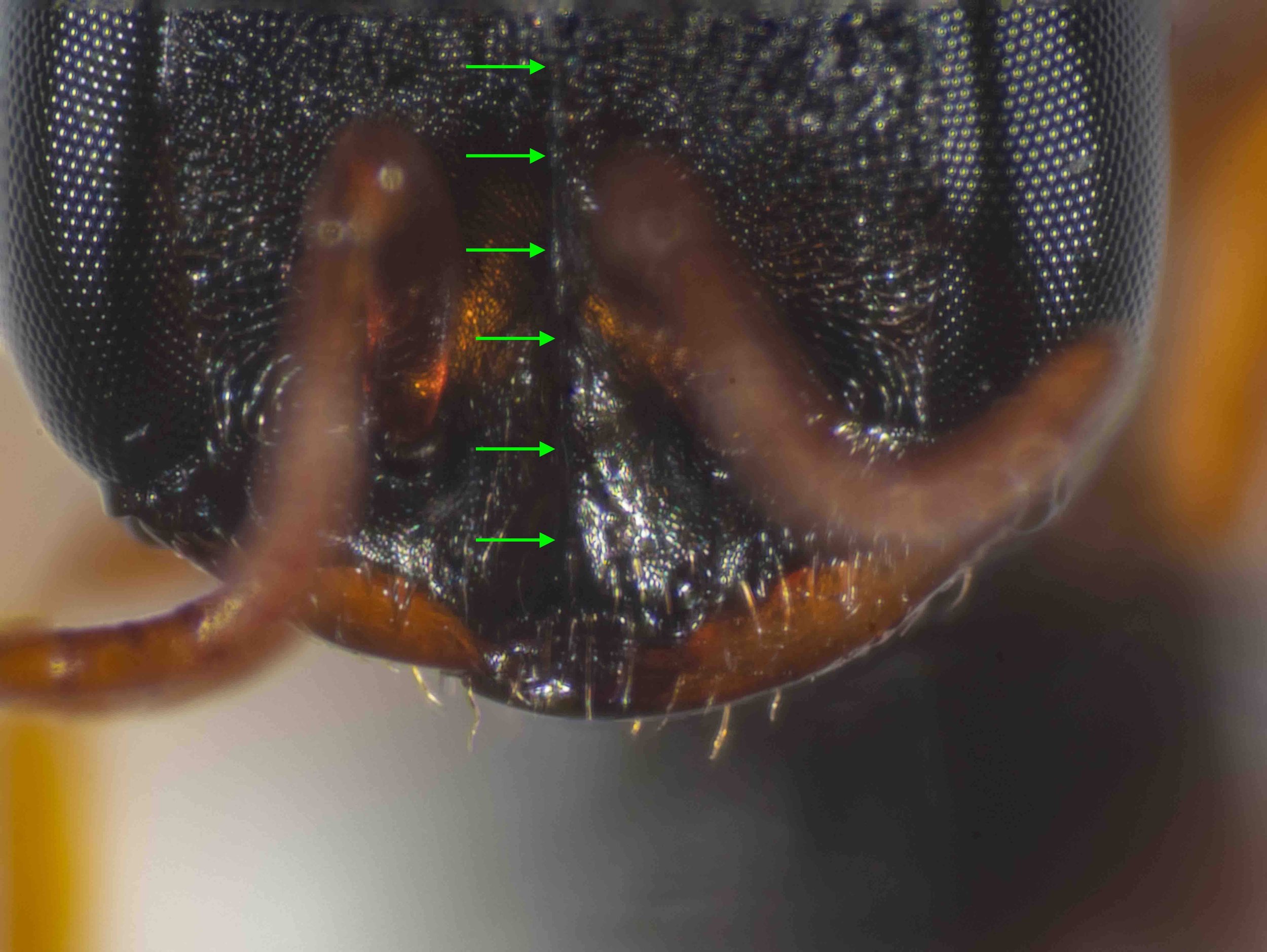
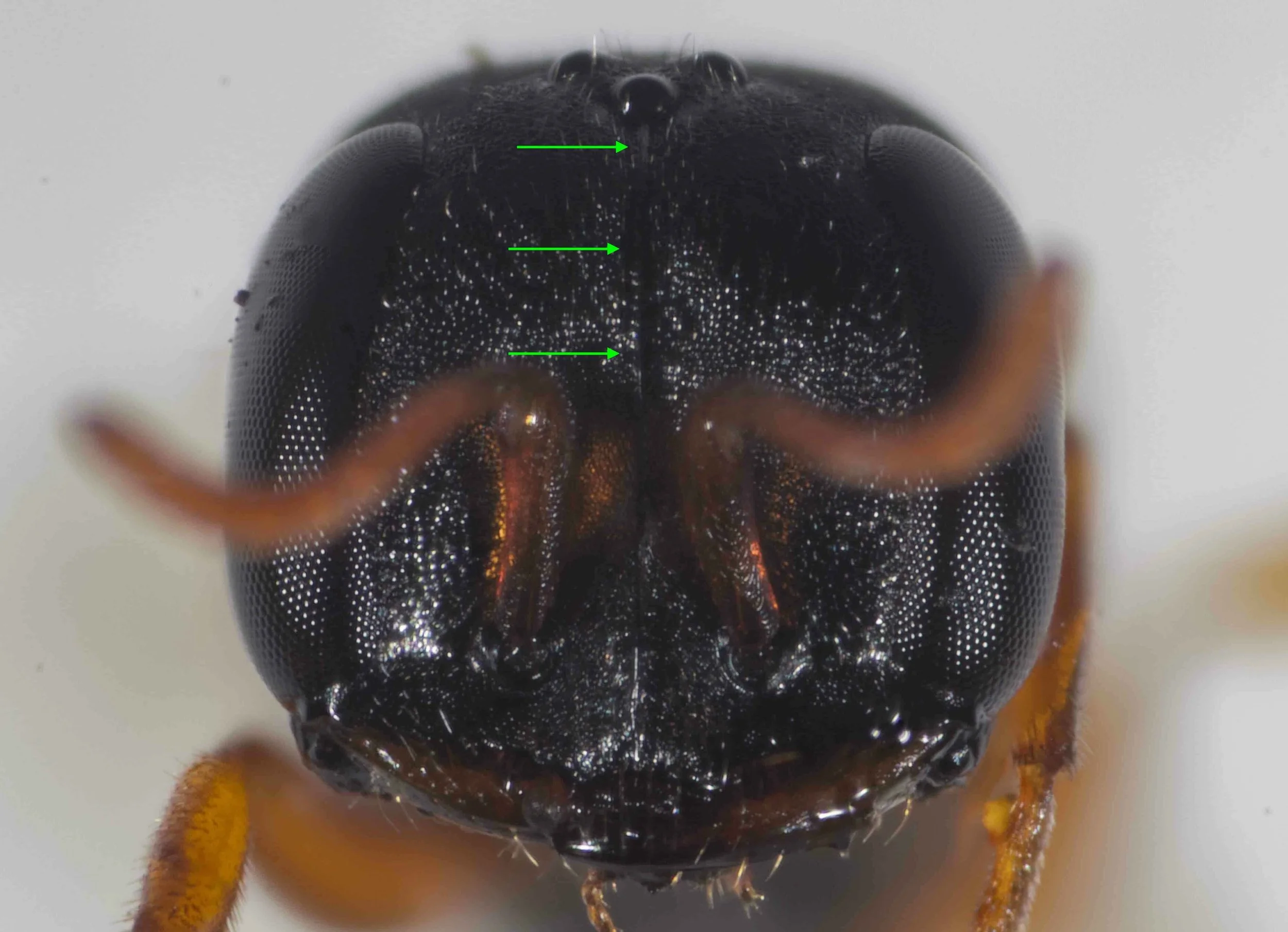
obvious frontal carina (arrows) extending onto clypeus
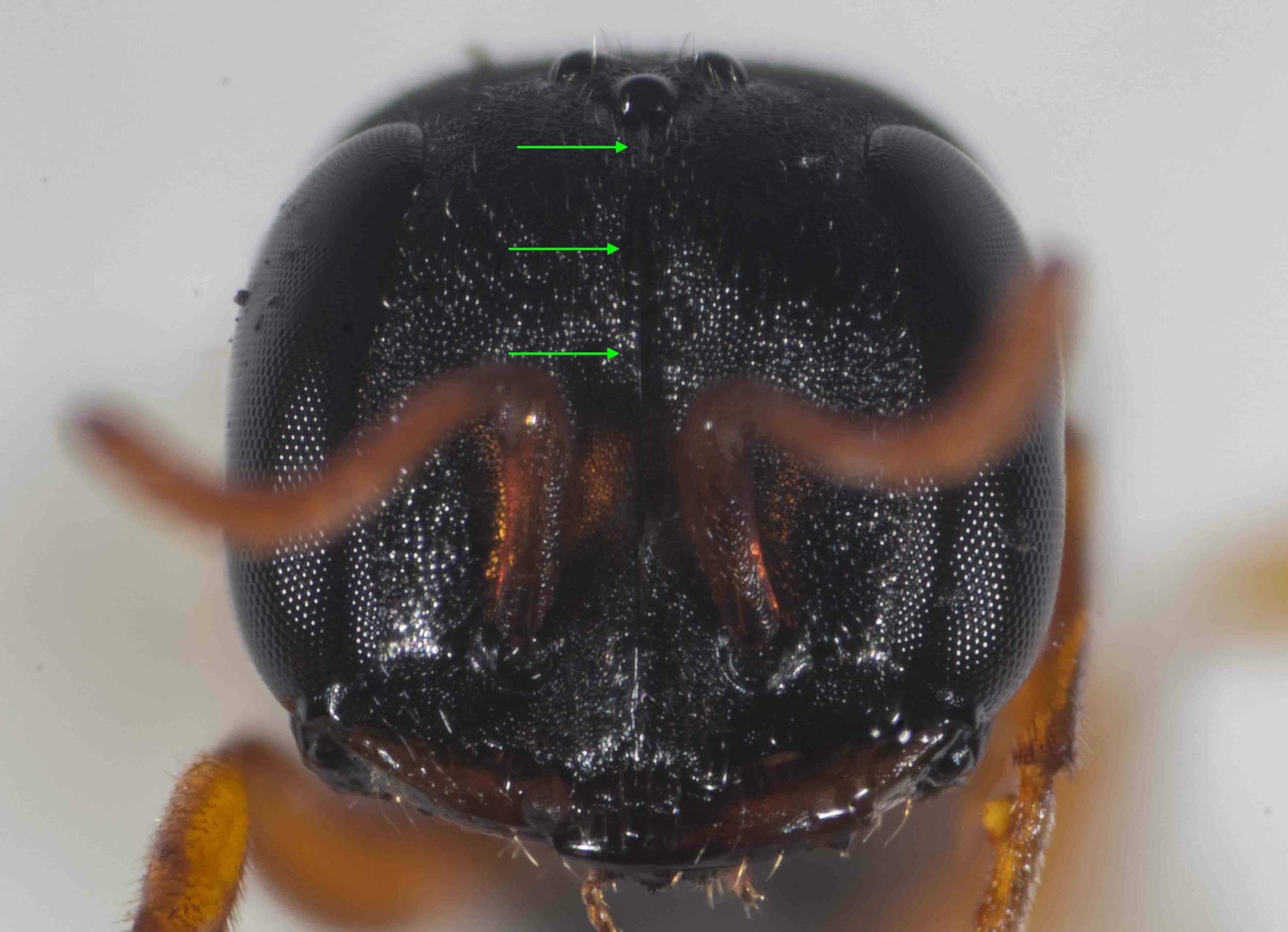
- frontal carina extends dorsally (arrows) to mid ocellus
- clypeus dark (not 'densely silver')
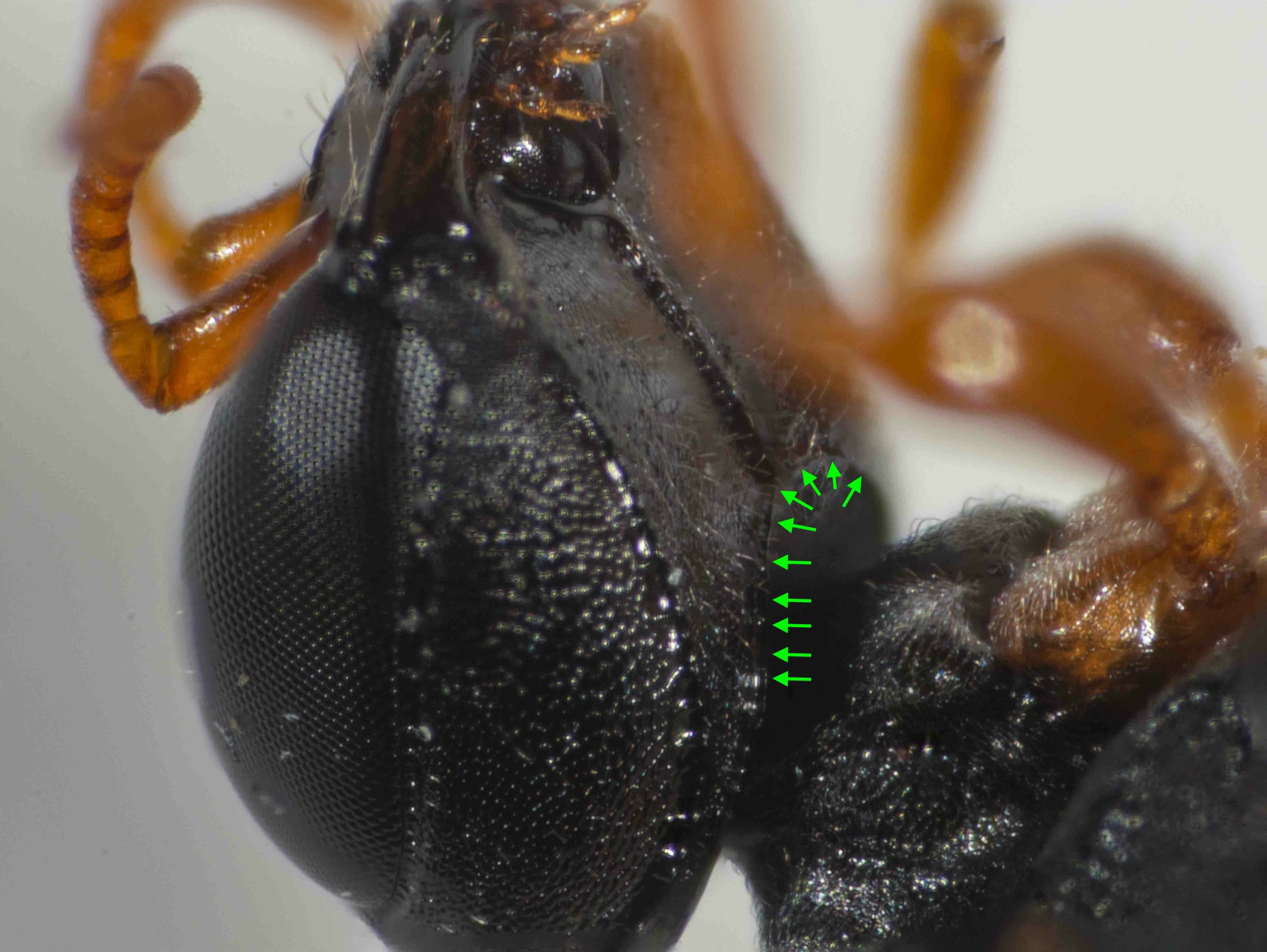
occipital carina present, and complete ventrally (arrows)
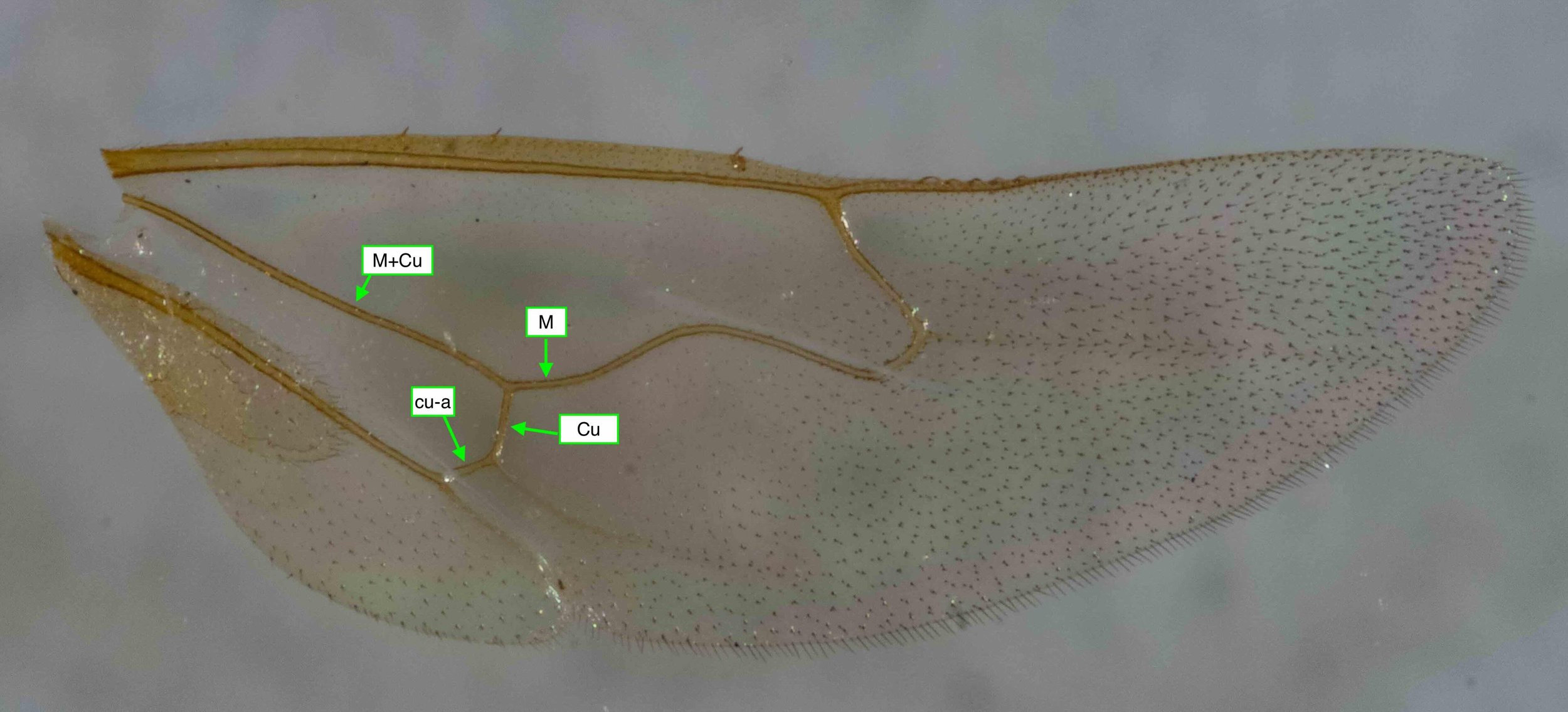
- hindwing media diverging before cu-a
- cu-a angled and appendiculate
(for nomenclature, see Fig. 5, Bohart & Menke 1976)
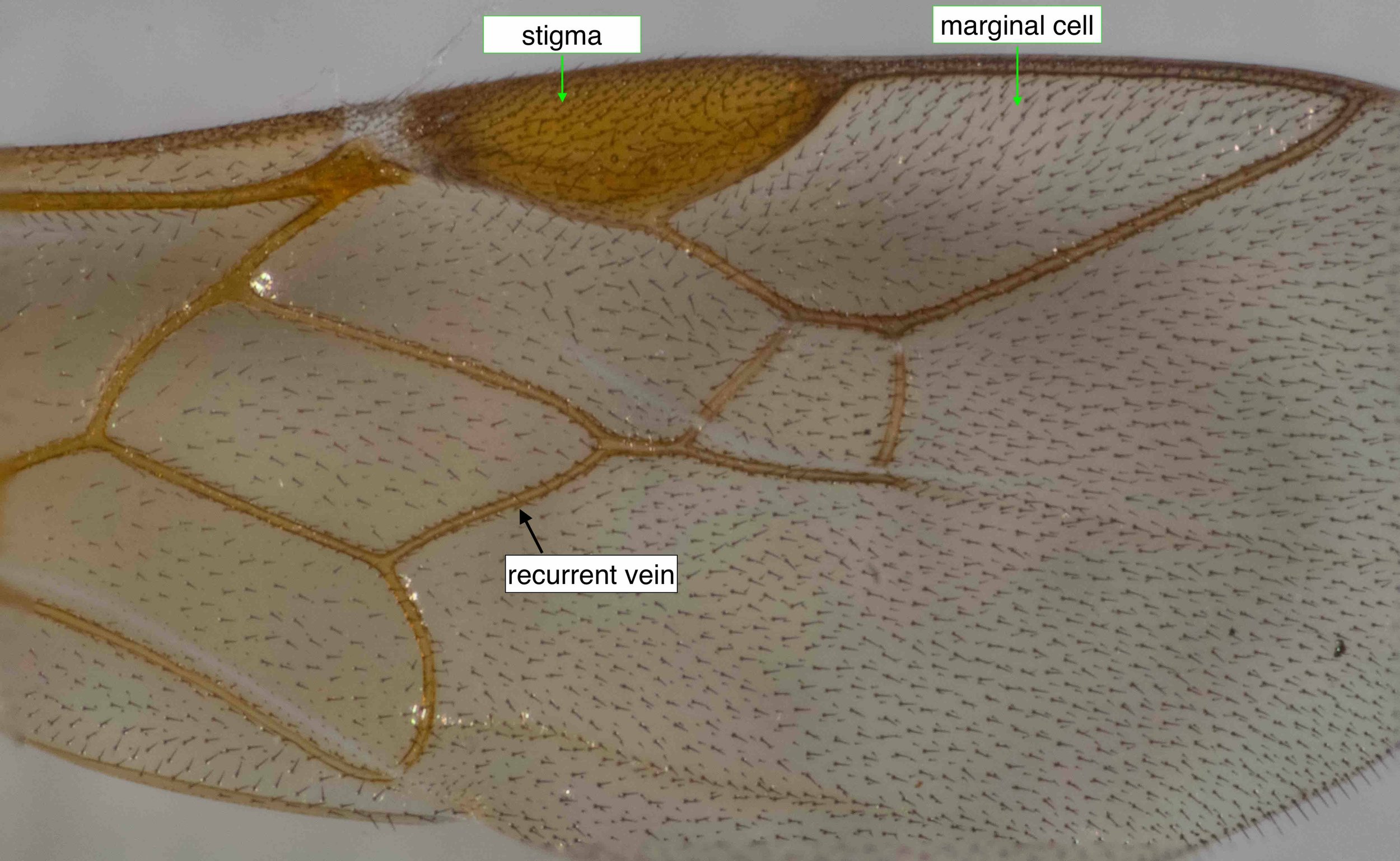
- forewing stigma large (i.e. 2-3x long as high) & completely covered by setae (i.e. micropore field not differentiated)
- forewing marginal cell also large
- single recurrent vein
key step 1
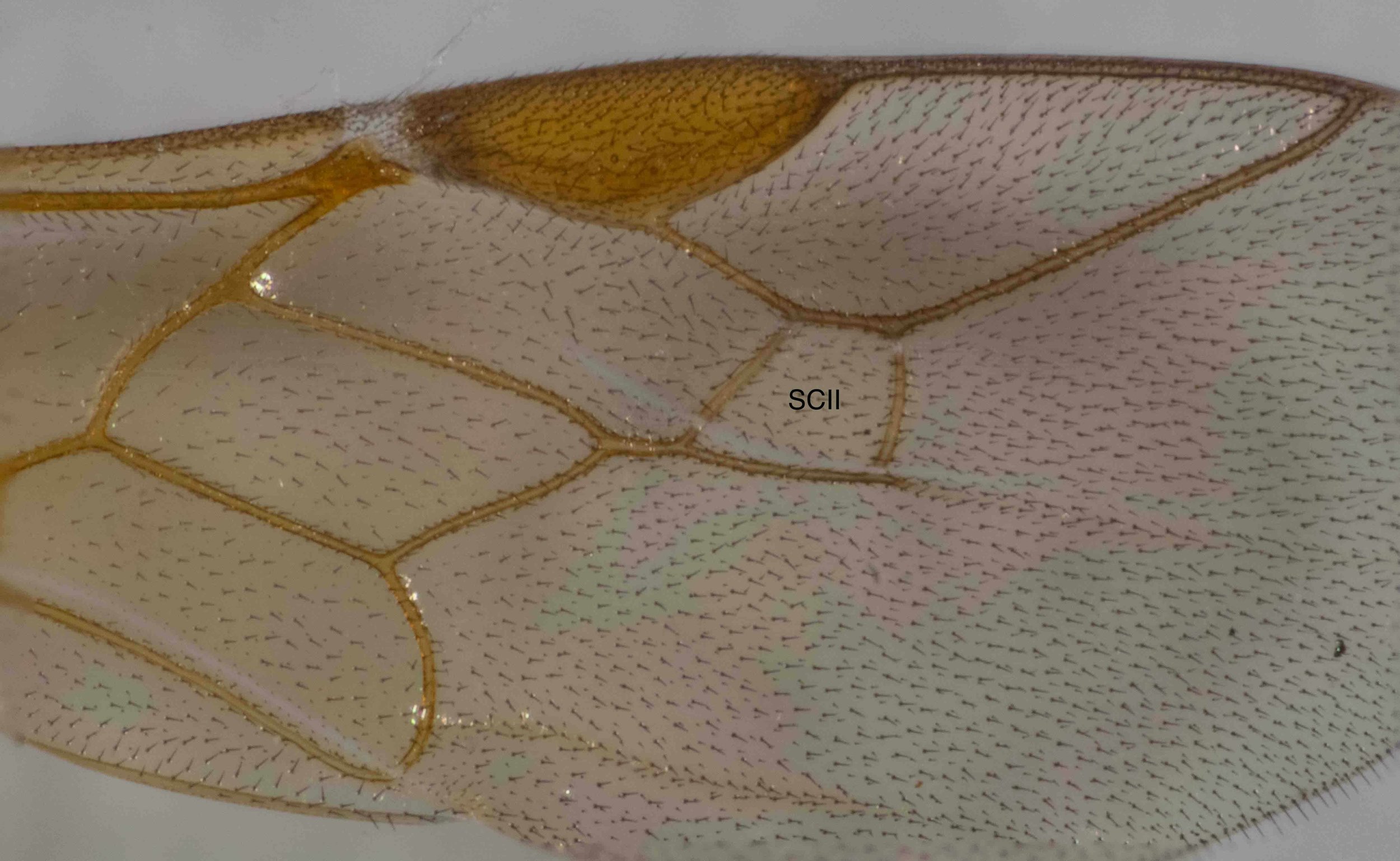
SCII of forewing is trapezoidal, not triangular
1. "Second submarginal cell trapezoidal or cubical, or if triangular, not distinctly stalked" –> 2
[excludes: A. queenslandensis]
key step 2
Head and mesosoma not strongly flattened; pronotum not elongated.
2. "Head globular to elongate, not at all flattened; pronotum transverse, not elongated and mesosoma not markedly compressed dorsoventrally" –> 4
[excludes: A. similus; A. platycephalus]
key step 4
Head and body entirely black/dark brown, including the clypeus and mesosoma (except the pronotal lobe), not marked with yellow, red-orange or cream. The antennae, mandibles, legs, tegula and pronotal lobe are orange-light brown.
4. "Body entirely black or dark brown, except occasionally tegula and/or pronotal lobe lighter" –> 15
[excludes: A. ruficollis; A. kakaduensis; A. tricolor; A. flavifrons; A. hursti; A. magneticus; A. arator; A. sulcatus; A. deserticolus; A. steindachneri; A. kohlii]
key step 15
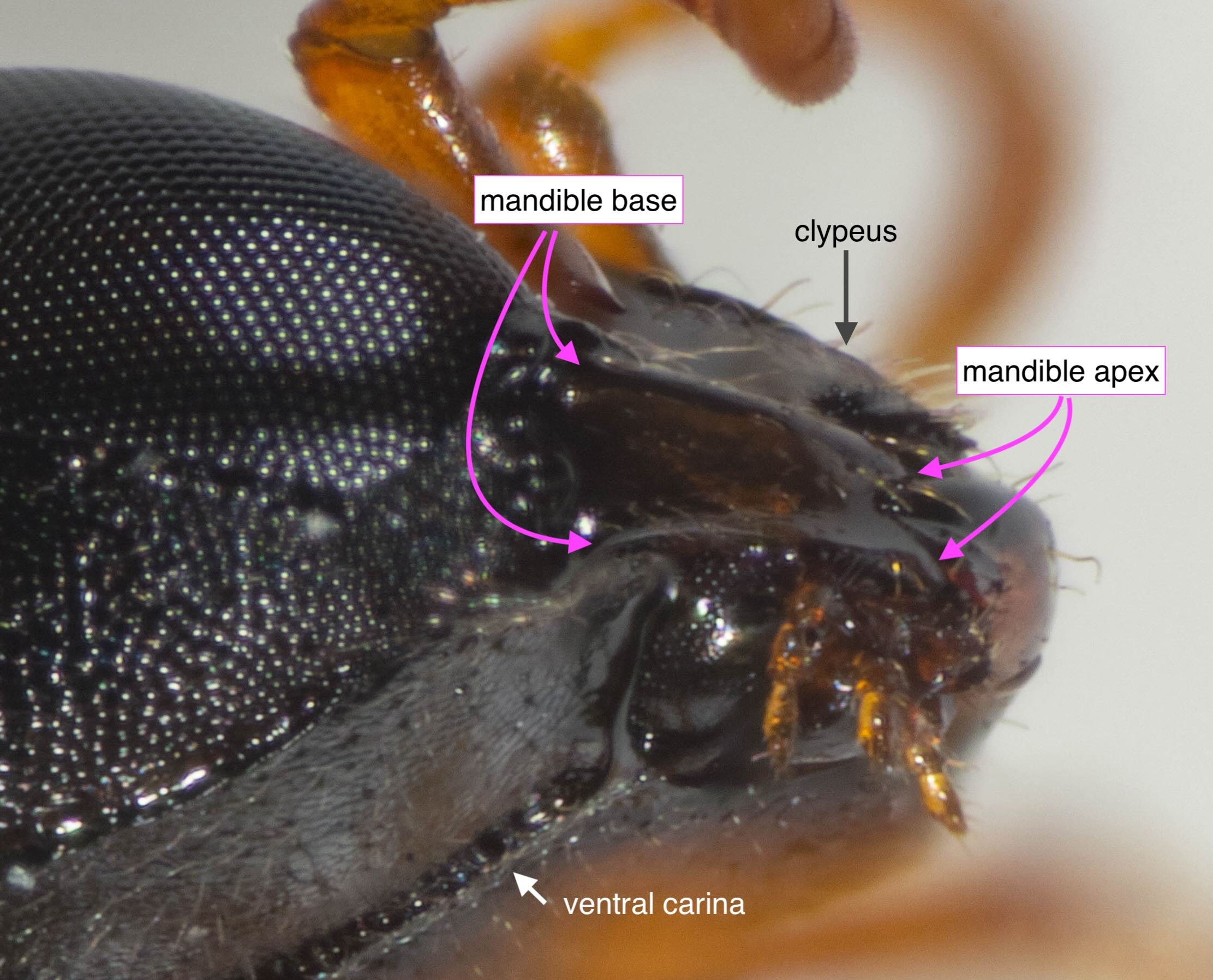
Mandible curved and gradually narrowing toward bidentate apex, not "strongly angulate at base and broadened just before apex".
15. "Mandible ... curved at base and gradually narrowing toward apex" –> 16
[excludes: A. mimi]
key step 16
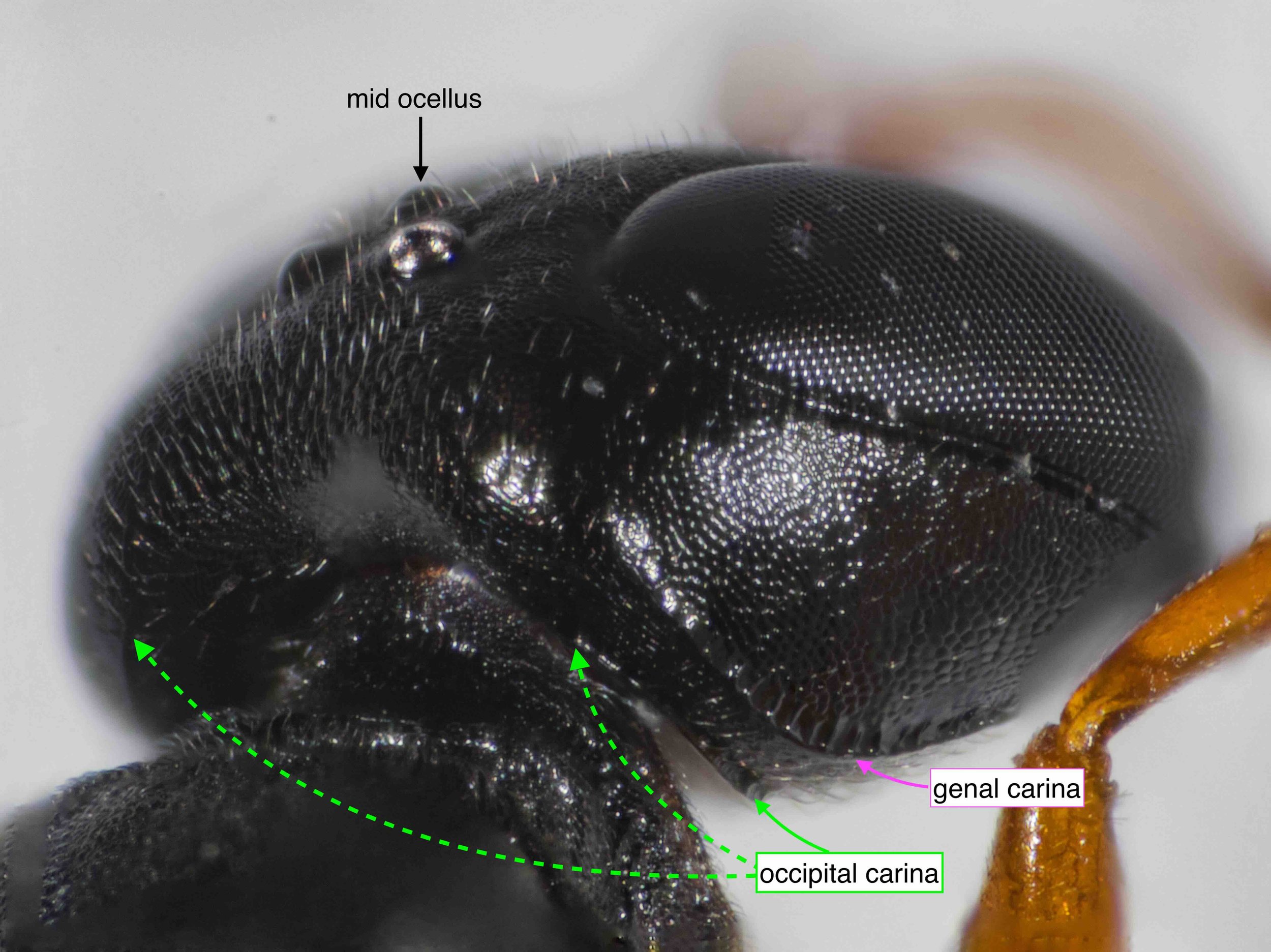
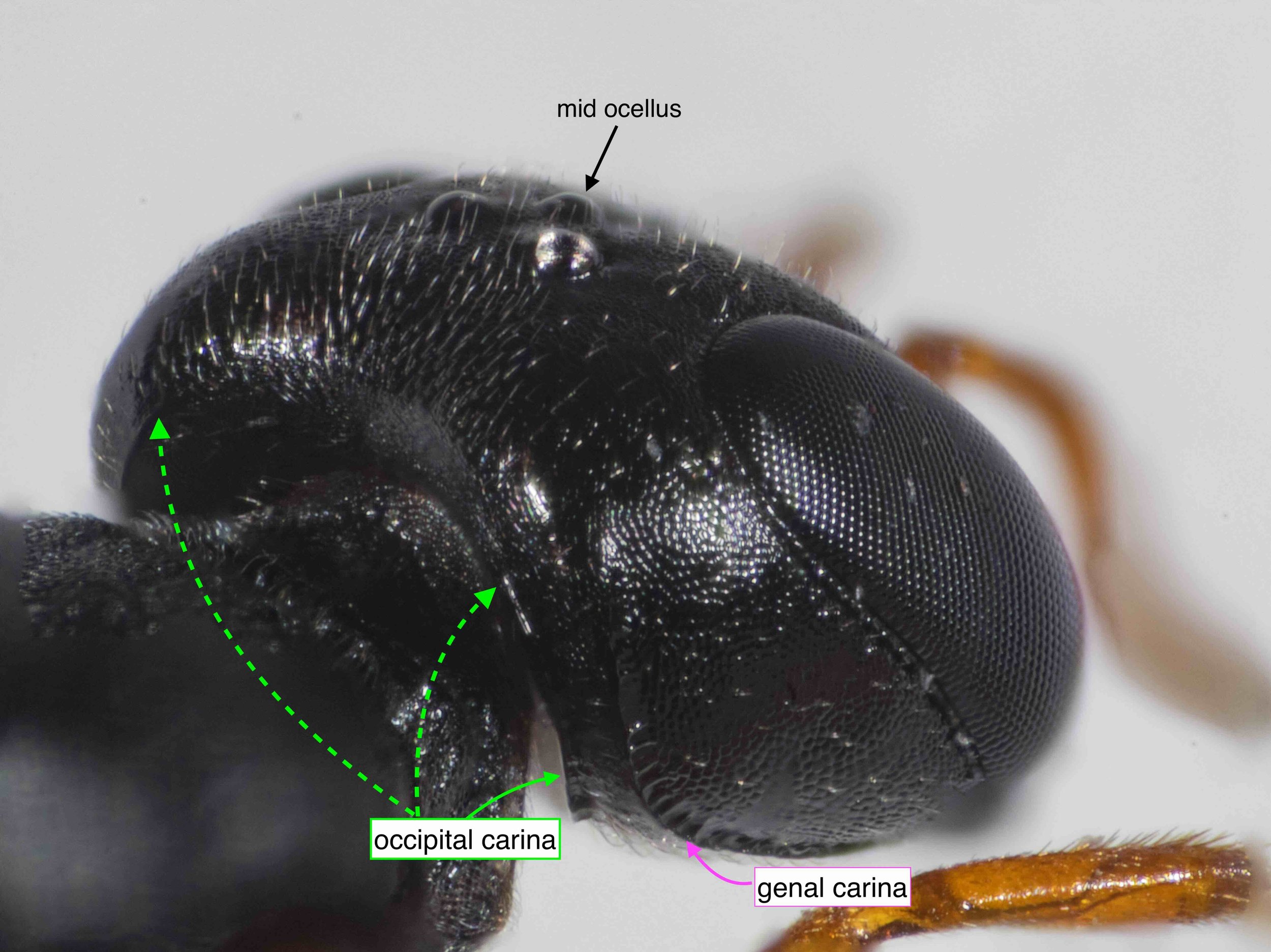
Occipital carina ends dorsolaterally (dotted arrows), so is not complete dorsally.
16. "Occipital carina incomplete, evanescent or interrupted dorsally" –> 18
[excludes: A. reticulatus; A. termes]
key step 16 ... another view
As this feature is a bit difficult to see, I include this second image from a slightly different angle.
key step 18
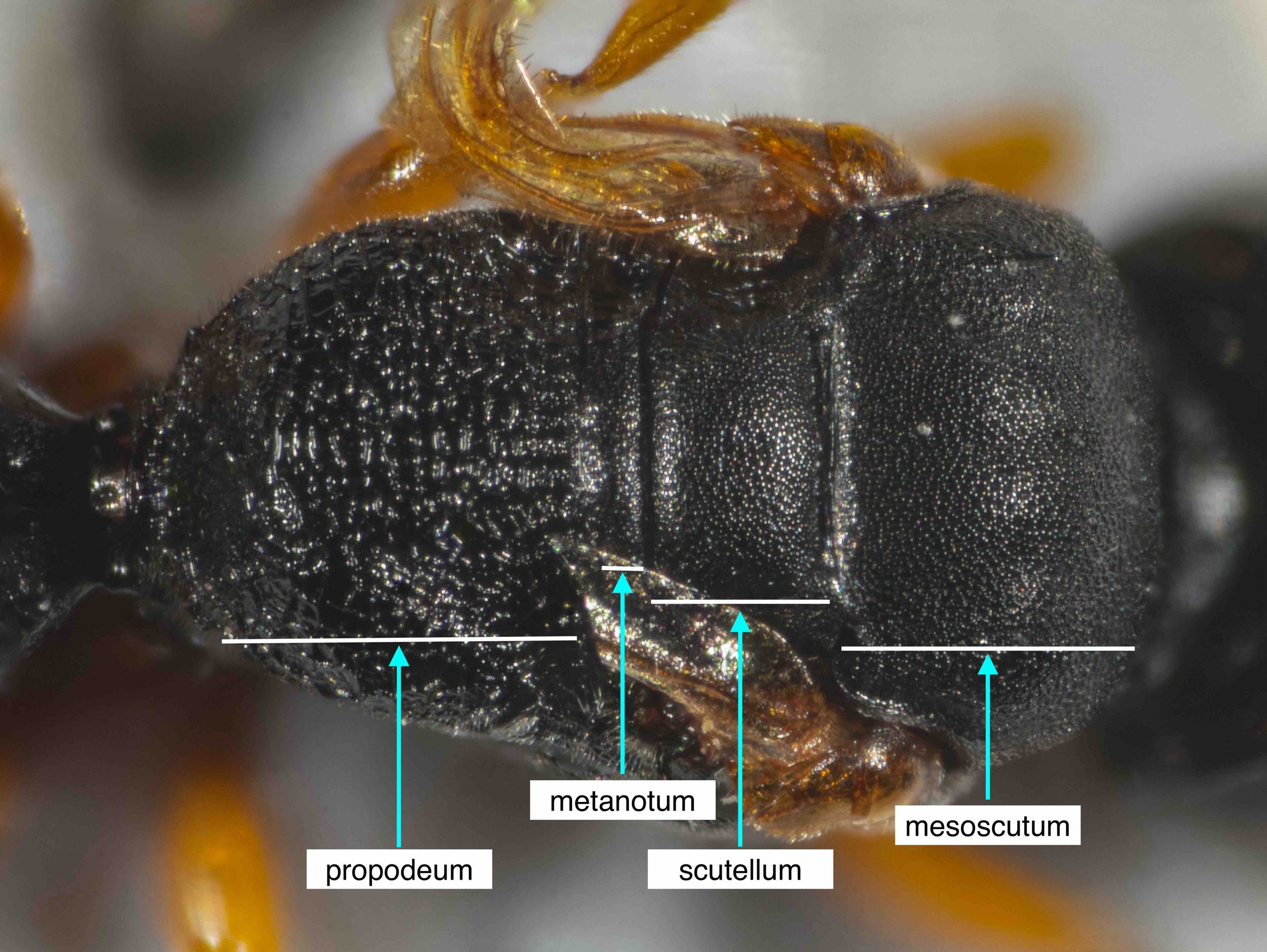
Mesoscutum with fine, punctate sculpture ... perhaps best closely matching Eady's (1968) illustration of 'punctate' microsculpture (Fig. 4. p.66). NOT with distinct, transverse carinulae.
18. "Mesoscutum mostly finely punctate; gena not strongly strigose" –> 19
[excludes: A. transversus]
key step 18
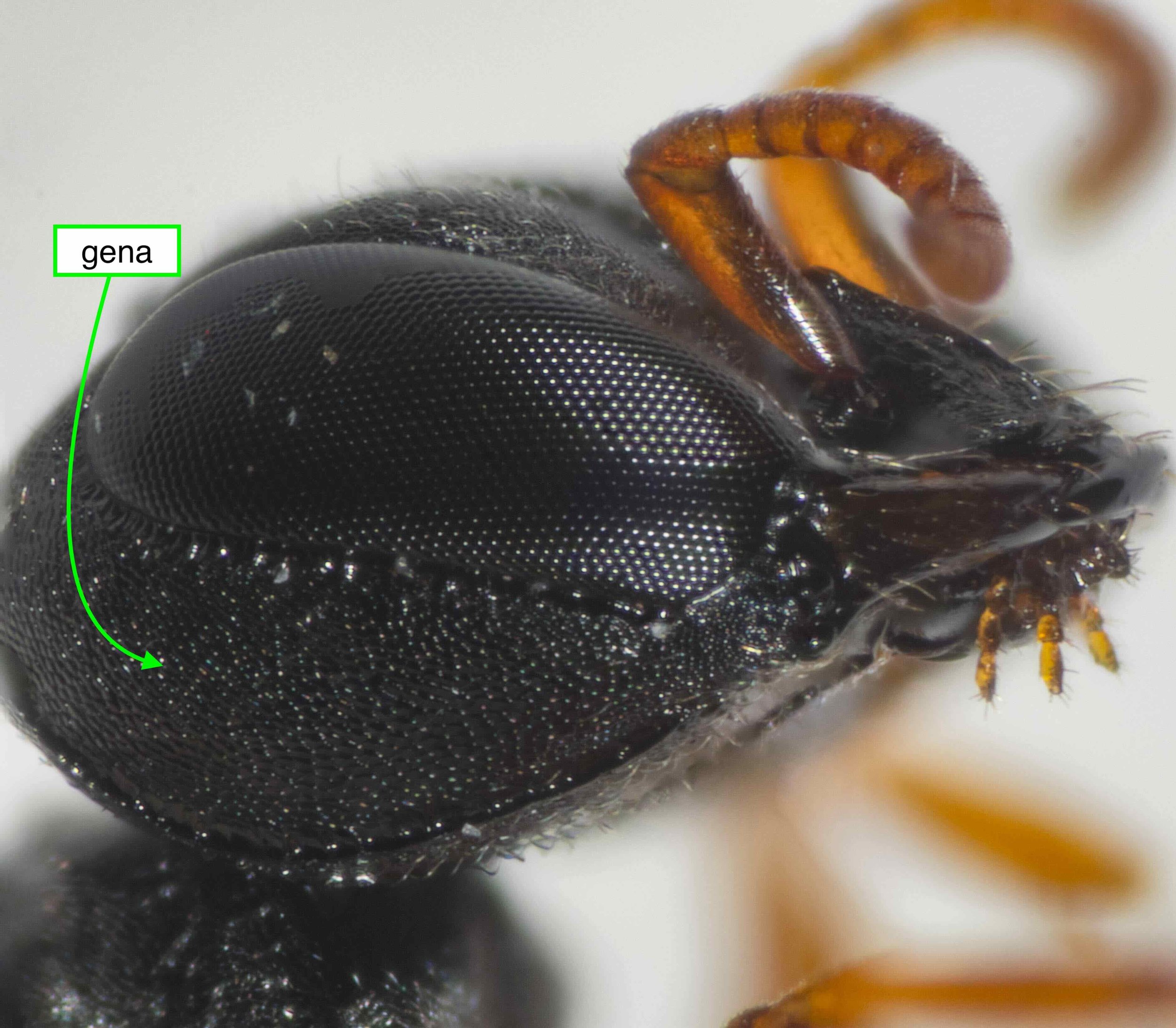
Genae evenly, finely coriaceous (see Eady 1968, Fig. 8, p. 67), not strongly strigose (see Eady 1968, Fig. 22, p. 67).
18. "Mesoscutum mostly finely punctate; gena not strongly strigose"–> 19
[excludes: A. transversus]
key step 19
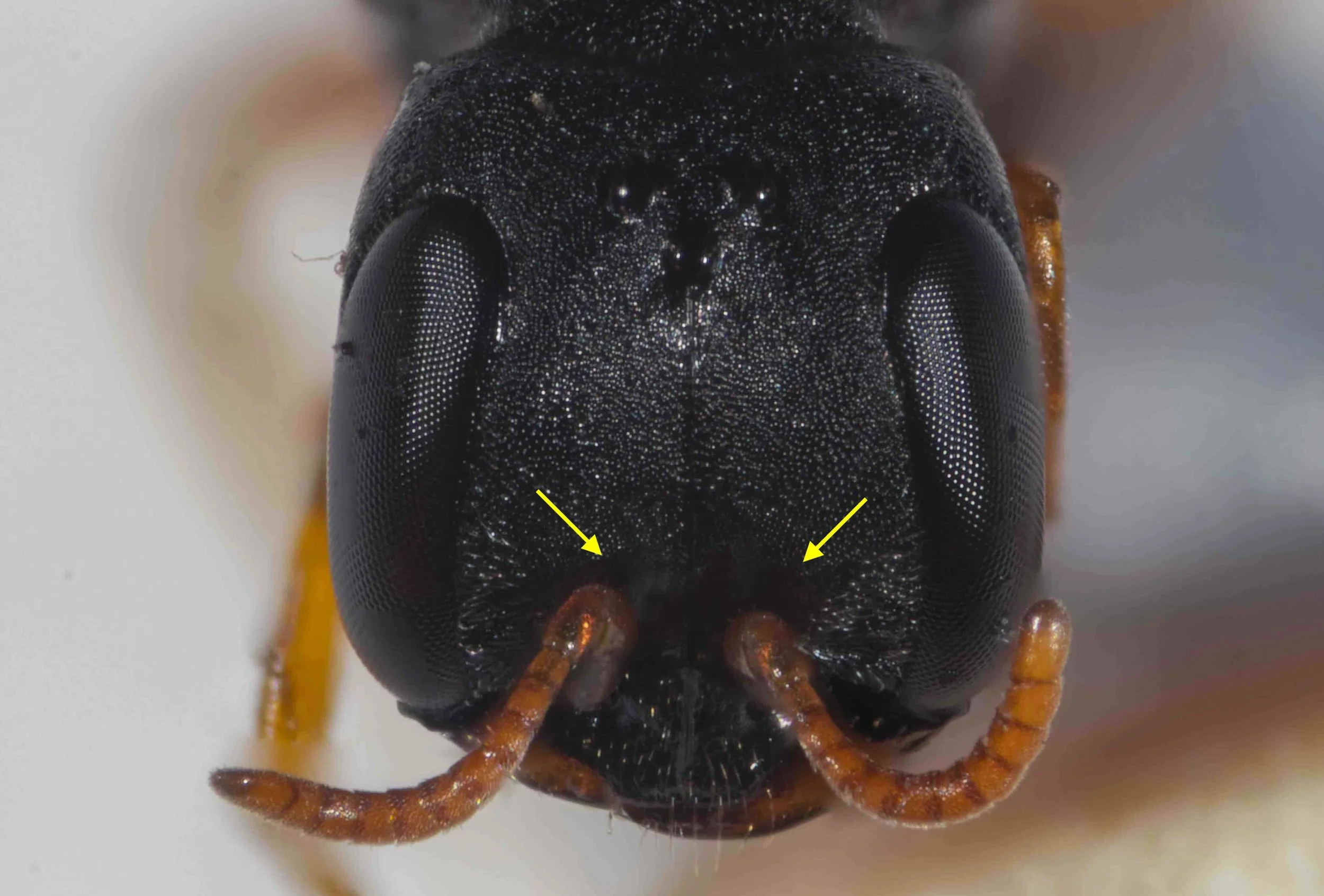
Frontal carina evident between antennae, and does appear slightly translucent along the edge ... however, I doubt this meets the definition of a "translucent lamella".
19. "Frontal carina low, barely raised between antennal scrobes" –> 20
[excludes: A. dubius] *see also comments below
key step 19
Frontal carina not prominent in the interantennal region.
19. "Frontal carina low, barely raised between antennal scrobes"–> 20
[excludes: A. dubius]
key step 20
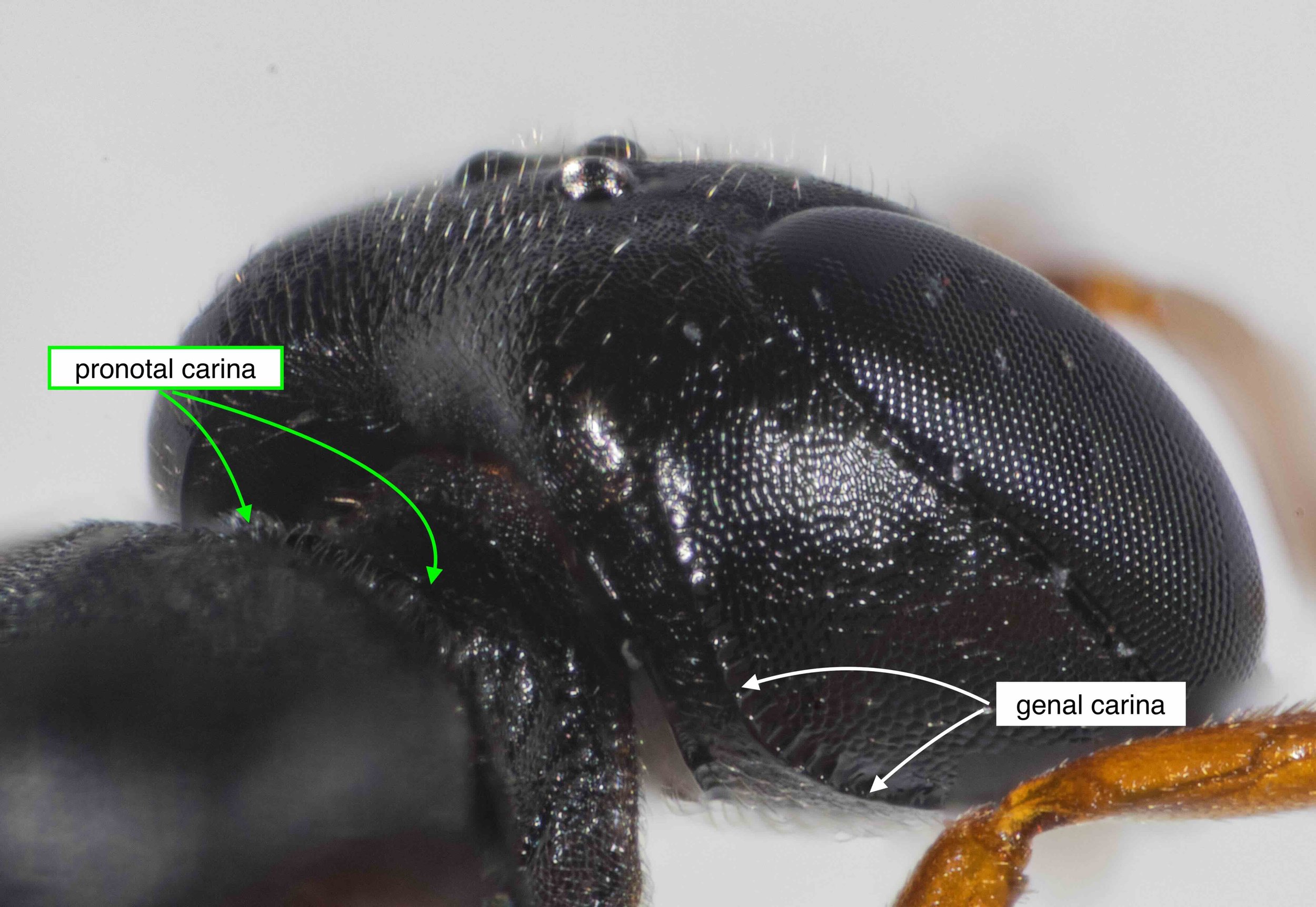
Genal carina definitely present! Also, pronotal carina discrete.
20. "Pronotal carina not especially raised, the anterolateral margin smoothly rounded, not at all projecting (with reference to a dorsal view); genal carina present" –> A. deakinus
[excludes: A. glabrellus; A. approximatus]
key step 20
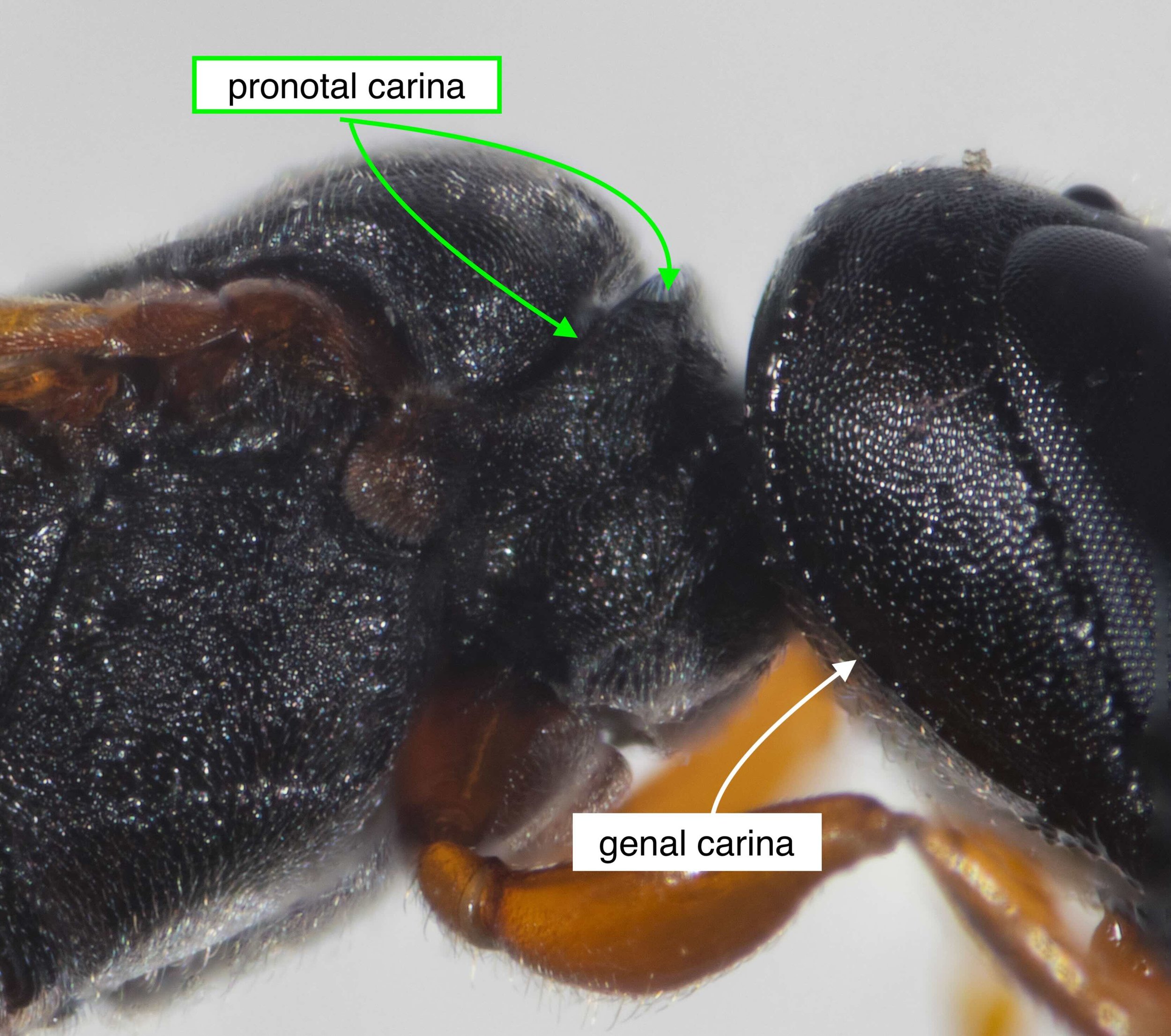
Pronotal carina low, not strongly raised, and without an angulate anterolateral margin.
20. "Pronotal carina not especially raised, the anterolateral margin smoothly rounded, not at all projecting (with reference to a dorsal view); genal carina present"–> A. deakinus
[excludes: A. glabrellus; A. approximatus]
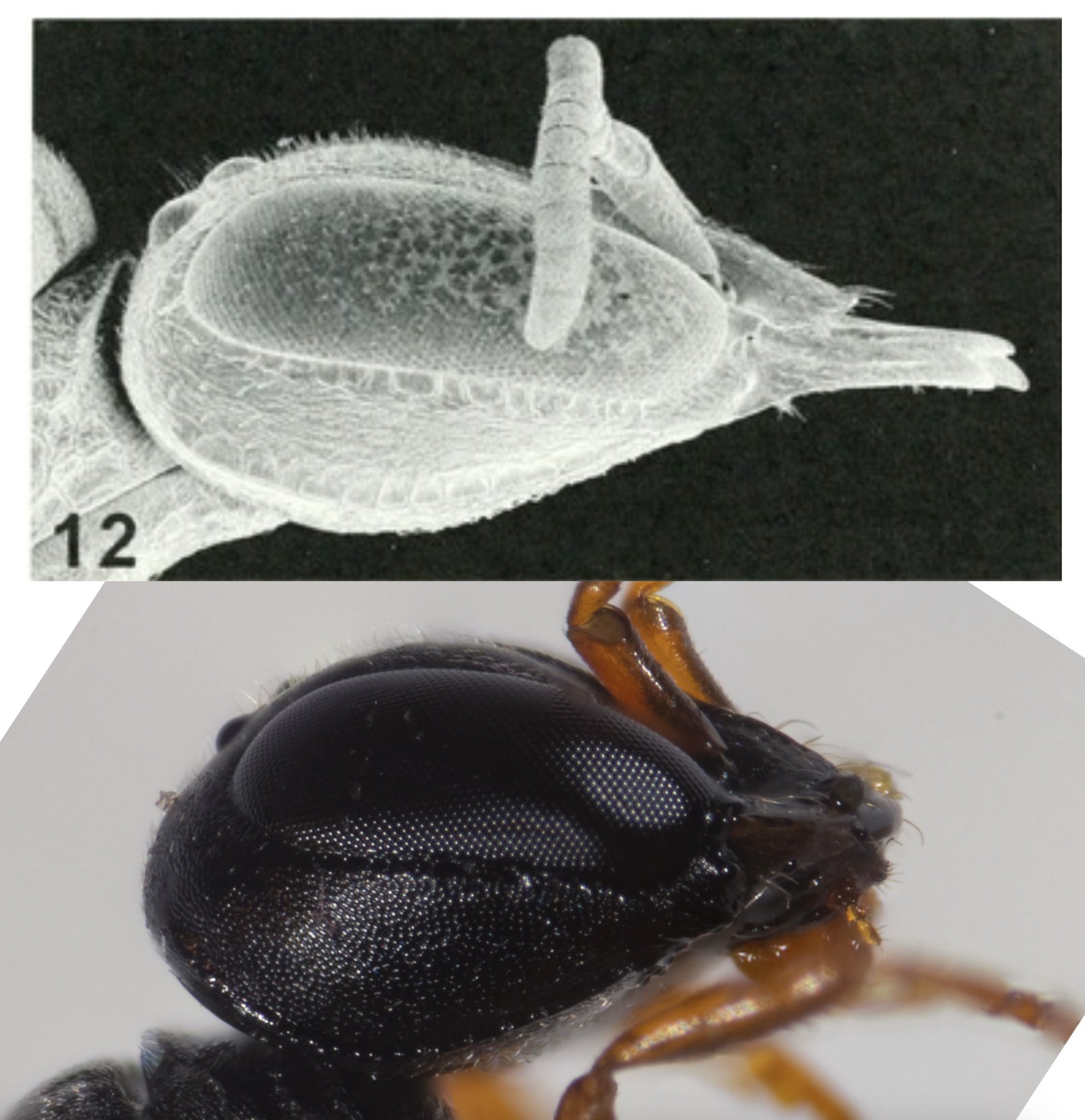
head shape
"Head: globular, without long post-ocellar area"
2406A (lower image) does appear to have wider genae and a slightly longer post-ocellar area. Otherwise it is very similar. Note that A. deakinus in Figure 12 (Matthews & Naumann 2002, p. 107) has the mandibles extended.
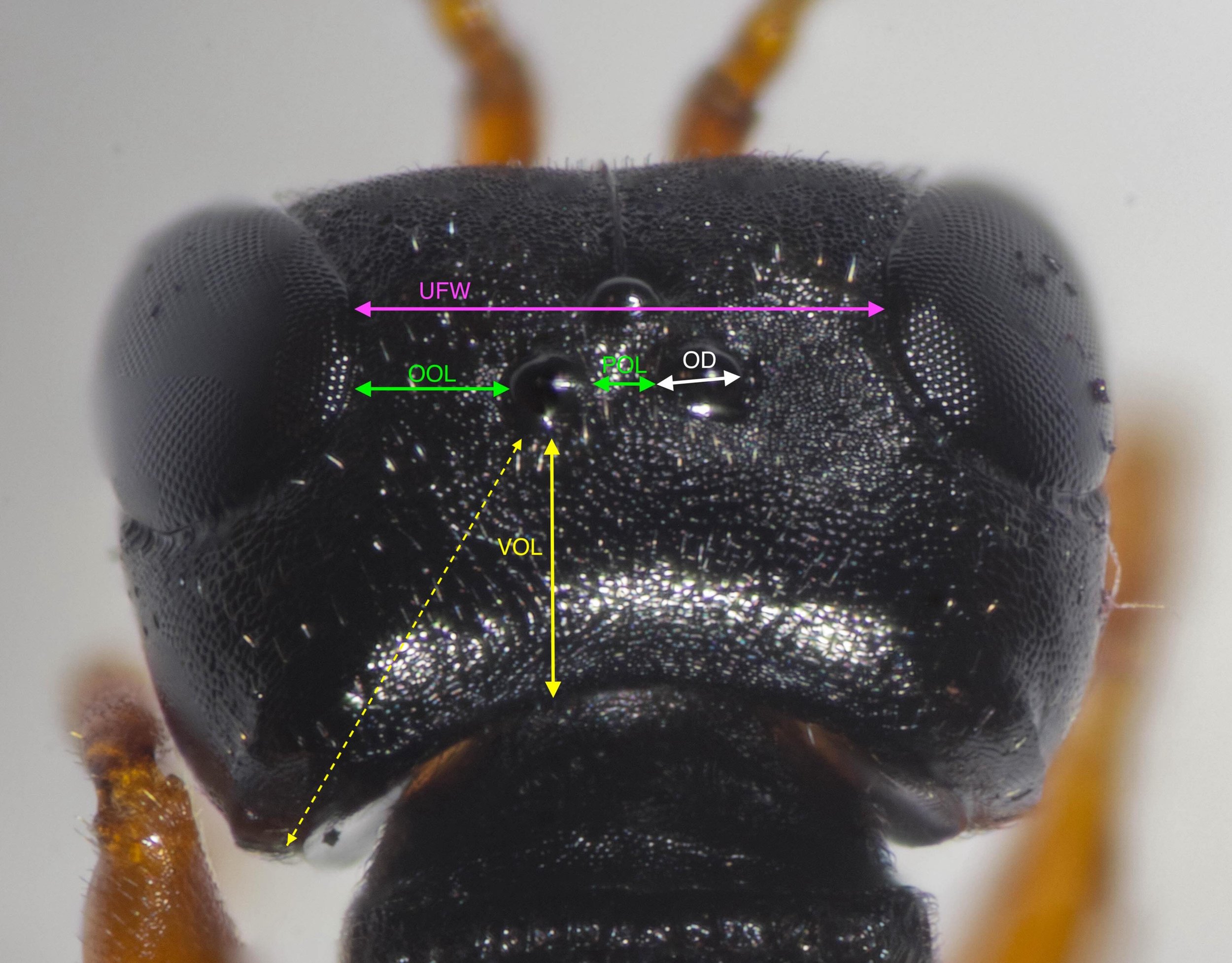
head measurements
"OD = maximum diameter of lateral ocellus = 3;
OOL = minimum distance between lateral ocellus and compound eye = 5;
POL = minimum distance between lateral ocelli = 4;
VOL = longitudinal distance between lateral ocelli and back of head (as seen in vertical view) = 15;
UFW = distance between compound eyes measured at level of anterior ocellus = 19"
The measurements are relative, not in absolute units. If I take the OD of 2406A as 3, then:
OOL = 5.3
POL = 2.3
VOL = 9 (or VOL dotted line = 15)
UFW = 18.5
So in comparison, 2406A has less distance between the lateral ocelli. Depending upon how the authors measured the VOL, 2406A has either the same VOL (dashed dimension) or a significantly shorter VOL (solid line).
body length
"length of body (excluding antennae) = 4.6mm"
I estimate 2406A at around 4.5mm. The curved posture makes a more accurate measurement a bit tricky.
forewing length
"length of forewing (apex to tegula) = 3.5mm"
Intact, the wing of 2406A would be 3.5mm
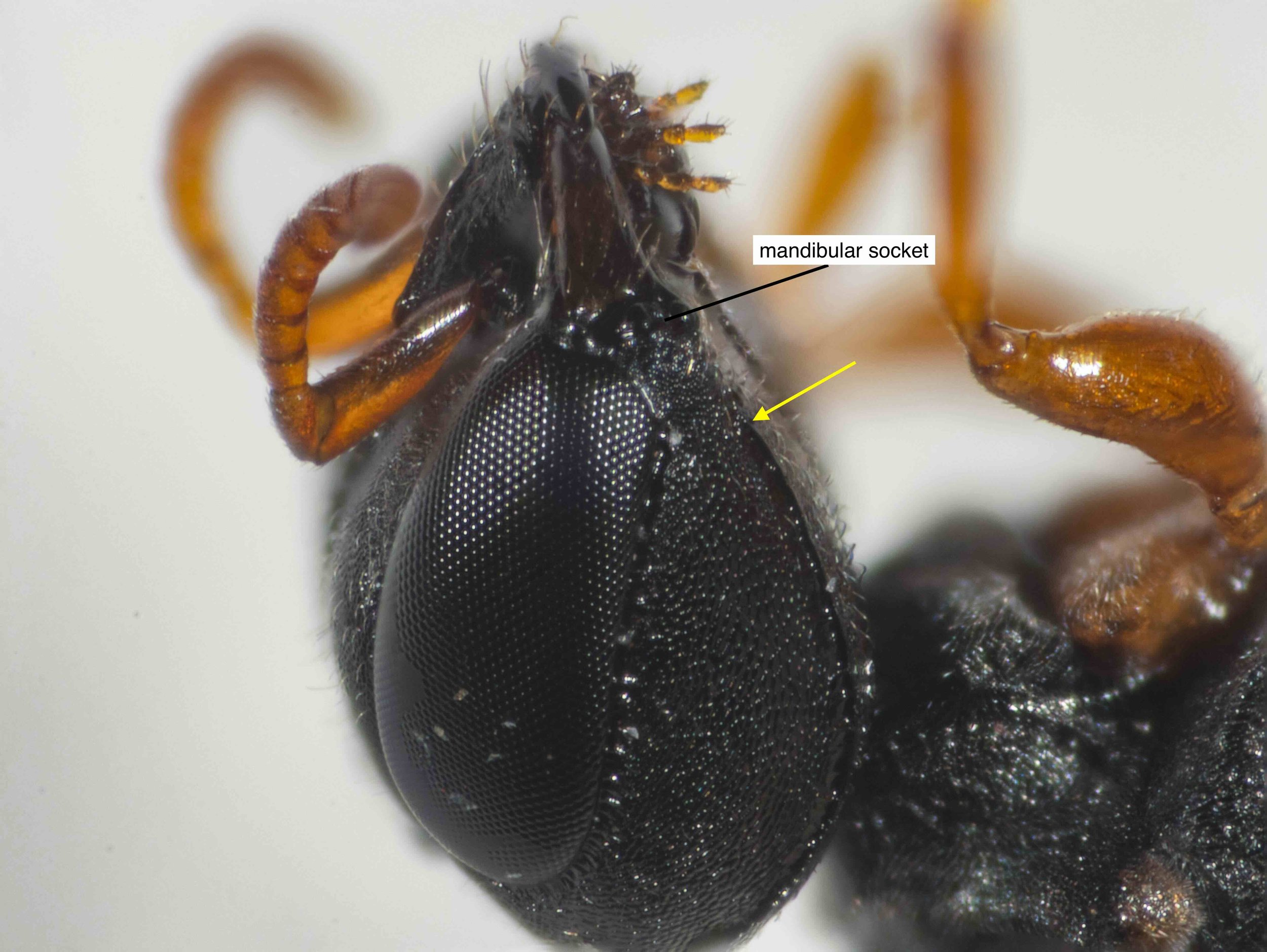
extent of genal carina
"Genal carina present, but fading ventrally before reaching mandibular sockets."
Arrow indicates ventral limit of genal carina.
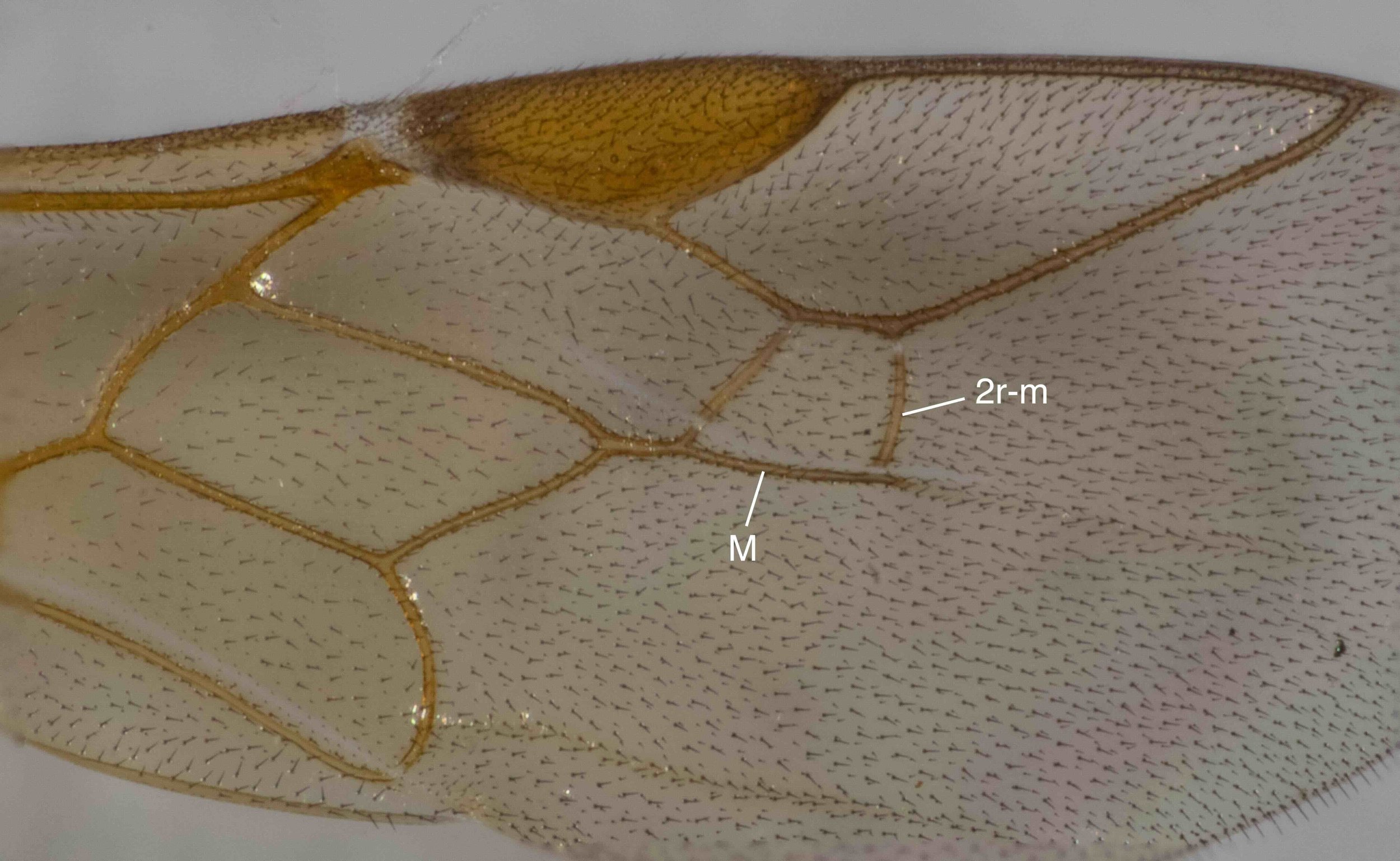
forewing venation
"M beyond 2r-m absent".
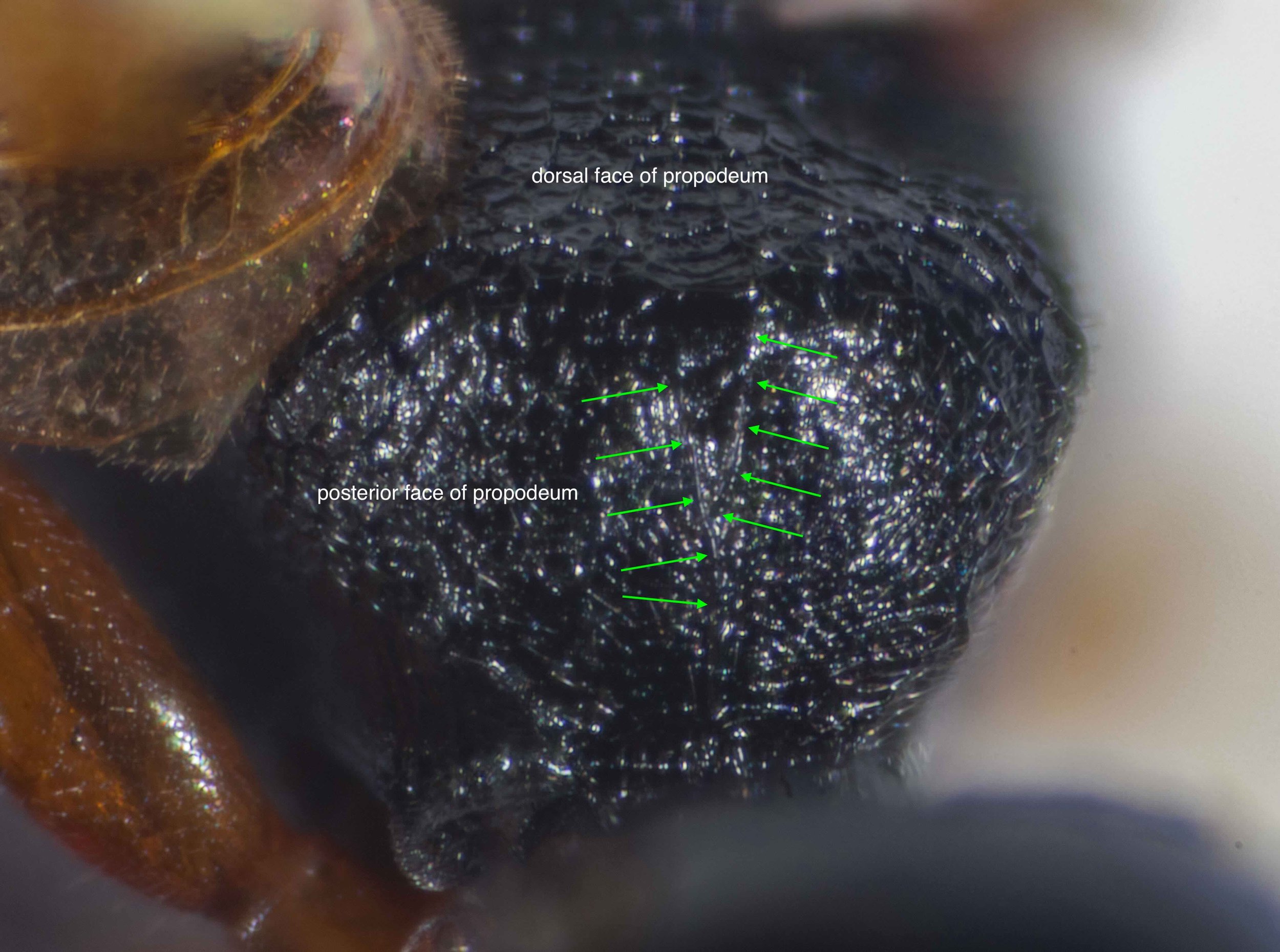
sculpturing of propodeum
"Propodeum uniformly areolate rugose (Fig. 14); posterior face transversely strigose costulate with a small central dorsal smooth area bounded by a Y-shaped carina whose base extends to metasomal insertion."
I can just make out a fine, Y-shaped carina (arrows).
texture of metasoma
"Terga 1 and 2 smooth, shining, with widely scattered setigerous punctures. T2-5 uniformly faintly microreticulate."T6 apically truncate with dense brush of short setae (Fig. 16)."
Note that this image was taken quite early on, while the specimen was in good condition. In some later images traces of wax (from mounting) obscure the shine on T1.
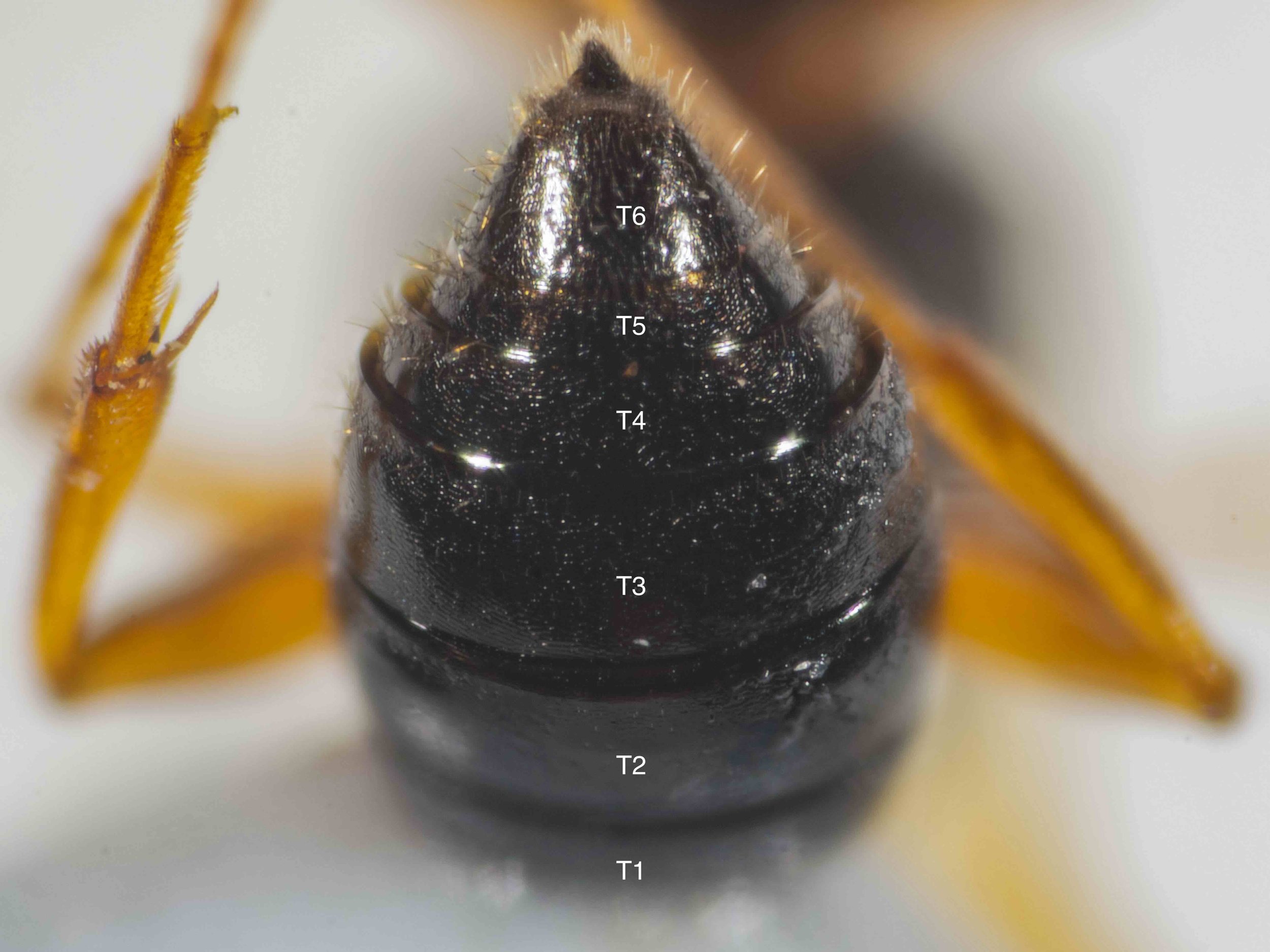
shape and texture of T6
"Terga 1 and 2 smooth, shining, with widely scattered setigerous punctures. T2-5 uniformly faintly microreticulate."T6 apically truncate with dense brush of short setae (Fig. 16)."
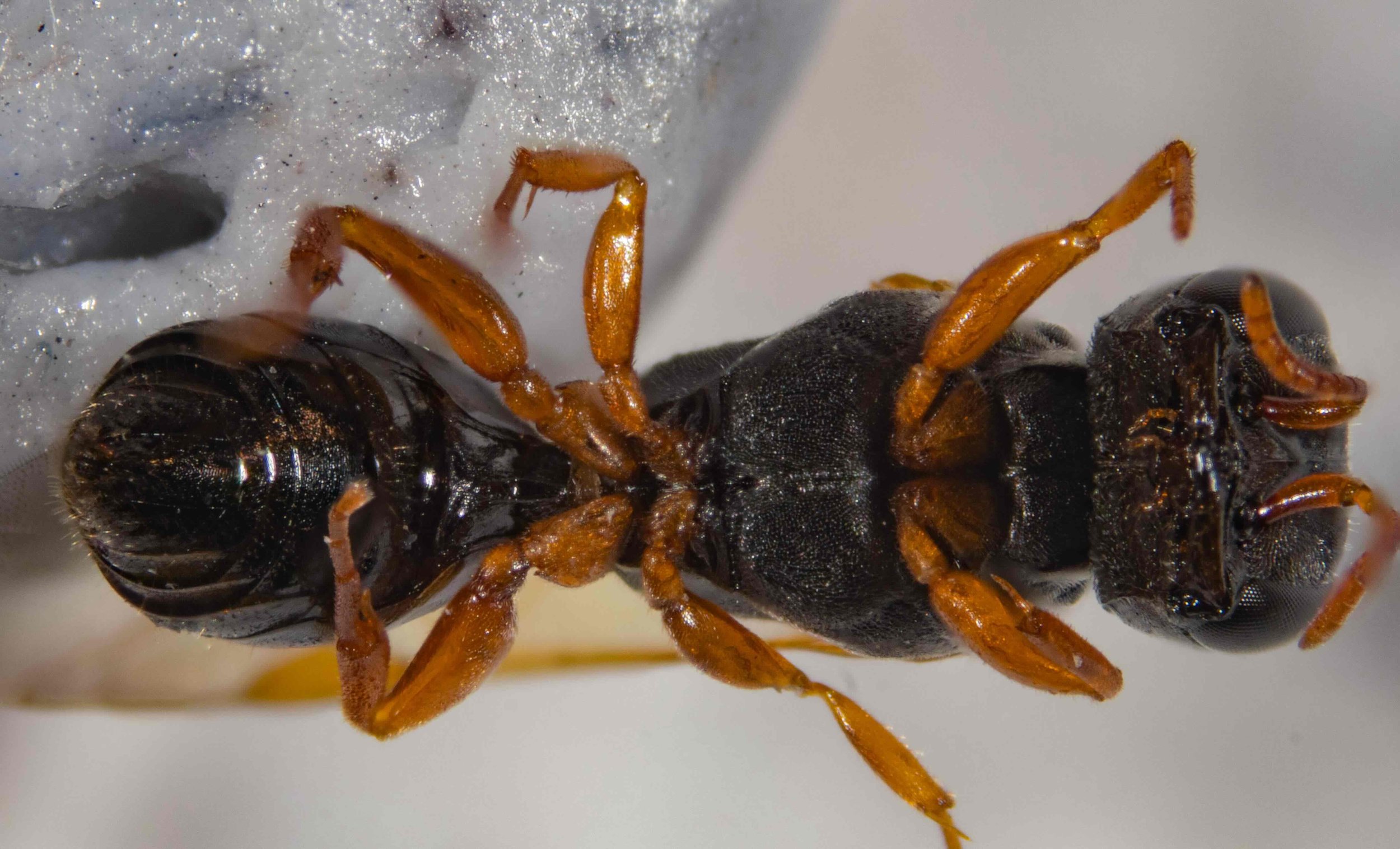
colour
"Head, mesosoma, and metasoma black, non-metallic. Antenna, mouthparts, tegula, legs (except coxae) orange/red. Coxae black basally, suffused with red/orange distally."
All in agreement, with the exception of the coxae which in 2406A are essentially entirely orange.
2 submarginal cells is typical
Nearly all Pemphredoninae have 2 submarginal cells and an enlarged stigma.
The shape of the submarginal cells varies considerably between species.
occipital carina
A distinct occipital carina is a feature of most crabronids (solid, straight arrows). The extent may vary, sometimes useful in distinguishing species within a genus. In Arpactophilus it is present, at least ventrally.
[Note that in this particular species, there is an additional, strong genal carina – dotted, curved arrows]
Spilomenina is unusual in completely lacking an occipital carina. The rear of the head looks remarkably smooth and rounded (see examples below).
frontal carina
The median ridge (arrows) running to the mid ocellus is typical of Arpactophilus. In Spilomena, it is very short, barely reaching half way to the ocellus.
scapal basin
Deep depressions above the antennal sockets (arrows) are characteristic of several Pemphredoninae, including Arpactophilus. In contrast, there is only the barest indication of such ‘scapal basins’ in Spilomena.
paraocular sulcus
Many Pemphredoninae have a groove alongside the eye (arrows). Often it is along the inner and/or upper margin of the eye, while In others (such as here) the groove completely encircles the eye. It may also be pitted (foveate’), as here.
Psenulus (tribe Psenini)
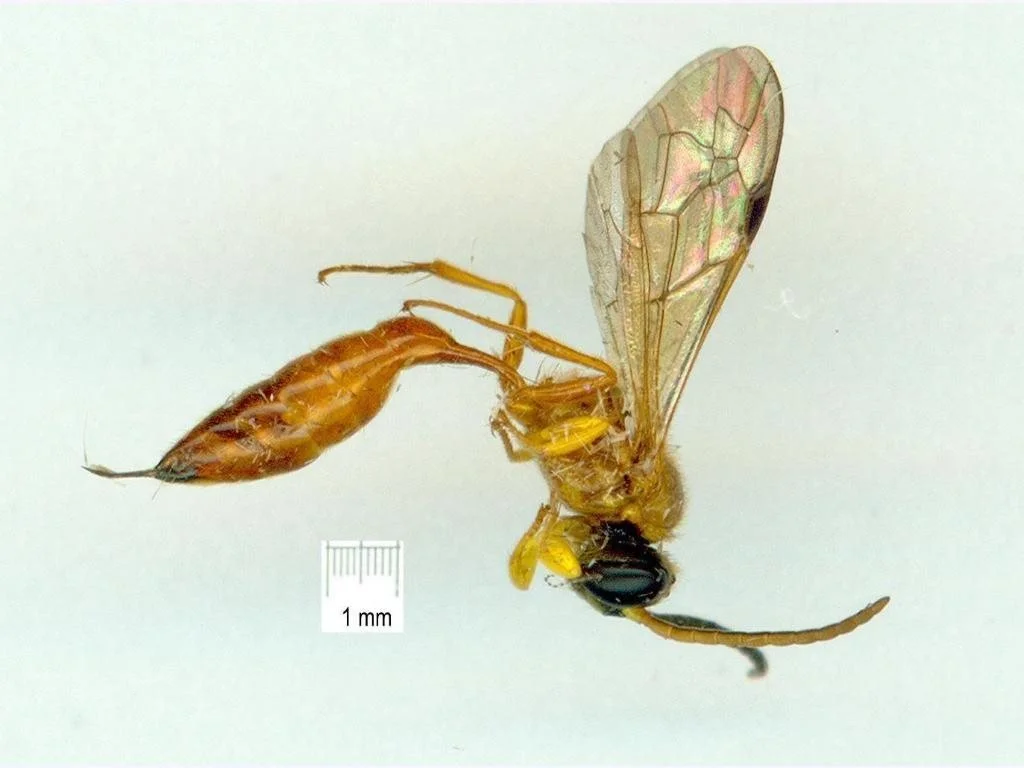
Unlike most of the Pemphredoninae, Psenulus has 3 submarginal cells. Note too the distinctly petiolated metasoma.
Image courtesy of: Graeme Cocks
https://inaturalist.ala.org.au/observations/28895056
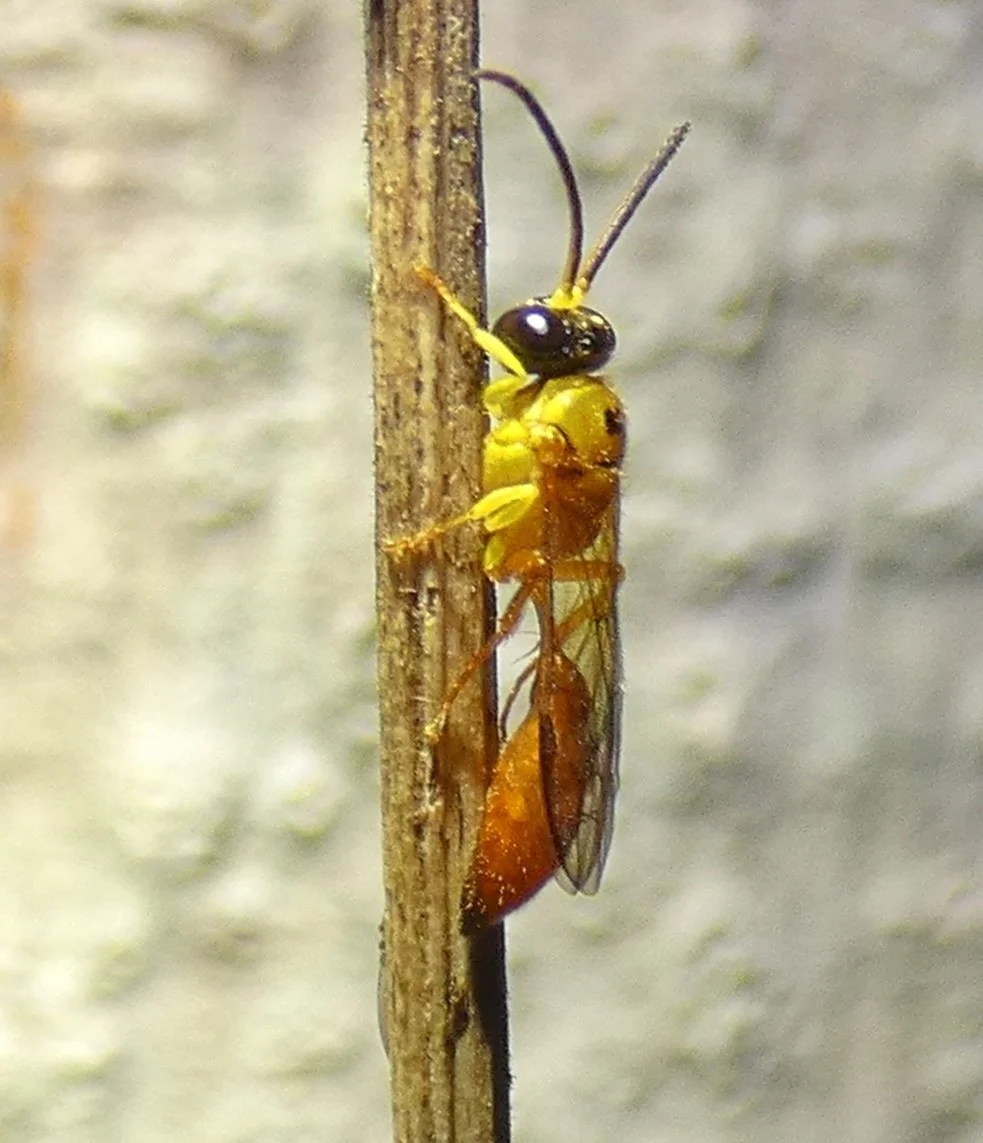
Psenulus
Note the distinctly petiolate gaster. The distinctive colour pattern makes this northern (e.g. QLD) species readily recognisable.
Image courtesy of: Kai Squires
https://inaturalist.ala.org.au/observations/203404918
Psenulus
There are just two described Australian species in this genus. This is the less common of the two.
Image courtesy of: Reiner Richter
https://inaturalist.ala.org.au/observations/15750028
Paracrabro
The combination of distinctly petiolate metasoma, carinate pronotum, and the shape of the vertex (produced behind the ocelli) all point to Paracrabro … but it it those massive, multi-toothed mandibles that are arguably the most convincing.
Image courtesy of ‘glyall’
https://inaturalist.ala.org.au/observations/332558352
Allostigmus
Note the relatively long petiole and the sharply declivitous vertex.
Image courtesy of: Stephen Fricker
https://inaturalist.ala.org.au/observations/104798102
(This is the image used as a cover photo for this page)
Allostigmus
This is ticks all the boxes for Allostigmus, including the relatively long petiole.
Image courtesy of Yu Jun
https://inaturalist.ala.org.au/observations/319903235
Arpactophilus
Note the sessile metasoma, and the frontal carina reaching mid ocellus.
Image courtesy of: Nigel Main
https://inaturalist.ala.org.au/observations/107011141
Arpactophilus
Note the sessile metasoma, presence of an occipital carine, and frontal carina reaching mid ocellus.
Image courtesy of: Matt Tudor
https://inaturalist.ala.org.au/observations/302997912
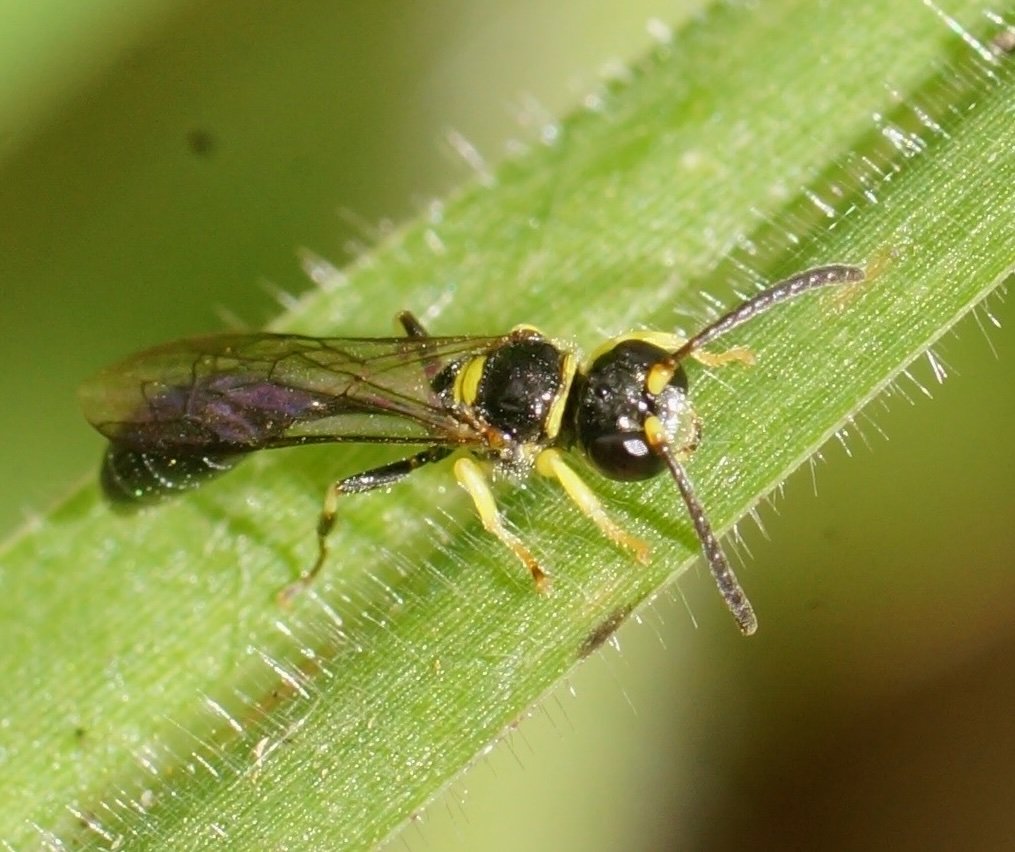
Spilomena
Note the sessile metasoma & absence of an occipital carina.
Image courtesy of: Graeme Cocks
https://inaturalist.ala.org.au/observations/28917588
Spilomena
The absence of an occipital carina, and the short frontal carina helps to distinguish this genus from Arpactophilus.
Image courtesy of: Yu Jun
https://inaturalist.ala.org.au/observations/320578838