
Perginae larvae batches 2 and 3
Workbook
Perginae larvae batch 2
- collected from Old Bridge Road, Sept 12, 2025. This clutch was housed in a metal cage and fed eucalyptus leaves collected from saplings near the collection site - mainly E. sieberi. These were replaced every few days and the stems pushed into a florist block in the centre of the cage. This block was watered regularly to keep the vegetation fresh. A deep layer of dead eucalypt leaves was placed in the bottom of the cage surrounding the florist block, contained within a plastic lining.
The larvae showed a regular pattern of activity, resting in a cluster on a leaf during the day. Starting around 5pm they would begin eating the leaf and when that was consumed, they would disperse towards new leaves. By early morning they had moved back into a rosette cluster on a single leaf.
This pattern of behaviour continued until 2nd October, 20 days after collection, when the clutch split into two clusters, both low down on the cage on the wire below the level of the plastic lining. One cluster subsequently moved up onto the vegetation but by the morning of 3rd October, all of the larvae had disappeared. Slight scratching sounds were heard between the wire and cage liner until 6th October.
The cage was emptied on 9th October and all of the larvae were found dead in the bottom of the cage beneath the plastic liner.
Perginae larvae batch 3
- collected from Eucalyptus consideniana on edge of Kizzy’s block on Sept 14, 2025. We housed this clutch like this one in a metal cage and fed them eucalyptus leaves collected from the same tree on which we found them - a Yertchuck (E. consideniana). These were replaced every few days and the stems pushed into a florist block in the centre of the cage. This block was watered regularly to keep the vegetation fresh. A deep layer of dead eucalypt leaves was placed in the bottom of the cage surrounding the florist block, contained within a plastic lining.
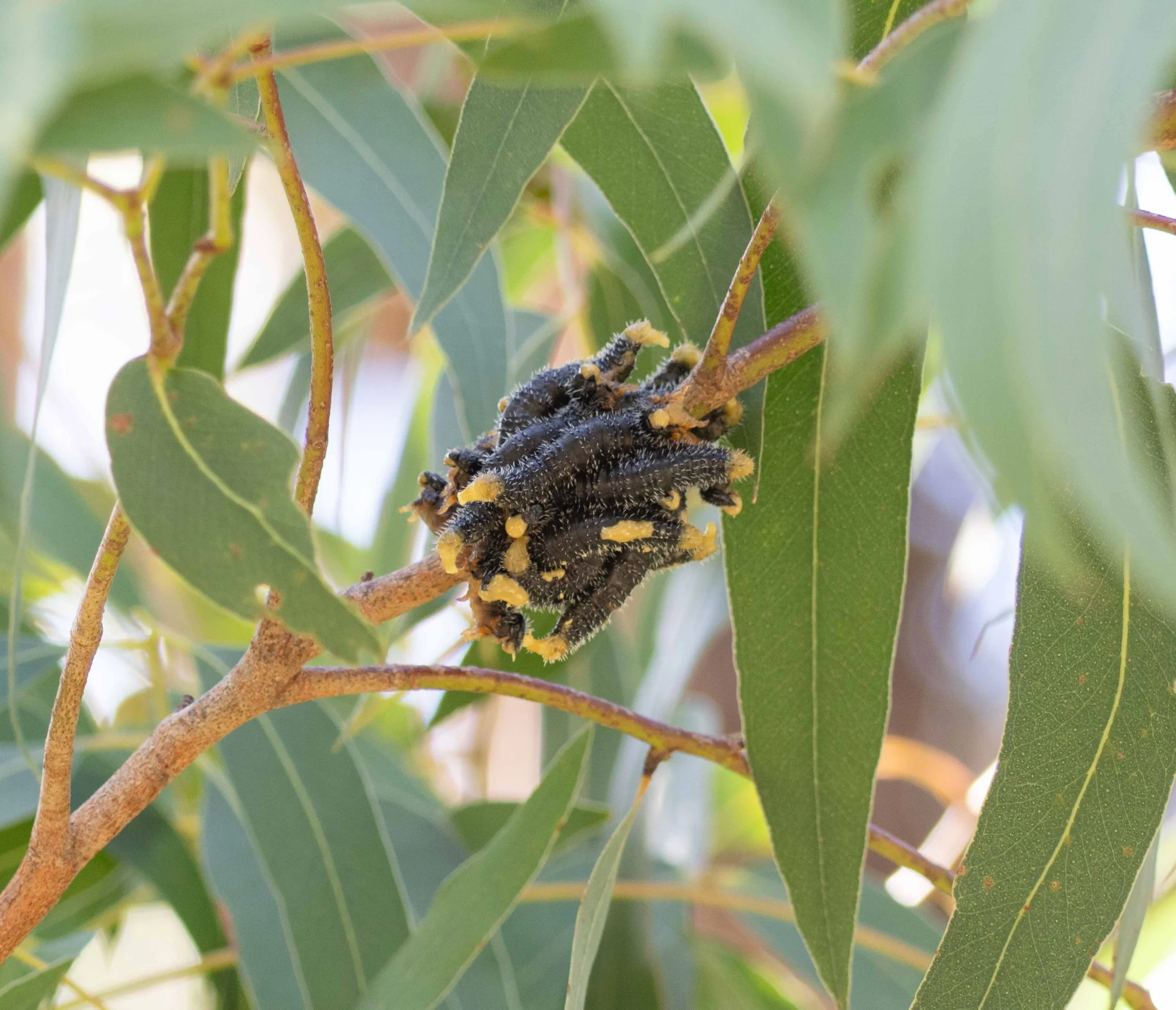
We added two separate clutches of larvae from this same tree. The first batch of ~15 larvae (shown in the image above) was collected during the day on 14 September. The side branch on which they were clustered, about 1.5m from the ground, was cut and placed in the florist block, together with additional branches from the same tree. These larvae showed the same regular pattern of activity as the 313502193 larvae, resting in a cluster during the day on the base of a stem and moving as individuals to leaves at night to feed. Then 6 days later, on 20 September all of these larvae had headed into the leaves at the bottom of the cage.
On that same day, at 10:30pm, we collected the remaining larvae from the same tree as the first clutch. These were dispersed in small groups among the young foliage at the top of the sapling, about 4-5m above ground. We added them to the same cage. These showed the same pattern of grouping into a single mass during the day (although there were numerous outliers in the leaf litter) and dispersing to feed at night. 3 days later, on 23 September the activity of the cluster appeared disrupted. Only a fraction of the larvae grouped together in a cluster on vegetation, while others remained hanging on wire or amongst the leaf litter. A week later, on 30th September only a small group of 6 larvae was seen feeding on the foliage during the day. This small cluster continued to feed at night and regroup in a resting group during the day but on 7th October they too had disappeared. On 9th October we emptied the cage and found all of the larvae dead, scattered amongst the leaf litter. There was no sign of pupae.
This is a workbook page … a part of our website where we record the observations and references used in making species identifications. The notes will not necessarily be complete. They are a record for our own use, but we are happy to share this information with others.