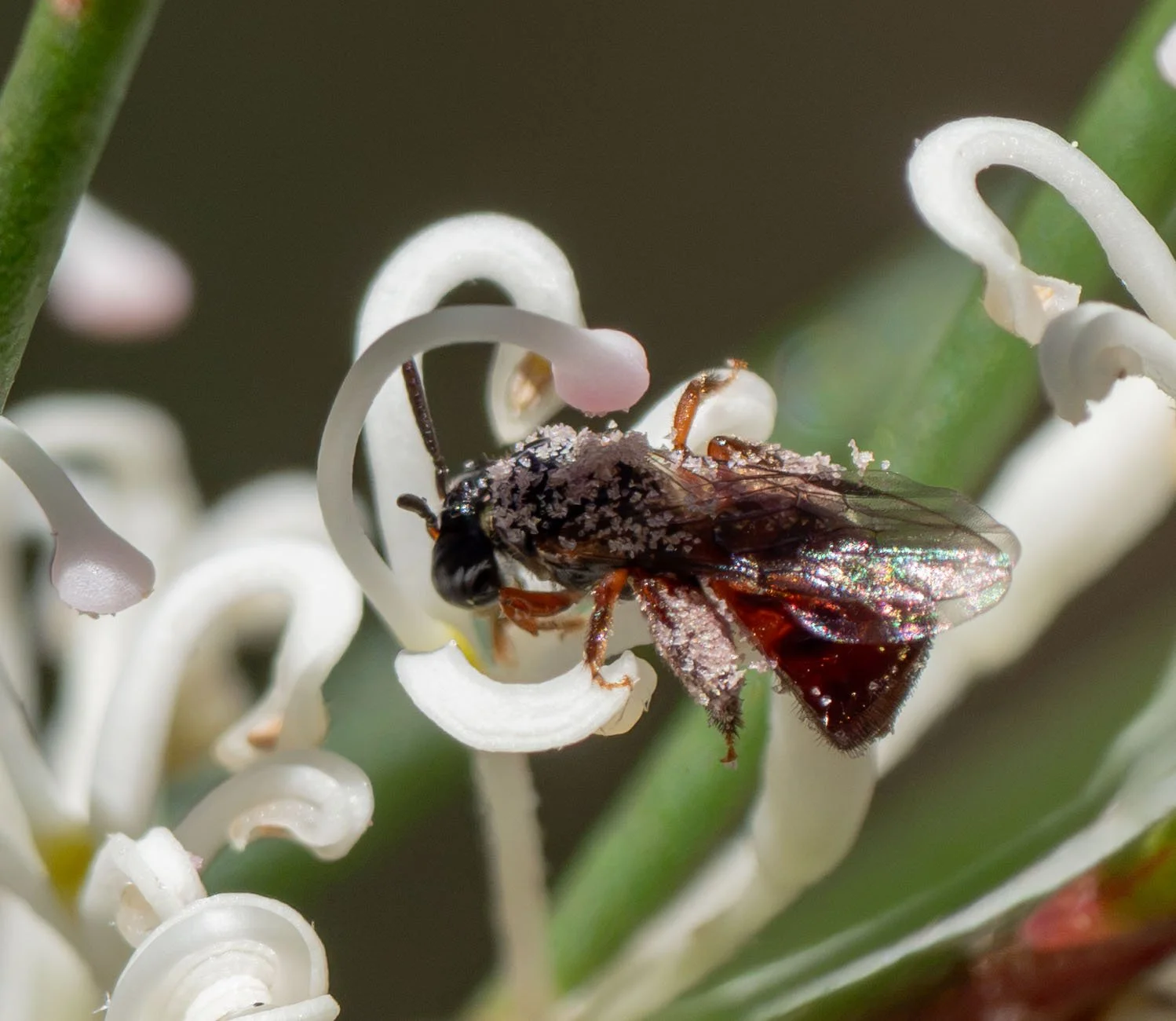
![The small, fuzzy white flowers of Styphelia ericoides are a magnet for insects. The plants start to bloom in July, but for several weeks the principal visitors are small flies. Then, quite suddenly, Exoneura appear. Exoneura [21st Aug]](https://images.squarespace-cdn.com/content/v1/58ec80a8d2b857fe42e4f603/1788502102226-P3T6KEVFVWRDFOGLZ0GQ/P8210274.jpg)
![I don’t see many male Exoneura , and with good reason. The sex ratio in bees of this tribe tends to be skewed towards females. When these goggle-eyed, hairy-faced bees turn up, I know I have a male. Exoneura robusta (?) [2nd Sept]](https://images.squarespace-cdn.com/content/v1/58ec80a8d2b857fe42e4f603/1788502653368-HWHLQ8LB6BTFU9JUHTI1/P9020202.jpg)
![Pink pollen!! This female will groom the grains from her back, moving it to the hairs of her hind legs for transport. Exoneura [29th Aug]](https://images.squarespace-cdn.com/content/v1/58ec80a8d2b857fe42e4f603/1788589879006-NPGGCF6GJOCUZ16LWZTT/P8290351.jpg)
![A third bee arrives and shows a lot of interest in burrow A. Exoneura (robusta?) [3rd Sept]](https://images.squarespace-cdn.com/content/v1/58ec80a8d2b857fe42e4f603/1788594253037-A4L8JJON5FD06CZSRMLF/P9030135.jpg)
![A fourth bee lands … and ‘Bee #3’ appears to challenge her. Note the open mandibles and raised abdomen. Exoneura (robusta?) [3rd Sept]](https://images.squarespace-cdn.com/content/v1/58ec80a8d2b857fe42e4f603/1788594373957-IPALG1GDJVO217EIZWZ4/P9030135.jpg)
1
2
3
4
5
6
7
8
9
10
11
12
13
14
15
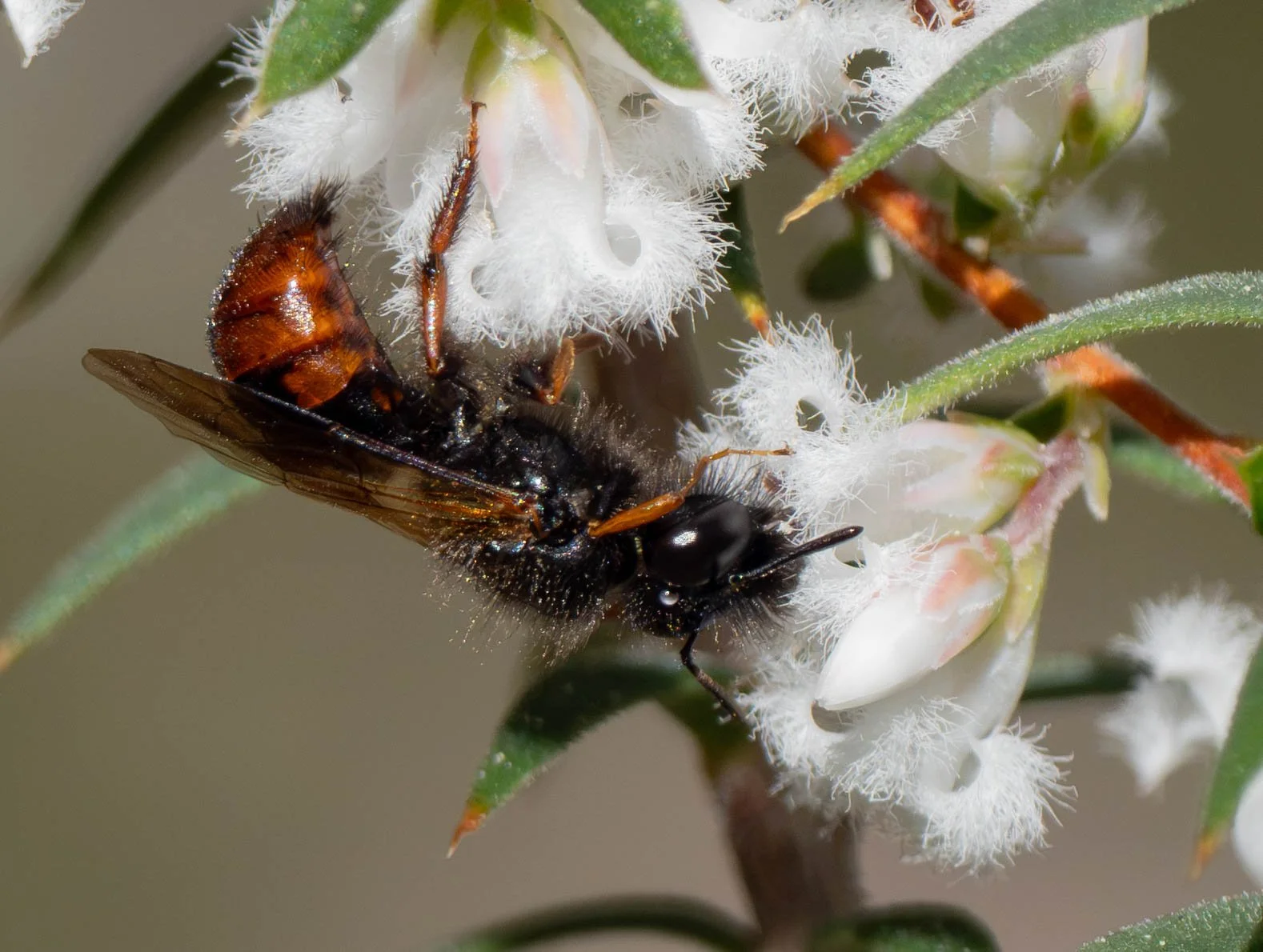
The small, fuzzy white flowers of Styphelia ericoides are a magnet for insects. The plants start to bloom in July, but for several weeks the principal visitors are small flies. Then, quite suddenly, Exoneura appear.
Exoneura [21st Aug]
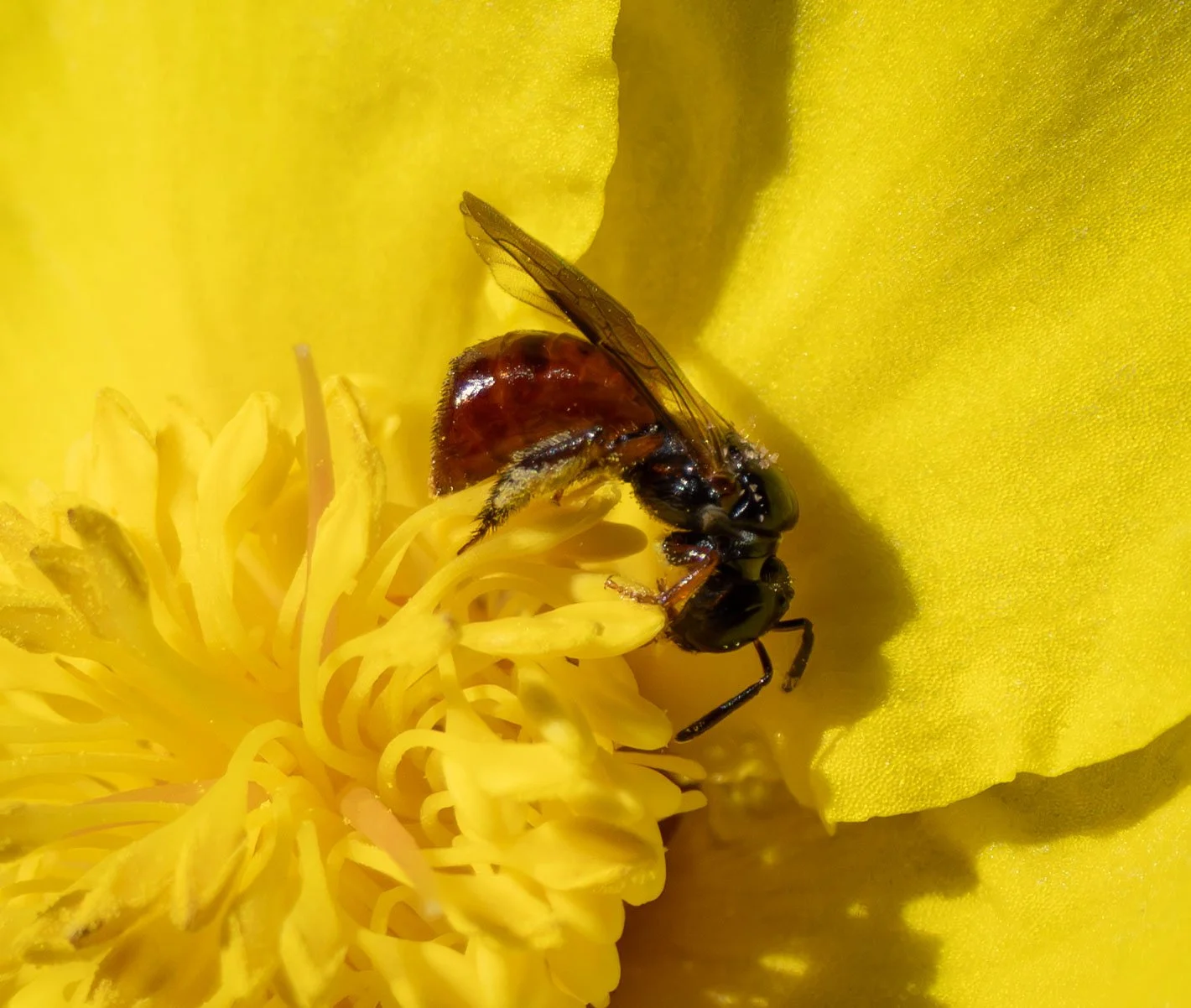
While the densely-flowering patch of Styphelia is certainly popular among the Exoneura, they are not fussy feeders. The large, bright yellow flowers of Hibbertia dentata are a good source of pollen … for those bees capable of shaking it loose from anthers. Hibbertia flowers produce no nectar, so the bees must shop elsewhere for that.
Exoneura [21st Aug]
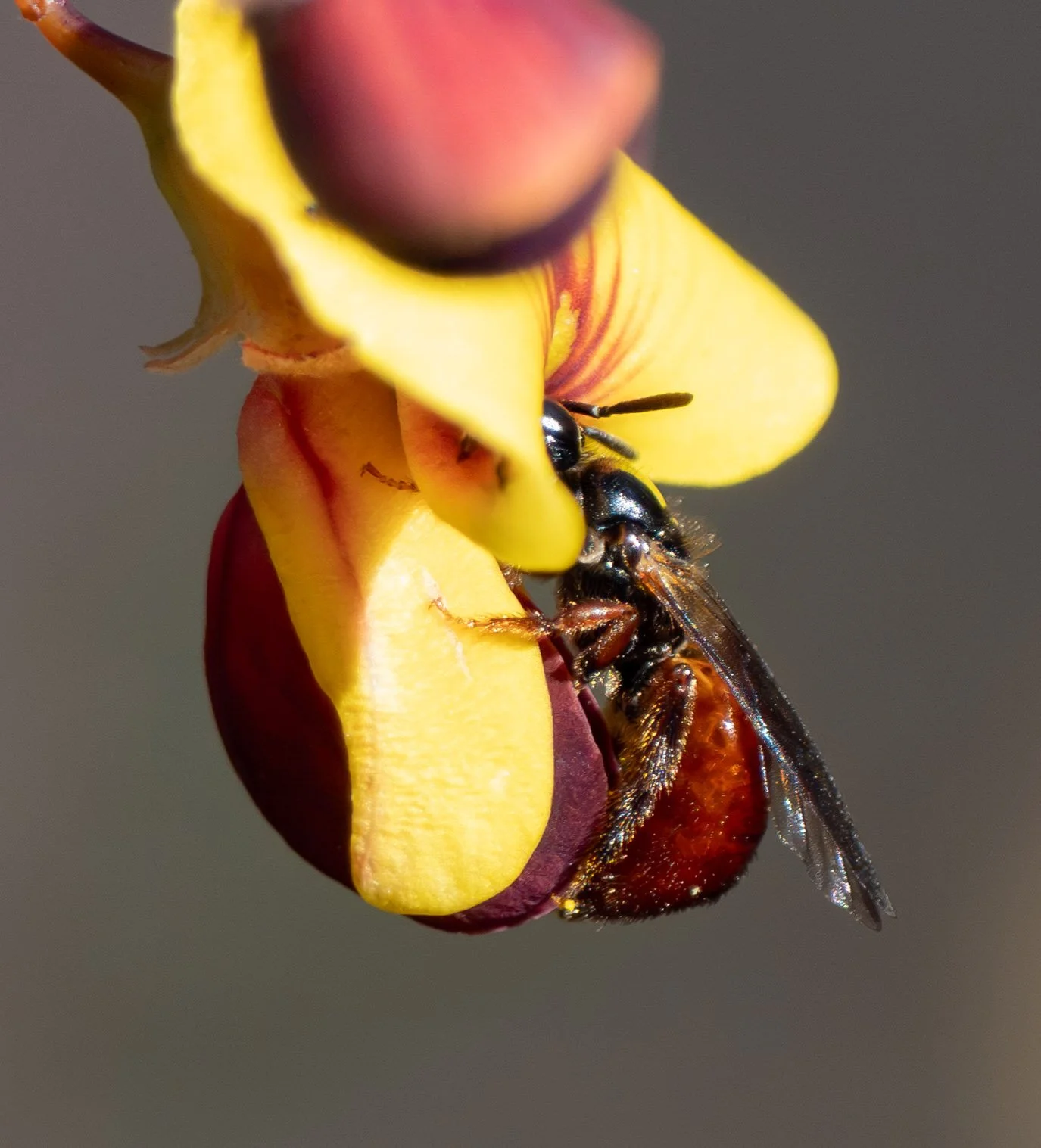
Pea flowers are a good source of both nectar and pollen … for bees strong enough to access it. This is one of the larger species of Exoneura here locally. As she reaches into the flower with her head and long tongue to reach the nectar, she also spreads the lower petals of the flower to expose the pollen-laden anthers.
Exoneura [28th Aug]
I don’t see many male Exoneura, and with good reason. The sex ratio in bees of this tribe tends to be skewed towards females. When these goggle-eyed, hairy-faced bees turn up, I know I have a male.
Exoneura robusta (?) [2nd Sept]
Other unusual features of these males are their tarsi (the end segments of the legs). The front tarsi are particularly long, and the basal segment of the hind tarsus is swollen. When I noticed these males for the first time (mid Sept 2023), they were swarming around the flowers … a behaviour associated with attracting females. My 3 sightings this year have each been of individual males, feeding. I’m keeping a close eye out for mating swarms though!
Exoneura robusta (?) [2nd Sept]
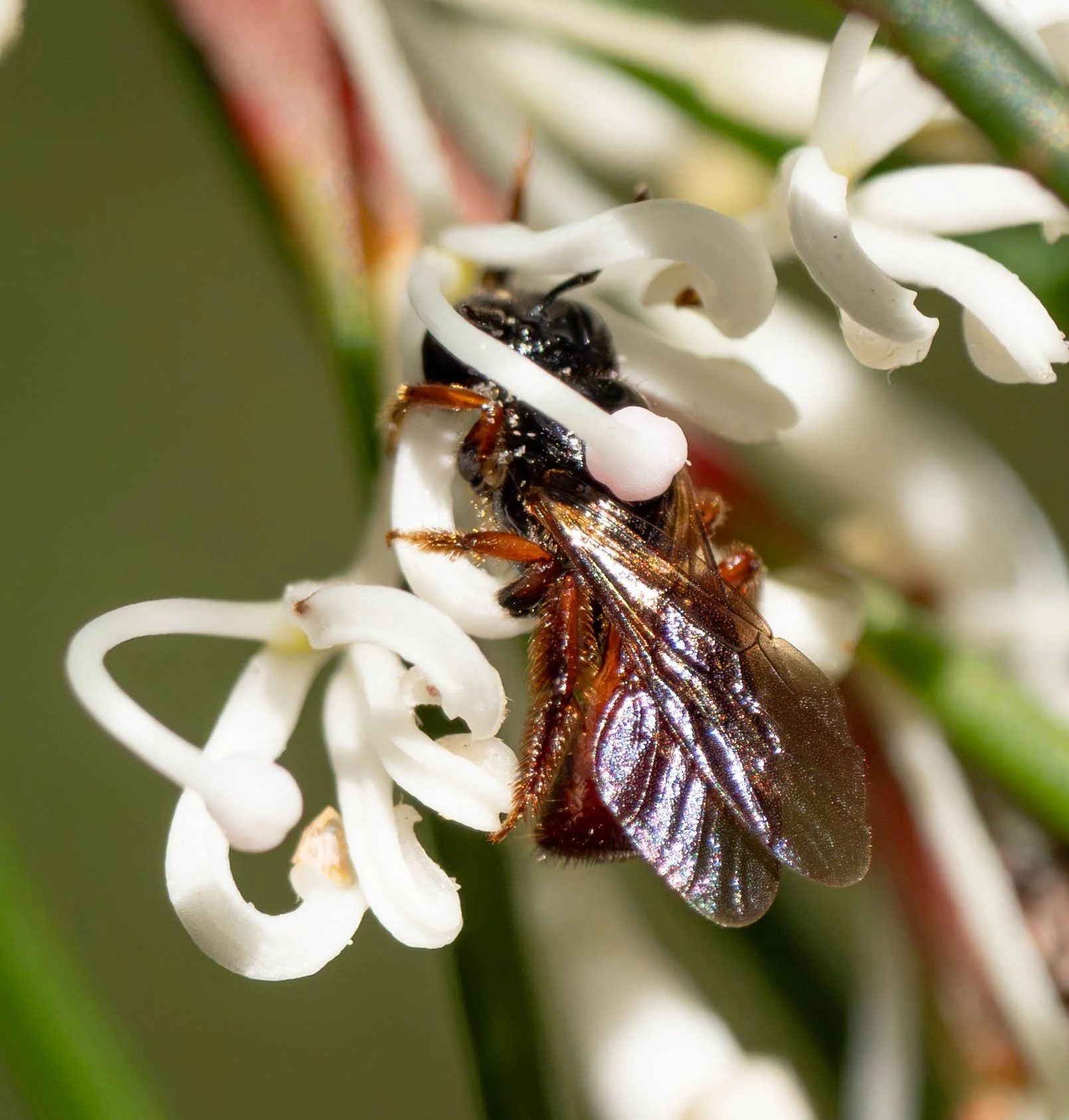
Like most Proteaceae, Hakea flowers have a specialised method of pollen dispersal. The anthers burst before the flower actually opens for insect visitors. The pollen grains are picked up by the end of the stylus (stigma), and only then does the flower open. The stigma is positioned such that insects visiting for a nectar drink receive a dab of sticky pollen on the back.
Exoneura [1st Sept]
Pink pollen!!
This female will groom the grains from her back, moving it to the hairs of her hind legs for transport.
Exoneura [29th Aug]
The flowering of Hakea macraeana has long puzzled me. The drooping branches are certainly eye-catching when festooned with delicate white flowers, as they are now. Yet insect visitors are relatively few – to the point where I’ve sometimes wondered about the identity of the plant’s pollinators. I wonder no more!
Exoneura [29th Aug]
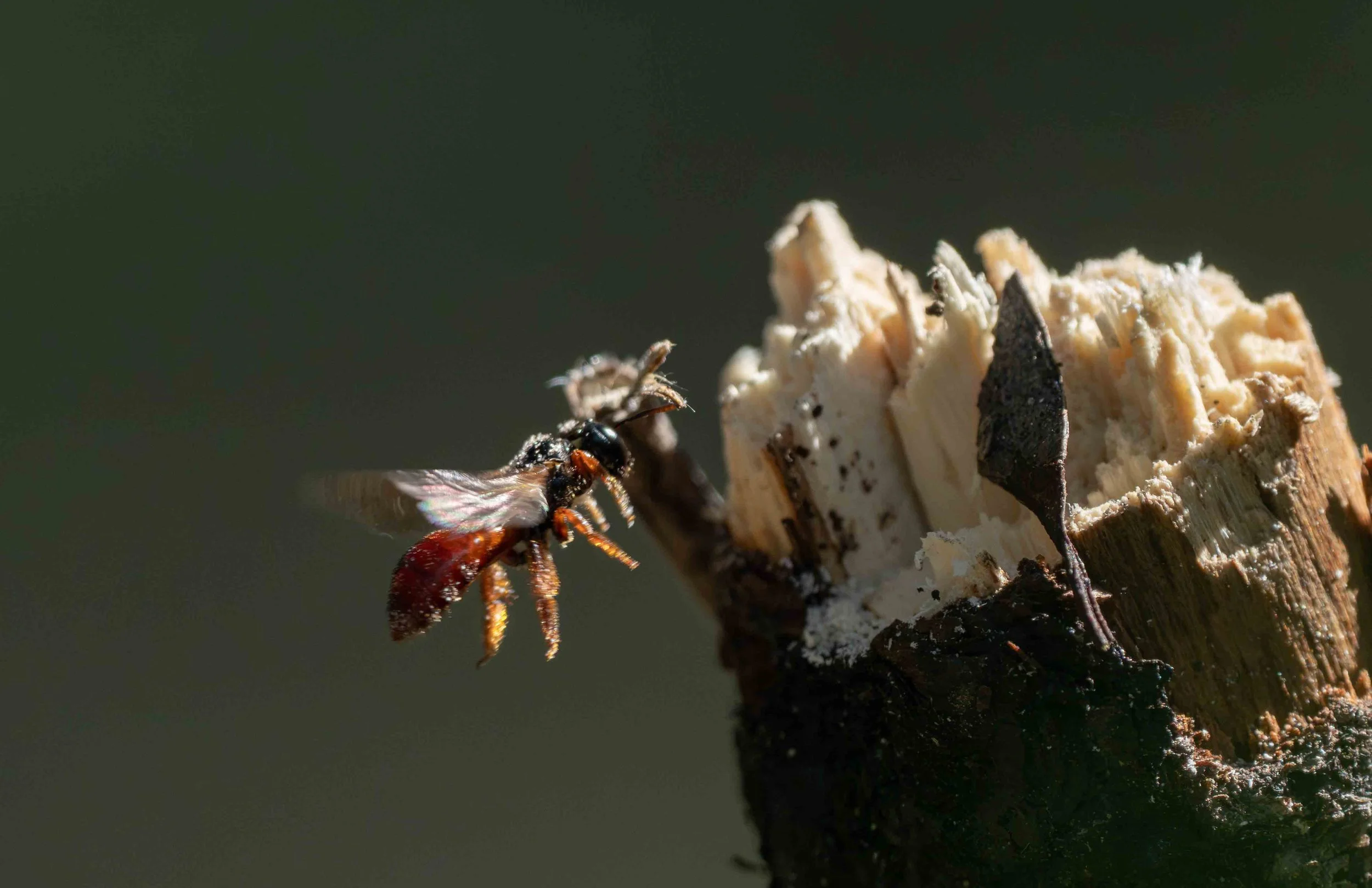
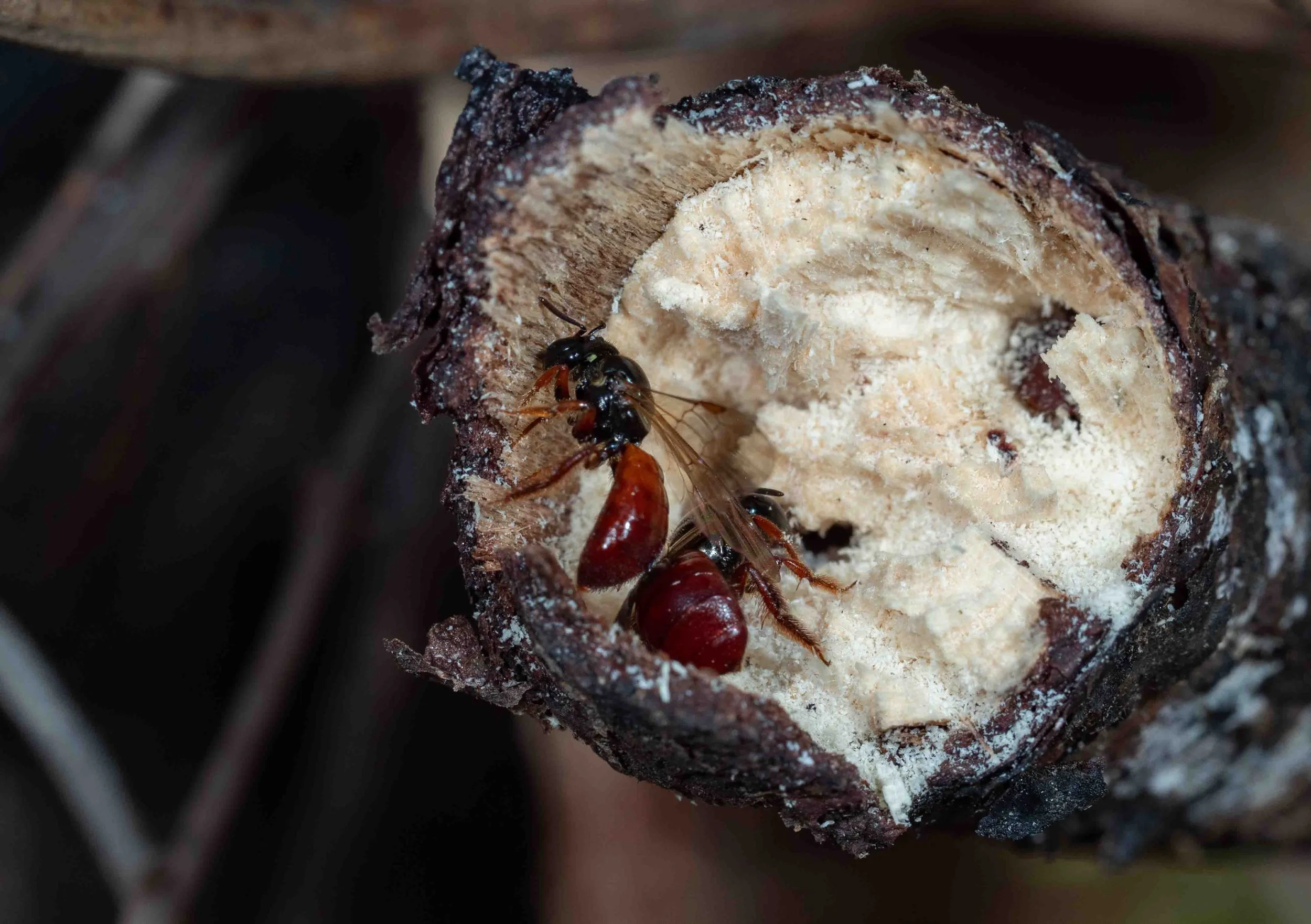
Several Exoneura flying about the broken ends of a dead Persoonia stem caught my attention. The plant was killed by the fire 6 years ago. Although still standing, it snapped in half some months back, exposing the relatively soft inner wood.
Exoneura (robusta?) [3rd Sept]
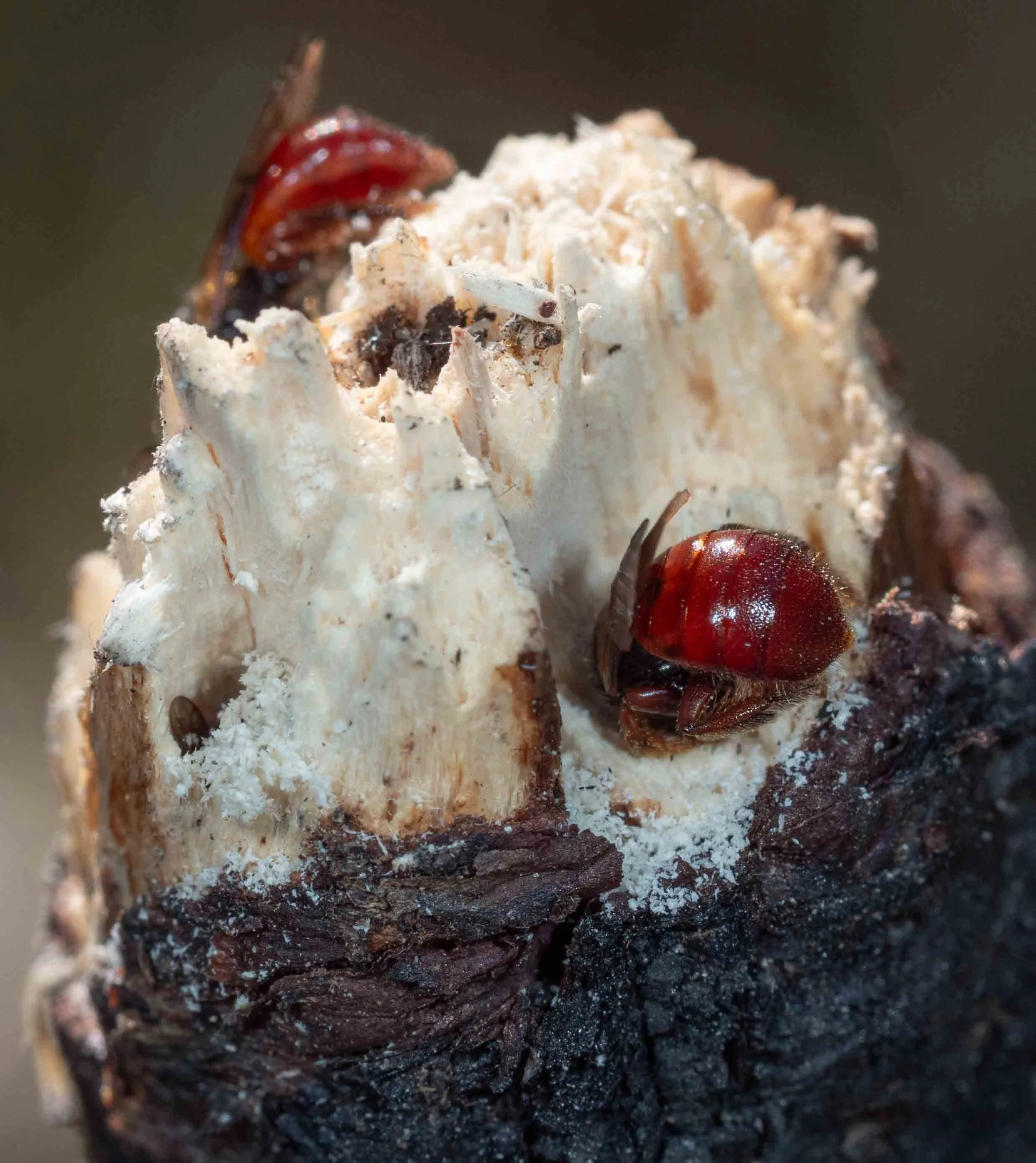
The bees were clearly digging into the wood, the discarded frass collecting on the surface. This high level of surface activity suggests that nesting is in its early stages. Established nests consist of a burrow many centimetres long, with a small diameter opening guarded – indeed, blocked – by a single bee.
Exoneura (robusta?) [3rd Sept]
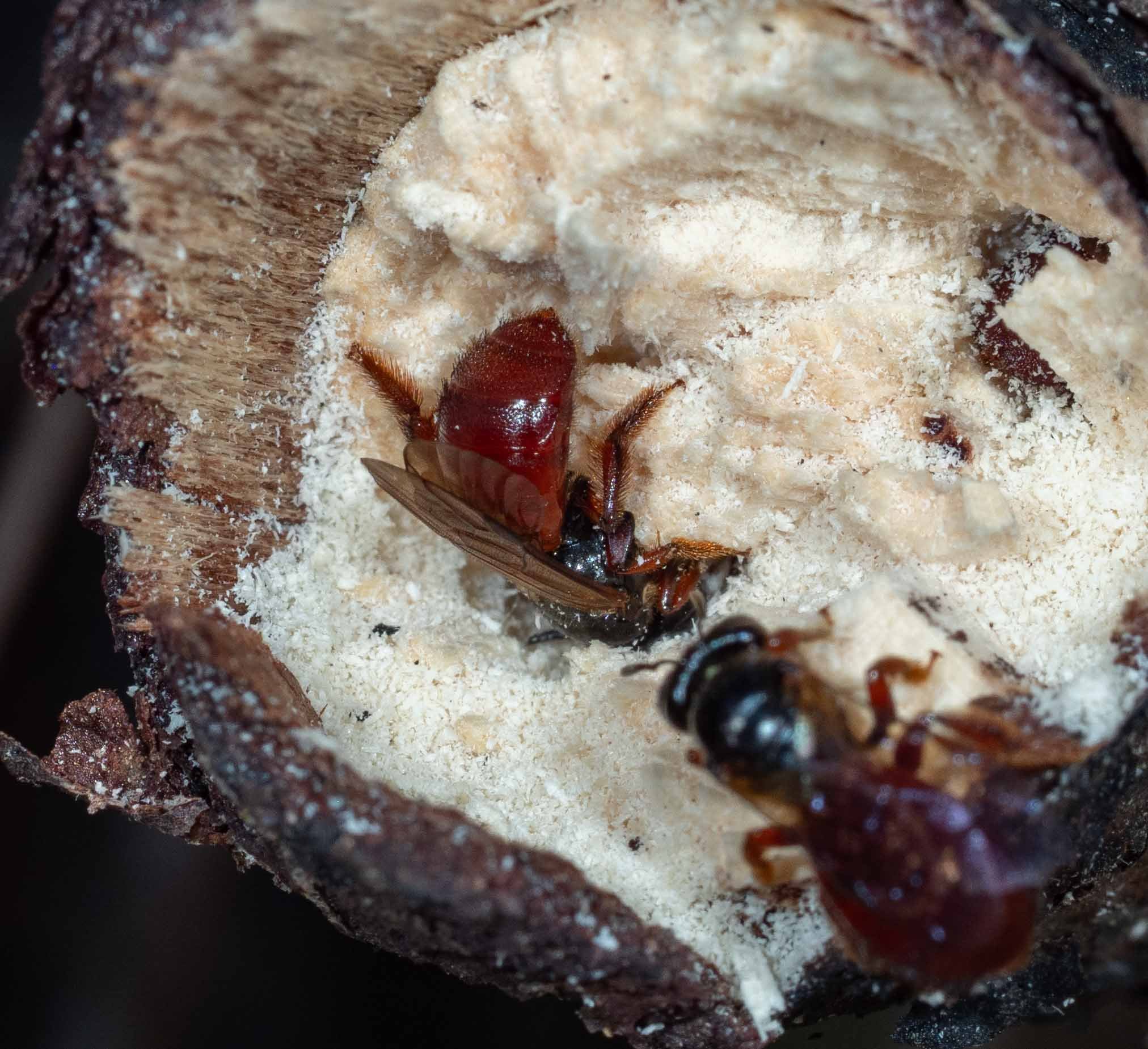
Each of the two broken stem ends had two burrows. And at times there was more than one bee per burrow!
Exoneura are among the most extensively studied of Australian bees due to the diversity of social behaviours they exhibit. So it comes as no great surprise to find multiple females involved at this single nesting site. What is less clear, however, is exactly what is happening in this case.
Exoneura (robusta?) [3rd Sept]
There was no sign of provisioning – further support for my theory that I caught the nesting action at the very beginning.
Unlike many native bees, Exoneura actively feed their larvae throughout development. If this was an established nest containing developing young, I would expect to see these females returning with pollen loads. Their legs are pollen-free.
Exoneura (robusta?) [3rd Sept]
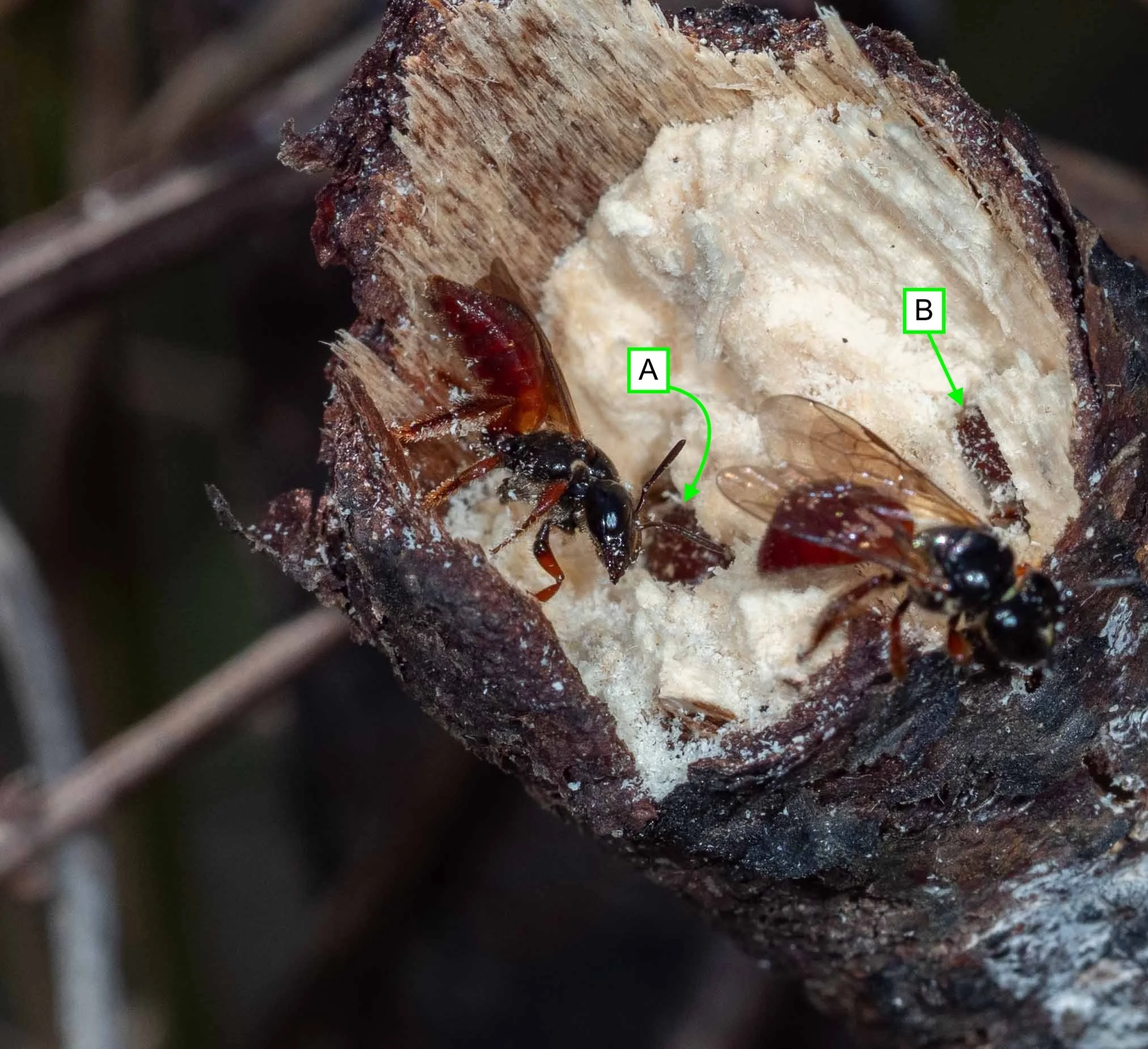
A third bee arrives and shows a lot of interest in burrow A.
Exoneura (robusta?) [3rd Sept]
A fourth bee lands … and ‘Bee #3’ appears to challenge her. Note the open mandibles and raised abdomen.
Exoneura (robusta?) [3rd Sept]
Bee #4 departs.
So … there is some level of contest here. But what is less clear is the relationship between Bee #3 and the bee already resident in burrow A. Are they competing for the site, or are they collaborating?
While some Exoneura females will go it alone when founding a nest, others will work together with their sisters or even invite unrelated females to join. And it has been shown that nests housing multiple females are more successful in the long run (Zammit et al. 2008).
Exoneura (robusta?) [3rd Sept]