
Week in pictures

19th to 25th January, 2018
Click to enlarge, and then 'hover' to read more about each image

This Garden Wolf Spider has made her burrow in a clear area close to the house, giving her a good view of passing prey. Here she is munching on a moth while warming up her egg sac in the morning sun.
Tasmanicosa godeffroyi (Order: Aranea; Family: Lycosidae)

Several of our Angophora floribunda trees have come into full bloom in the last week. Angophora flowers differ from those of the other eucalypt genera - Eucalyptus and Corymbia - in possessing petals and sepals. The pink-edged, white petals can be seen in this image.
Angophora floribunda (Family: Myrtaceae)

A rear view of Angophora floribunda flowers, showing the triangular, brown sepals alternating with the white, pink-edged petals. The prominent ridges on the cup-like hypanthium at the base of the flower is another distinctive Angophora feature.
Angophora floribunda (Family: Myrtaceae)

Several species of lacewings lay their eggs on long silken stalks in a tight alignment. This may prevent the voracious larvae from eating their neighbours straight after they hatch.
Order: Neuroptera
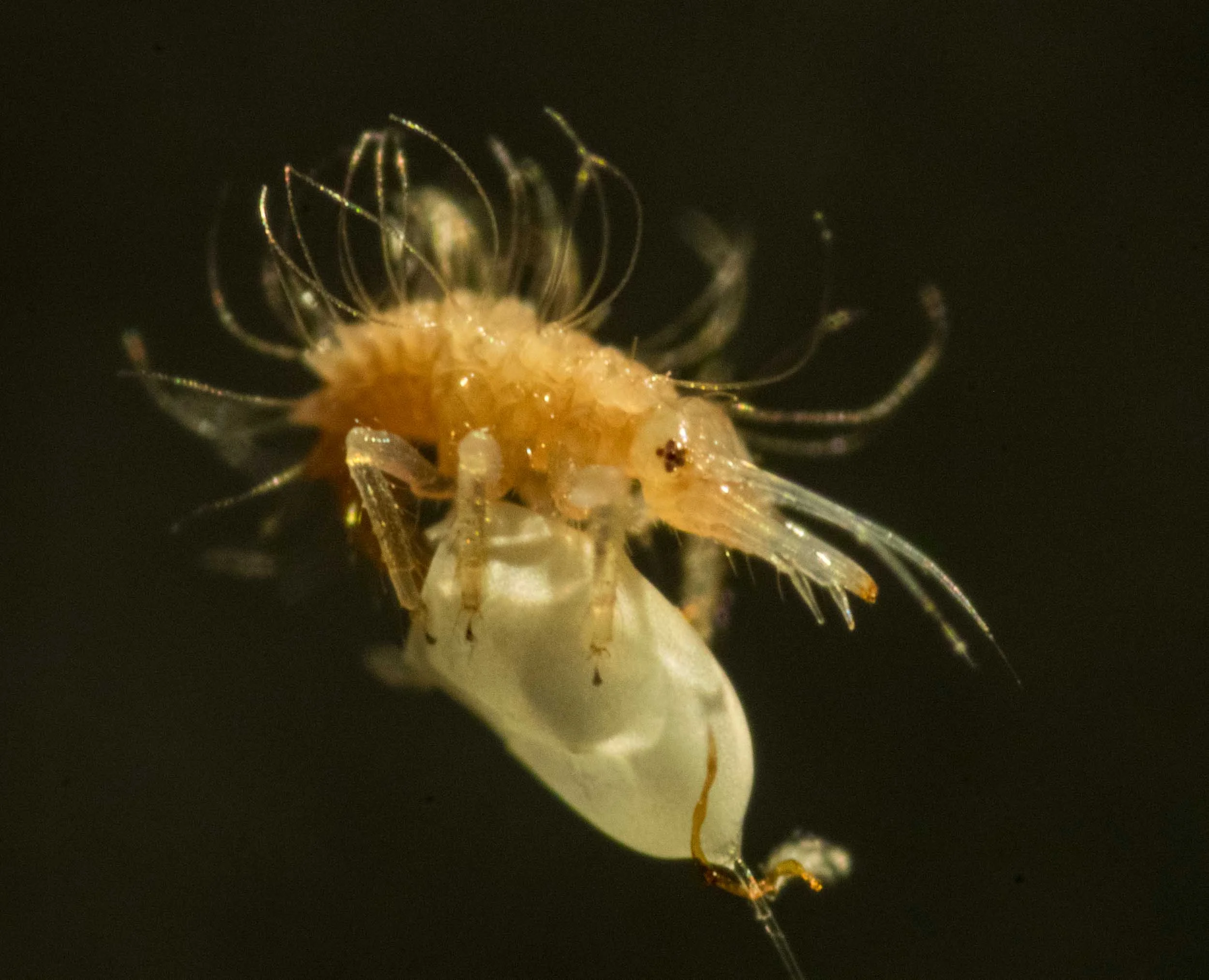
This green lacewing larva has just hatched from the egg on which it is standing. The long hairs on the back trap debris as the larva moves around, providing effective camouflage.
Order: Neuroptera; Family: Chrysopidae

This particular species of largish robber fly has been a common sight all week. They are such obliging subjects for photography ... they perch prominently and are completely motionless.
Ommatius sp. (Order: Diptera; Family: Asilidae)


Females are flightless. They climb up a stem when they emerge from pupation underground, releasing pheromones to attract a mate.
Epactiothynnus sp. ? (Order: Hymenoptera; Family: Tiphiidae)

The male brings gifts in the form of liquid food. He feeds her during their extended mating, and may even carry her to nearby flowers to feed.
Epactiothynnus sp. ? (Order: Hymenoptera; Family: Tiphiidae)

A newly-minted butterfly warming its wings in the early morning sun.
Hypocysta metirius (Order: Lepidoptera; Family: Nyphalidae)

Another newly-emerged Nymphalidae butterfly, but this one much larger and showier. This species flutters slowly but lands only occasionally. This one rested briefly on seed stems of Gahnia, the host plant for its larvae.
Tisiphone aboena (Order: Lepidoptera; Family: Nymphalidae)

It's amazing how much damage butterfly wings can take, and still the insect is able to fly.
Tisiphone aboena (Order: Lepidoptera; Family: Nymphalidae)

The fat bodies of 'Skipper' butterflies make them look rather like moths.
Trapezites symmomus (Order: Lepidoptera; Family: Hesperidae)

These beautiful white flowers are proving to be quite a bee magnet. In addition to a number of small species, I've seen Blue-banded Bees buzzing about this plant.

Bees like this one collect pollen with their front legs and then pass it back to the middle legs ... which in turn pack it into the specialised carrying hairs on the hind legs. Quite a feat, really.

This Oncopeltus bug had no sooner become trapped in the web than the spider came to investigate. After a couple of leg taps, however, the spider retreated. Apparently the bug was either too large or too toxic. Moments later it broke free.