Week in pictures

23rd October to 5th November, 2017
Click to enlarge, and then 'hover' to read more about each image

Most of the photos this week were taken during a quick trip to southern Victoria and the Australian Alps. This as-yet unidentified fly was displaying on a fallen leaf in the Gurdies Conservation Area, Victoria

This is probably Eriophora pustulosa, although it's difficult to be sure - the genus is widespread, highly variable, and under revision.
The Gurdies Nature Conservation Reserve, Victoria

These vocal birds are regular visitors to the southern forests, including throughout south-eastern Victoria.
The Gurdies Nature Conservation Reserve, Victoria

A bossy little species, commonly seen flying and feeding alongside Yellow-faced Honeyeaters.
The Gurdies Nature Conservation Reserve, Victoria

I initially thought this was a wasp, but I'm now convinced it's a bee. Species? I'm working on it.
The Gurdies Nature Conservation Reserve, Victoria

Many native bee species have been reported, and photographed, 'bubbling'. They regurgitate a bead of nectar, presumably as a way of making it more concentrated by evaporation.
The Gurdies Nature Conservation Reserve, Victoria

The high country is the best place to see Flame Robins. The extraordinary colour of the male makes them difficult to overlook, even in an Alpine forest.
Kosciuszko National Park


This male Flame Robin spent some time beating a caterpillar against a branch, before swallowing it. Guess he doesn't like his meals to wriggle on the way down.
Kosciuszko National Park

The calls of breeding pardalotes rung out in the forest lining the banks of Thredbo River.
Kosciuszko National Park


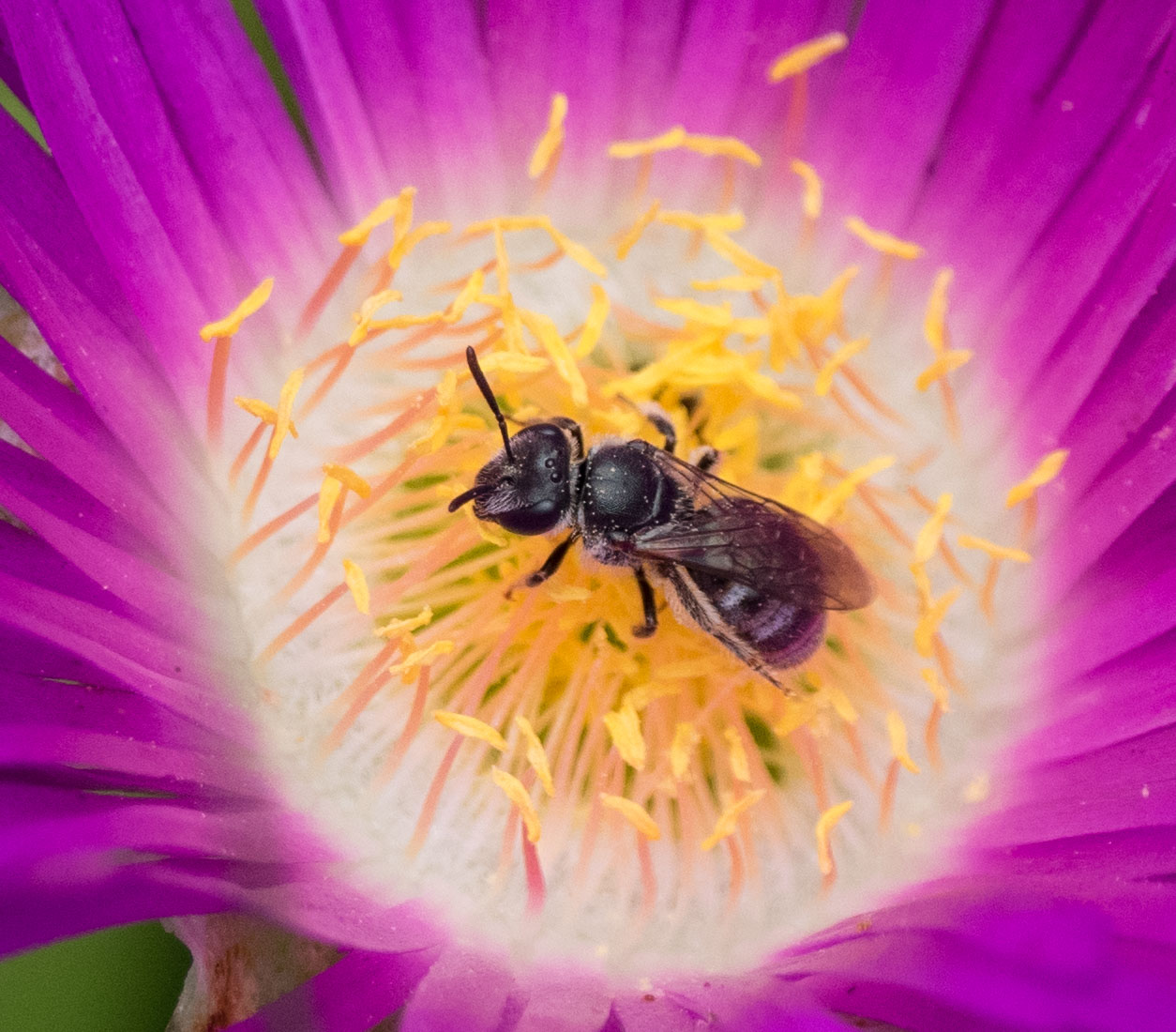
Yesterday I discovered that the Carpobrotus ('Pigface') flowers at the beach are full of tiny native bees.
Wonboyn Lake, NSW

These tiny bees completely disappear among the stamens, no doubt diving down to the where the nectar is pooling.
Wonboyn Lake, NSW

Most of the photos this week were taken on our travels in Victoria and the Australian Alps. This one, however, is one of our home birds. The pair is now well-settled and they almost certainly have eggs.